
Sleep and sport: the recovery dial every coach has
Your training schedule hasn't changed since September, and yet by mid-November three players are sitting out. The reflex is to look at the load. But something outside the hall has changed: the exam period has started and your team is sleeping less. Sleep is the recovery factor you can influence without a single extra minute of court time, and at the same time the one that is rarely asked about in the hall.
What sleep loss does to a sporting body
The best-known figure in this field comes from a study by Milewski and colleagues, published in 2014 in the Journal of Pediatric Orthopaedics. They looked at the relationship between sleep duration and injuries in adolescent athletes, and found that those who slept less than eight hours a night on average had had roughly 1.7 times as many injuries as those who reached eight or more.
Be honest about what that means: this is an association, not proof that short nights cause injuries. People who sleep little often also have busier lives and more sporting commitments. But it doesn't stand alone. Watson summarised the literature in 2017 in Current Sports Medicine Reports and arrives at the same picture: too little sleep is associated with worse performance, a higher injury risk and more illness. For a coach that is enough to act on, even without conclusive proof.
In the hall you don't see it as tiredness. You see it as reaction time and decisions. The player is half a beat late under the ball, chooses the safe tip instead of going through with it, and makes errors in the fourth set that he didn't make in the first. That exact pattern looks from the outside like something else — how to tell whether it is the training load is in recognising overtraining. The general recovery basics, including the hour guidelines and what to eat and drink after exertion, belong in cool-down and recovery. This article is about the part that doesn't fit there: a teenager's body clock, and what late start times and your own session layout do to it.
Why a teenager biologically falls asleep later
"Just go to bed earlier" is well meant and doesn't work, and that isn't down to character. In puberty the biological clock shifts backwards: the body gets ready to sleep later in the evening than it does in a younger child or an adult. A teenager who is in bed at half past ten is often simply lying there awake. That shift pulls back again over the course of young adulthood.
Work the consequences through and you have the problem. A youth player who doesn't fall asleep before eleven and has to be up at seven for school gets a maximum of eight hours — exactly at the lower limit from the Milewski study, and that on an ordinary night without a match. Anything you stack on top of that comes straight off. That is the core of this subject: with a teenager you have no margin. With an adult recreational player you do.
With growing players something else is added: a child who grows eight to ten centimetres in a year needs more recovery than the year before, while the diary is getting fuller. What a growth spurt does to technique is in what a growth spurt does to a youth player.
The 9.15pm match, worked out
It is easy to underestimate what a late start time costs, because you count up to the last point. Work it right through once for a fifteen-year-old:
- 9.15pm: first serve. Three sets take around 75 minutes.
- 10.30pm: last point. Cool-down, changing, waiting until everybody is ready: out of the door at 10.50pm.
- 11.20pm: home, after half an hour's drive from an away match.
- midnight: lights out. There has been a shower and something to eat, because the last proper meal was around six.
- 12.45am: actually asleep. A body that has been playing flat out for over an hour doesn't settle in ten minutes: heart rate, body temperature and a head still replaying the fifth set need time to come down.
- 7.00am: alarm. Net: six hours and a quarter.
Set that against the eight to ten hours that is the guideline for a growing athlete and that night is a good hour and a half to almost four hours short. One such evening a month is nothing — a body is built for that. Two a month plus a tournament day is no longer an incident but a pattern, and that is the level at which you have to think about it. Whether your league plays on Friday or Saturday evenings and how late the last matches start differs by federation and by division; check it in your own fixture list and simply count how many evenings finish after ten.
The session that runs to 10.30pm, and the first session after
With sessions you have something you don't have with matches: the last half hour is yours. The court booking from 9.00pm to 10.30pm is fixed, but what you do in that last block decides whether a player gets home with a body still running at pace or one that is already coming down.
In practice: put the jump-intensive and competitive work before 10pm, and use the last thirty minutes for something that already brings the body down. Serving for accuracy, technique at low tempo, a calm game format with no scoreboard, walking cool-down and a two-minute finish. Then the cooling down has already started in the hall instead of at home on the sofa. Finish your session with the match play everybody is shouting for and you buy fifteen good minutes at the price of a harder night.
You set up the session after a late weekend differently. Tuesday evening after a match that finished at one in the morning on Sunday night is not the moment for your heaviest jumping block — the player has had one full night to make up for that short Sunday night, and one night is rarely enough for that. A workable layout for 90 minutes: 15 minutes warm-up, 30 minutes technique with lots of repetitions and few maximal jumps, 25 minutes game play at three-quarter pace, 10 minutes tactics or video standing up, 10 minutes cool-down and finish. The heavy jump work moves to Thursday. You lose nothing: you are moving it to the day where it pays off rather than causes damage. Why jumps count more heavily than hours is in how often youth volleyball players should train.
Naps, lie-ins and tournament days
A nap isn't a luxury but a tool, provided you get the duration right.
- 20 to 30 minutes is the usable length. You wake up sharp from it and it barely eats into the sleep pressure you need in the evening.
- An hour or longer makes it likely that you wake up groggy and that it doesn't clear straight away. Fine on a free afternoon, fatal in the hour before a match.
- Not after about three in the afternoon for players who already struggle to fall asleep in the evening — then the nap works against the night.
On a tournament day, the gap between the pool phase and the knockout rounds is the moment. If there is nowhere to lie down, twenty minutes with eyes closed against the wall, phone in the bag, still beats twenty minutes in the canteen. Do say that it doesn't have to be sleeping; the instruction "just do nothing" takes the performance pressure off. How to divide such a day into blocks is in planning a volleyball tournament.
On lie-ins: sleeping through until noon on Sunday feels like catching up, but it shifts the body clock further back and makes Sunday evening harder still. Rule of thumb for your players: at the weekend, get up at most an hour later than on a weekday. Half an hour longer in bed on Saturday and Sunday delivers more across a week than one morning until midday.
Screens, the team chat and the hour after the match
The blue light of a phone usually gets all the blame in this story. What certainly wrecks the night after a match isn't the colour temperature of the screen but what is happening on it: the team chat buzzing four more times at 11.40pm, the argument about that one substitution, the clips of the last set watched back three times. That keeps running exactly the system you want to bring down.
This is where you as a coach have a lot of influence, and it is precisely that influence that is rarely used. Three agreements that cost nothing:
- No team messages after 10pm on a match day. Not from you either. Especially not from you, because the coach who still sends a message at 11.15pm gives the whole group permission to do the same.
- The debrief is in the hall and lasts three minutes. Whatever else you want to say, you share the next morning. How to structure that debrief so three minutes is enough is in the match debrief with data.
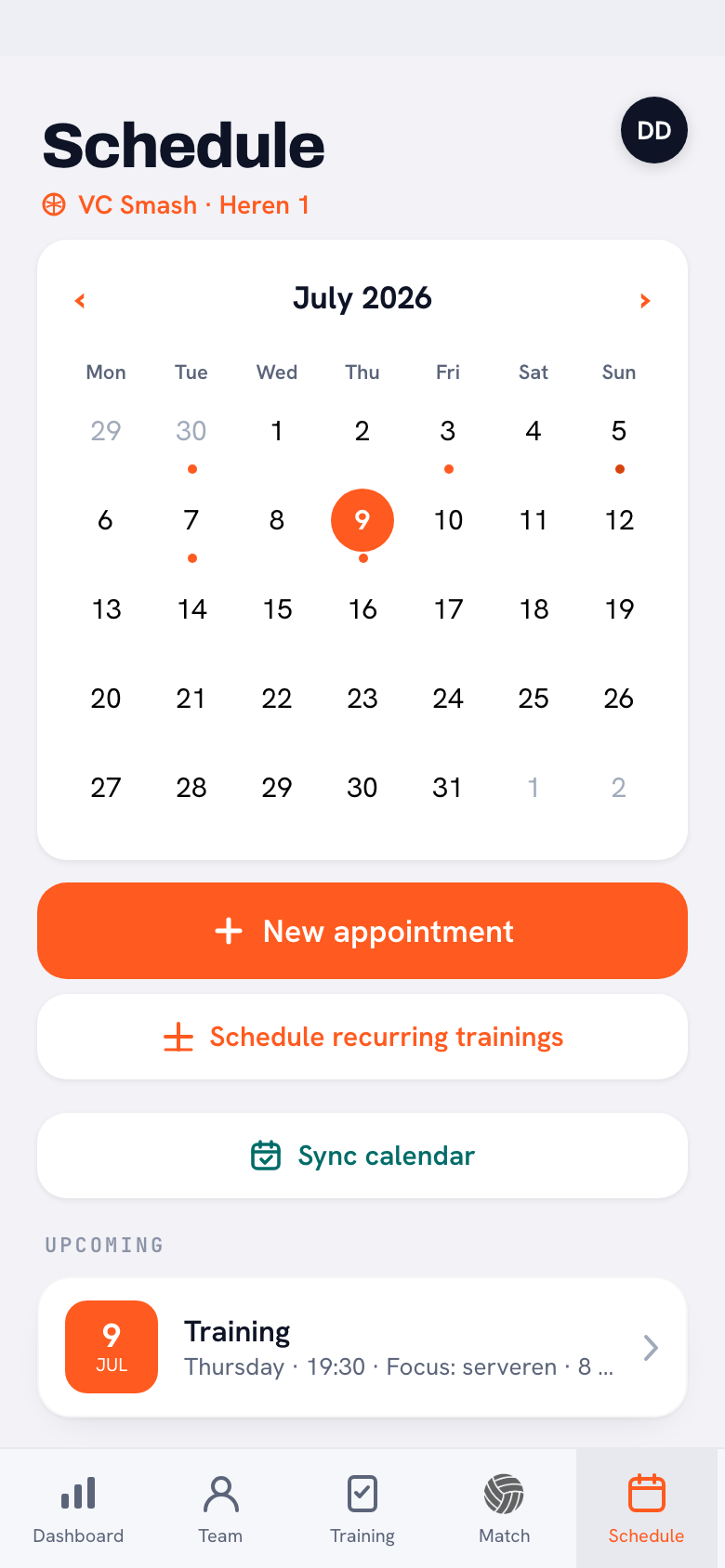
- The match report goes out the next day. In Koach you can finish the report after the match and share it the next morning; the point isn't the app but the timing.
Put those three into your team agreements at the start of the season, alongside the agreements about calling in absent and about conduct. Introduced afterwards it feels like a correction; agreed in advance it is simply how things go at your club.
The question to ask instead of "are you tired?"
"Are you tired?" always produces "no", and with a fifteen-year-old more than ever. Being tired feels like a verdict on yourself, and nobody admits that to the coach who picks the line-up. So don't ask about a feeling but about two numbers:
"What time did you go to bed last night, and what time did your alarm go?" No comment on it, no advice afterwards. Two figures, two seconds, and you know more than from five questions about fatigue.
For the whole group, the show-of-hands version works. At the start of the session: "who slept less than seven hours last night?" Count the hands and note the number against that session. Three out of twelve on a Tuesday is information. Eight out of twelve is a reason to move your jumping block there and then to the technical work you still had to do anyway. Do this for a few weeks and you have something more valuable than a feeling: a series. If the number of hands drops along with attendance and effort, you have a load problem in view before the first player breaks down — the rest of that arithmetic is in injury prevention.
What you don't do is attach a judgement to it. A player who gives an honest answer and is then told he should organise his life better will next time answer whatever you want to hear. You then have no information at all, only a tidy story.
November: the exam period isn't in your training schedule
The load in November usually isn't higher than in October. The number of sessions is the same, the matches aren't harder. What has changed sits outside the hall: for many youth players an exam or assessment period falls in the autumn term, and then they work later and sleep less as a matter of routine. Exactly when those periods fall differs by country and even by school, so this isn't a date you can look up — it is a question you ask in September.
Do it concretely: at the start of the season, ask players or parents when the exam and assessment weeks fall, and put them in the team calendar alongside the matches. Plan deliberately lighter in those weeks — fewer maximal jumps, more technique and tactics — and expect more absences without saying anything about it. And do the sums once in your own records: put last season's injuries and drop-outs next to the weeks in which your team had exams. If the pattern holds, you have a planning argument for next year instead of a gut feeling.
What to say to parents (and what not to)
This is where it goes wrong most often. "Your daughter needs to go to bed earlier" is parenting advice from a volleyball coach, and that is precisely the sentence after which parents tell you nothing any more. The way out is simple: talk about your planning, not about their house rules, and ask for information instead of for behaviour.
Three sentences for the parents' evening at the start of the season:
- "This season we play five times on an evening that finishes after half past ten. That costs your child around two hours of sleep that night, and that is simply how it is — I don't set the court times."
- "What I do about it: the session on the Tuesday after is lighter, with fewer jumps. That is my part."
- "All I ask from you is this: if your child is in an exam period or is routinely in bed after midnight, send me a message. Then I take them out of the heavy work that week. I won't have an opinion about it beyond that."
Three things make that text workable. You start with what you are doing, so it isn't a list of demands. You give no bedtime advice, so there is nothing to reject. And you ask for a fact with a clear consequence, which means reporting it delivers something instead of costing something. With older youth players you have exactly the same conversation directly with the player.
One more thing to leave out: the word discipline. A teenager lying awake at eleven isn't undisciplined but biologically on time. A coach who explains that difference to a parent in one sentence has a much easier time talking about it for the rest of the season.
Key point: you don't change your players' sleep by preaching about it, but through three things that are entirely yours: the last half hour of your session, the weight of the session after a late weekend, and the time at which you send your messages. Start there — the rest follows, or it doesn't, but these three cost you no court time and no goodwill.
Frequently asked questions
How much sleep does a youth volleyball player need?
Eight to ten hours a night is the guideline for athletes who are still growing, and seven to nine for adults; those guidelines and the rest of the recovery basics are in the article on cool-down and recovery. For you as a coach, regularity is more usable than the exact figure: the same wake-up time, weekends included.
Is it true that too little sleep leads to more injuries?
A clear association has been found: in 2014, Milewski and colleagues saw roughly 1.7 times as many injuries in adolescent athletes who slept less than eight hours a night. That is an association and not a proven cause, but the picture comes back in later review articles. Reason enough for a coach to take it into account.
My players say they can't get to sleep after an evening match. What helps?
After an evening match it takes a while before heart rate and body temperature come down; you can't force that, but you can bring it forward. Let the cooling down start in the hall with a calm cool-down, keep the debrief short, and agree that the team chat stays quiet after the match. It won't make the night long, but it will make it a little longer.
Is a nap before a match a good idea?
Twenty to thirty minutes yes, longer no. After a nap of an hour or an hour and a half you often wake up groggy, and that is exactly the hour in which you have to be sharp. On a tournament day the gap between the pool phase and the knockout rounds is the logical moment.
How do I raise sleep with parents without sounding preachy?
Talk about your own planning and ask for information, not for behaviour. Tell them how many late evenings there are this season, what you adjust in training afterwards, and only ask them to let you know if their child is in an exam period. Don't give bedtime advice; that is the moment the conversation stops.
Why does my team break down every November?
Look outside the hall first. In many countries an exam or assessment period falls in the autumn term, and then players sleep less while the training schedule stays the same. When those weeks fall differs by country and by school, so ask in September and put them in the team calendar alongside the matches.