What information should a coach collect from players?
Most coaches only discover they are missing an emergency number at the moment they need it. Half an hour at the start of the season prevents that. This is the list of details you really use as a coach, plus the things you deliberately do not record.
The basic list: what you know about every player
Start small and functional. Per player you need: name and date of birth (for eligibility and age category), phone number and email address, for youth players those of at least one parent or guardian, and at least one emergency number that isn't the player's own. Add to that: jersey number, position and any second position, and shirt size. That is the complete administrative base, and it takes ten minutes per team to fill in.
Practically just as valuable is a second layer nobody asks about: who can and can't drive, who can never make Wednesdays, who has a job with irregular shifts, and whether anyone plays a second sport. That last one isn't nosiness but load information: a player who also trains three times a week has a different recovery story from the rest.
The health side: short and functional
You are not a doctor and you don't need to keep medical files. What you do want to know is what you must be able to do in the hall. Four questions are enough: does the player have a condition you need to account for during exertion (asthma, epilepsy or diabetes, for example)? Is there medication that has to be within reach during sport, such as an inhaler, and where is it? Are there allergies that matter around food or first aid? And: which previous injuries still need attention?
That last question is the most useful one for your practices. A previous ankle sprain or knee complaint means extra attention in the build-up, not less training. What you do with that knowledge is in injury prevention. What you don't do with it: give advice. With complaints, doubt about load tolerance or a return from injury, the physiotherapist or the doctor is in charge, not the coach.
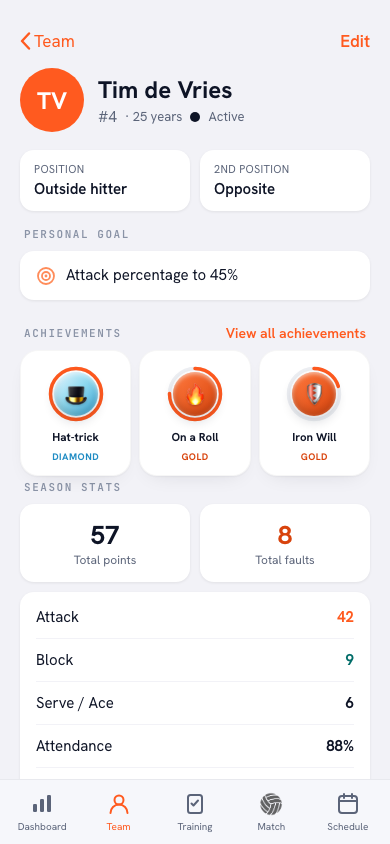
Collect it in one place as well, instead of on a folded sheet of A4 in your bag. Player profiles and coach-only notes in Koach keep this in one place, so when there is an injury or an absence you don't have to scroll back through three chat threads. How to set such a profile up is in creating a player profile.
With youth players: consent and agreements
With players under eighteen three things are added, and you preferably arrange them in writing at the start of the season. One: who may take the child home after a match? On an away trip with a driving rota it isn't obvious that every parent knows who their child is riding with — record who may and who may not. Two: images. Ask permission for photos and video, and respect a no without discussion; team photos on social media are one of the most common sources of trouble. Three: circumstances at home that are relevant to how you support the child, for example a separated situation where communication has to reach both parents. Don't probe, but give parents room to mention it — and then make sure announcements demonstrably reach both parents.
What you had better not record
- Detailed medical information. Diagnoses, treatment reports and medication schedules don't belong in a team administration. Note only what you need to know in the hall and where the medication is.
- Judgements about character. Write down behaviour ("was late three times"), not labels ("unmotivated"). The first is something you can discuss, the second is a verdict that sticks to a player for a season.
- Private information about families that you happen to hear and that has no bearing on how you coach.
- Anything you wouldn't want to read out to the player. That is the best test for every note you make — see also keeping player notes.
Storing, sharing and clearing out
Three simple rules keep it tidy. Limit access: contact details can sit with the team manager, coach notes belong to the coach. Share nothing outside the team without the player or parent knowing — not even a phone list to another club. Clear out: at the end of the season, delete the details of players who are leaving and hand over only what the next coach needs. How a club handles this more broadly is in privacy and data. For most teams this is enough: collect little, keep it in one place, and throw it away when it is no longer needed.
Do it in one go: have players and parents complete the form in the first week, not in dribs and drabs. A list that is 80 percent complete is precisely the list where the missing emergency number turns out to belong to the player you need in November.
Frequently asked questions
May I keep medical information about my players as a coach?
Only what is functionally needed to train responsibly and to act in an incident, for example asthma or an allergy. Detailed medical files don't belong with the coach and you deliberately keep them out of the team administration.
What do I do if a parent doesn't give permission for photos?
Respect it without discussion and make sure your team knows, so no group photos with that child get shared either. Make it one agreement at the start of the season and you don't have to think about it every match.
How long do I keep player details after the season?
As briefly as is practically possible: delete the details of departing players at the end of the season and hand over only what the next coach needs. The club's own administration has its own rules; check those with the board.