Does a Block Count as a Hit in Volleyball?
Block, dig, set, attack: that is four touches and still no fault. The block exception is one of the most practical rules in volleyball, but it only works if the touch actually qualified as a block under the rules. And that is where it regularly goes wrong.
The rule: a block touch does not count
Rule 14.4.1 is short and unambiguous: a contact by the block does not count as a team touch. The consequence follows immediately: after a block touch, the team has three touches to bring the ball back over the net. Block, dig, set, attack is therefore entirely legal — four contacts, three touches.
Rule 14.4.2 adds to it: the first contact after the block may be made by any player, including the one who touched the ball on the block. A blocker who catches their own blocked ball and plays it on is not making a double contact. That is exactly why the exception exists: on a block you cannot choose whether the ball hits you.
But when is it a block?
Here is the trap. The definition (14.1.1) sets three conditions: it is the action of players close to the net, aimed at intercepting the ball coming from the opponent, in which they reach higher than the top of the net. That last condition is about the hands, not the ball — the ball itself may be contacted lower.
The consequence: a player at the net who stops an attack with their hands below the tape is not blocking. That is an ordinary first team touch. Your team then has two touches left instead of three, and that player may not play the ball again straight away. Precisely that difference costs teams points: the blocker ducks away from a hard ball, gets a low hand on it, and the rally is then finished one contact too late.
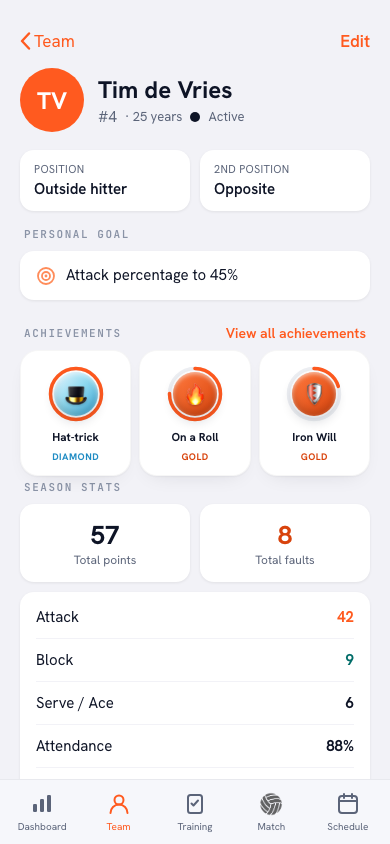
A block touch is not a team hit, but it is a statistic: Koach counts block touches and block points per player.
Two more conditions people forget
- Front-row players only. A back-row player or libero may not complete a block. If they touch the ball in such an action, it is not a block touch but a fault — see can a back-row player block.
- The ball has to come from the opponent. You cannot block your own ball. A player who swats a team-mate's ball away above the net at the net is simply making a team touch.
Simultaneous contact between two or three blockers from the same team also counts as one touch — and therefore still as zero team touches. A collective block where the ball grazes two sets of hands costs you nothing.
Another consequence that surprises teams: a blocked ball that drops straight onto the opponent's floor is a point for you, even if you got only a fingertip on it. And a blocked ball that goes out of the court off your own block is a point for the opponent — the block may not count as a touch, but it is still your contact that sent the ball out.
What this gives you tactically
The block exception is more than a technical detail: it is the reason a soft block pays off. If your block slows the ball down instead of hammering it back, your defence gets an easy ball and your team still has three full contacts to build a real attack. Blockers who desperately try to kill everything give away more than they win. How to teach that is in blocking technique.
For the attacker on the other side the mirror image applies: tooling the block — deliberately hitting off the hands so the ball goes out — works precisely because the block is not a touch of theirs while still sending the ball out of the court.
Beach: there the block does count
On the sand the rule is reversed: a block touch there does count as a team touch, leaving a beach team only two contacts after the block. With two players per side, a block that did not count would make defending too easy. All the other differences are in indoor volleyball vs beach volleyball.
What it means for your statistics
Because the block touch is not a team touch, in most statistical models it is not a 'contact' either but a separate category. Distinguish two things there: a block point (the ball drops straight onto the opponent's floor) and a block touch (the ball is slowed and your own defence plays it on). Teams that count only block points systematically undervalue their middle blockers — most of the value of blocking sits in the touches. How to measure it is in measuring block points, and the rest of the ball-handling rules in double contact and technical faults.
Frequently asked questions
Does a block count as one of the three hits?
No. A block touch does not count as a team touch, so after a block your team still has three full contacts to bring the ball back. Block, dig, set and attack is therefore completely legal.
May the blocker play the ball again afterwards?
Yes. The first contact after the block may be made by any player, including the one who touched the ball on the block. That is not a double contact.
When is a touch at the net not a block?
When the player does not reach higher than the top of the net, when they are a back-row player or the libero, or when the ball does not come from the opponent. In all those cases it is simply a team touch.
Does the block also not count on the beach?
In beach volleyball the block touch does count as a team touch: after it the team has only two contacts left. That is one of the biggest differences between the indoor and beach games.