
Measuring block points: the undervalued statistic
Ask who played well yesterday and you'll hear hitters. The middle blocker who stuffed three balls — worth three direct points plus ten cautious attacks afterwards — gets forgotten. The block column is their redemption.
Why block points count double
A kill block is a direct point (recorded as point type block) — but the real return sits in the effect afterwards. A hitter who has been blocked twice swings more carefully at the third ball, tips more often and watches the block longer than the court. That behavioral change earns your defense points for the rest of the set, without a statistic ever existing for it. The kill block is the visible tip of largely invisible value.
What is a good number?
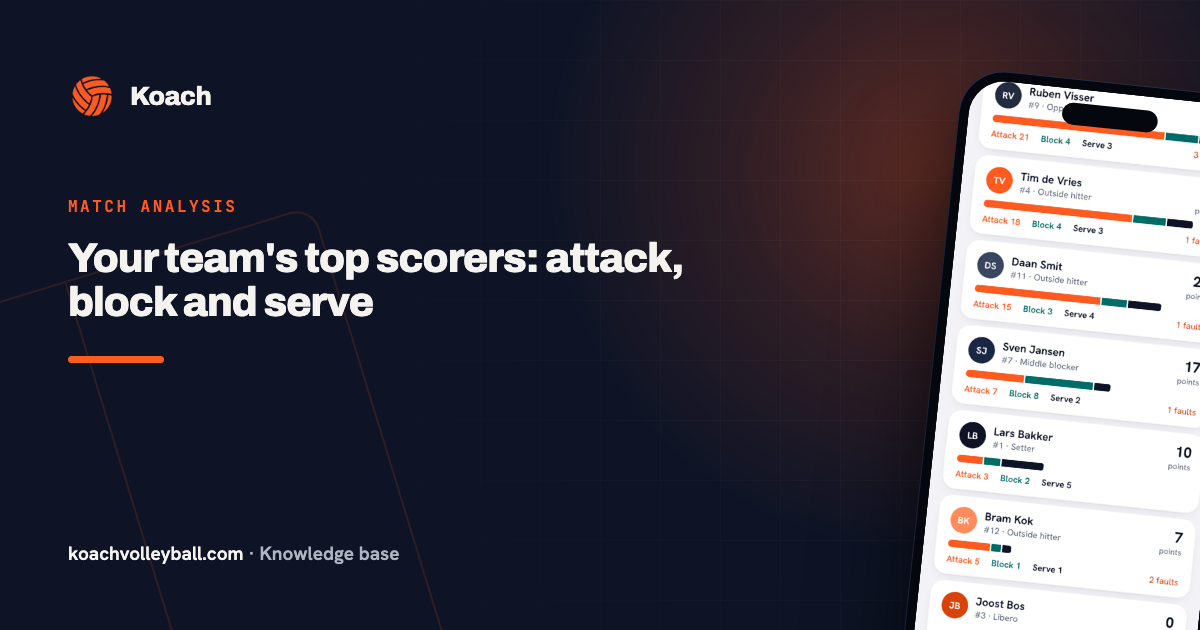
Guideline for amateur volleyball: 6–12% of your team points from blocks is healthy; a middle who produces 3–5 kill blocks per match is having a top night. But as always: the trend beats the benchmark. A middle who grows from an average of 1 to an average of 2.5 block points has measurably improved — most likely in their timing and footwork.
Steering with block numbers
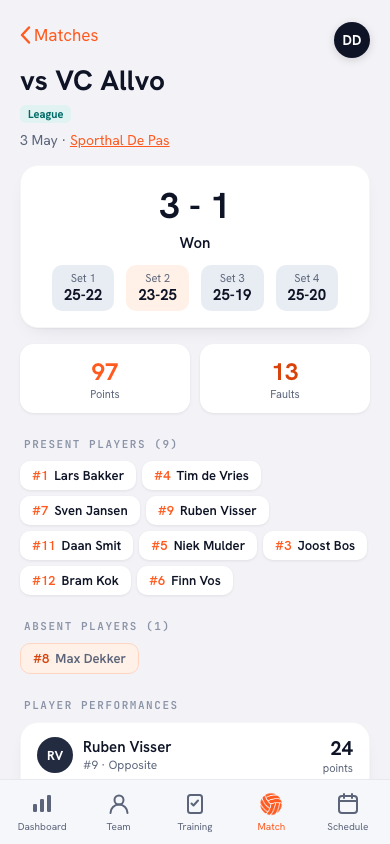
- Match-ups: the block column tells you who belongs opposite their top scorer — the core of organizing your block.
- Recognition: name block points explicitly in the debrief; it's the column that never sells itself.
- Practice: an empty block column across three matches is a practice assignment, not bad luck. Usually it's not the jump that's missing but the footwork.
Count touches in the debrief too. The statistic records kill blocks, but also name the touch that made the ball defendable — that's half a point in disguise. Middles who hear their touches are being seen keep jumping.
Frequently asked questions
Who gets the block point on a double block?
The player who actually touched the ball — when in doubt, the player who organized the block. Pick one rule and stick to it all season; consistency outweighs the perfect attribution.
Why does my tall middle barely score block points?
Height doesn't block — timing and position do. Look at their footwork (do they reach the pin in time?) and their reading (are they watching the hitter or the ball?). Both are trainable.
Is a block point worth as much as an attack point?
On the scoreboard exactly as much; psychologically more — few points break a hitter like a kill block does. All the more reason to take the column seriously.
Try it yourself in Koach
Less admin, more coaching — starting at your next practice.
Get started with KoachOr read first what the volleyball coaching app does.