
How many challenges in volleyball, and when to use one
The ball lands just wide of the line, your player throws a hand up, and there you are on the bench with the one rules question where you press the button yourself. On television the coach draws a rectangle in the air and a moment later a decision rolls out of a computer. In your hall there is no camera. This article is about both: how the challenge system works and when it earns you something, and what you can actually ask for without cameras.
First this: in most halls the challenge does not exist
A video challenge is not a rule of the game but an installation. It needs cameras on the lines, the net and the antennas, an operator, a review monitor beside the court and a clause in the competition regulations. That exists at international tournaments and in the top national leagues, and virtually nowhere else.
So for most readers the answer to the question of how many challenges you get is not two but none. In regional and club competition you cannot have a single decision reviewed, however clearly you saw it. That is not a shortcoming in the referee; the system simply is not there.
Underneath the question sits a second one: what happens when the referee, in your view, gets it wrong? At the top level that is the challenge. At club level it is a smaller toolkit — one that does exist, and that most coaches never use. The second half of this article is about that.
How many challenges do you get per set?
In the common FIVB set-up each team gets a fixed number of unsuccessful challenges per set, usually two. The wording matters more than the number. It works like this:
- If you are proved right, the decision is reversed and you keep your challenge. A coach who is right four times in a row can still request a fifth review in the same set.
- If you are proved wrong, the decision stands and you have used one up.
- Once you have lost two, that is it for the rest of that set.
- Every new set the allowance starts again, the fifth set included.
In that set-up a challenge costs you no time-out and no point: they are two separate allowances running alongside each other, and your two time-outs per set stay untouched. The number of challenges, whether a wrongly filed request costs anything extra, and the list of reviewable cases are not in the general rules of the game but in the regulations of the competition concerned. So they differ by federation and by level: some competitions give one per set, others two, and in others the referee may start a video review himself. If you play at a level where the system is running, look that passage up before your first match — not at the moment you need it.
Which decisions can be reviewed, and which never
A challenge is not a general objection to the previous rally. You ask for a review of one specific case, and that case has to be on the list announced before the match. These are the cases that appear on it most often:
- In or out. The classic. What the camera judges is not where the ball appeared to land but the contact area on the floor — the reason the footage so often works out differently from the naked eye, explained in ball on the line: in or out.
- Touch. Did the ball that landed out come off a blocker's finger or off a defender? This is the category where the footage adds the most, because a block touch at speed is almost invisible to the naked eye.
- Antenna. Did the ball touch the antenna, or did it cross the net outside the crossing space?
- Net touch. Did a player touch the net during his action? What counts and what does not is in the net fault rules.
- Foot fault on the serve, and entering the court too early.
- Floor contact. Did the ball touch the floor before it was played?
Depending on the competition, a back-row attack fault, a centre-line fault or a rotation fault are sometimes on the list too. What is never on it, in any competition: judgement calls about ball handling. A carried ball, a double contact, a ball that in your view sat too long in the hands — that stays the first referee's judgement. Equally unrequestable: something from an earlier rally, and something that was not whistled at all. Ask for one of those anyway and it will be refused and, depending on the regulations, still cost you a challenge.
How the request works in practice
The coach requests the challenge; if the team has no coach, the game captain does it. The window is small: immediately after the rally and before the first referee authorises the next serve. In practice that is a few seconds. Once the whistle has gone for the serve, the chance is gone — even if the whole bench has come round by then.
You give the usual hand signal, a rectangle in the air representing a screen, and you name the case: touch on the block, antenna, net touch. Not "would you have another look at that", because then the operator has no idea what to look for. The first referee interrupts play, the footage is reviewed, he takes the decision over or lets it stand and indicates that with a gesture — the rest of his signals are in referee signals explained.
One temptation to resist: a challenge breaks the rhythm of an opponent who has just scored three in a row, and that feels like a free time-out. It is not. A request with nothing behind it simply costs you your challenge. If you want to break the rhythm, use a time-out — that is what it is for.
When is a challenge worth it? Count in points, not in being right
This is where practically every explanation stops, and where the coaching starts. Because the question is not whether you are right, but whether being right earns enough to give up the allowance. In those few seconds, run three questions, in this order.
- Is this case on the list? If not: done, no request. A carried ball is never a challenge, however obvious it was.
- Who saw it, and how certain are they? Not the crowd, not the player who lost the point, but the person who was actually looking at that contact at that moment. If they doubt it, the answer is no.
- What is this point worth at this score? That is the question that decides it.
Because the price of a challenge is not the point and not the time-out. The price is the challenge you no longer have at 23-23. And the value of a point climbs steeply as the set goes on. At 5-2 in the first set at least twenty more points have to fall before the set is over; one reversed point disappears into that. At 22-22 the winner only needs three more, so that same point is a third of everything still to be won — plus a service turn.
From that follows a usable rule of thumb, not a rule of the game:
- Up to about point 12: only request if your spotter is certain. When in doubt, save it.
- From point 12 to point 19: make sure you still have at least one challenge left at 20. That is the only hard rule in this list.
- From point 20 onwards: the threshold goes down, not up. The point is worth more, so a reasonable suspicion is enough.
- Facing set point: everything you still have goes in. An unused challenge at the end of a lost set is completely wasted — there is no next rally left to spend it on.
Two situations in which coaches challenge with nothing to win. The first: the fault you saw that did not decide the point — a net touch in a rally you went on to win anyway. There is nothing to reverse. The second, and it is far more common: the request made out of anger about the previous decision. Then you are not buying a point but a feeling, and at 24-23 you stand there empty-handed.
Key point: in the common set-up a challenge costs you no point and no time-out, but it does cost you the challenge you need later. So count in points rather than in being right: the further the set has run and the tighter the score, the less certainty you need to spend one — and a challenge you keep unused in your pocket at the end of the set has earned you nothing.
The bench protocol: who watches, who decides
The practical problem is not the rule but attention. You were watching your setter or the middle's approach, not the line where the ball landed. A coach who challenges on his own observation is guessing.
Solve it with one agreement made in advance. Appoint one person on the bench per match as the spotter — a substitute is perfect for it. His brief is narrow: he follows the ball all the way to the floor and watches for block fingers and the antenna. Nothing else.
- One signal. Flat hand up means: I saw it myself, and it was wrong. No hand means no. He does not shout, and he never says anything to the referee.
- Only what he saw himself. "The rest of the hall was shouting it too" is not an observation. The bench sits low and looks along the court: good view of the net and the nearest line, poor view of the far sideline.
- The coach decides. The spotter supplies the certainty, you supply the score. Those two together are the decision.
- Agree in advance which cases you will request at all. Most teams will never challenge a rotation fault: you cannot see it reliably from the bench, and then the request is a gamble with your allowance.
No cameras? Here is what you can ask for
Back to the hall where most of us actually stand. There the position is: the first referee decides, and on a judgement call his decision is final. There is no remedy against "in", "out", "carried" or "net touch" — not on a Saturday, not afterwards. Anyone who keeps pressing gets a warning first and then a card.
What is possible runs through the game captain — not through you, and certainly not from the end line. Three things, more sharply bounded than most teams think:
- Asking for an explanation of the application or interpretation of a rule. The game captain is the only player allowed to do that during the match, calmly and between two rallies. The line is precise: about the rule yes, about the judgement no. What else your captain may and may not do is at the captain's role.
- Having a factual error corrected. A point that was not recorded, a wrong service order, a player standing in the wrong position, a wrong count of substitutions: those are not judgements but facts, and they belong corrected. The condition is that you report it straight away, before the next serve. After that the score usually stands and you are too late. At club level this is by far the most valuable thing you can do — and it is exactly what almost nobody does.
- Asking for a check of the net tension, the net height or the opponent's line-up.
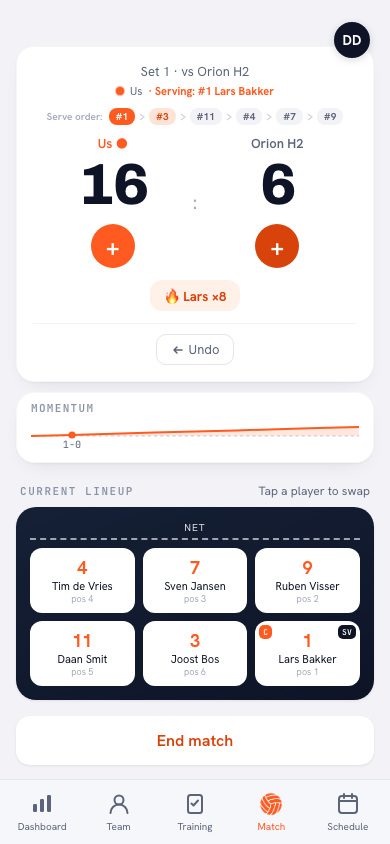
Three sentences your captain can use word for word: "Could you tell me which rule you are applying here?" — "Our point at 14-12 is not on the scoreboard, could you have that checked before the next serve?" — "We will play on, but we would like it recorded that we disagree." You do not need more, and you will not get more. Anyone scoring live does not have to guess at that second sentence: in Koach you can see which rally the point fell off at, and that is the difference between a suspicion and a report.
As a coach there is one thing you may do yourself that often works better than talking: take a time-out. Not to reverse the decision, but to stop your team giving away the next two rallies as well.
When a protest is possible
A protest is not a heavier form of objection but a different instrument, with a subject of its own: it is about the application of a rule or about facts of the match, never about a judgement. "The referee awarded the point to the wrong team after a double fault" can be protested. "The ball was out" cannot, at any level.
That immediately explains what protests are about in practice: administration. An ineligible player, a wrongly applied substitution rule, the wrong ball. The category "the referee saw it wrong" does not get anywhere, because that is not what a protest is for.
The route runs through your captain and through the match sheet, and those steps are written out in digital match sheet or scoring app. Remember one thing from this: the procedure and the deadline differ by federation and by country, so look them up in the regulations of your own competition — preferably calmly at the start of the season, not on the Saturday evening it went wrong.
What you teach your team about all this
Whether you have two challenges or none, the most expensive seconds are the same: the ten seconds after a decision that goes against you. Teams rarely lose a set to one bad call, and far more often to the two rallies after it, in which part of your team still has its head at the line. So agree one rule and enforce it: only the captain talks, everybody else plays on.
You can train that. During a practice match, deliberately call two balls wrong and see who reacts — not to punish them for it, but to make it visible that it happens. Then agree the reaction you want to see: one sentence to each other, "next ball", and get into position. A team that has that under control needs a challenge system less than a team that has not will ever need one. The rest of the rules all of this rests on are bundled in the overview of the volleyball rules.
Frequently asked questions
How many challenges do you get per set in volleyball?
In the common FIVB set-up, two unsuccessful challenges per set: if you are proved right you keep the right and can request another review. Every set the allowance starts again. The exact number is in the regulations of your own competition and differs by federation and level.
Do challenges exist in club and regional competition?
In practice, no. A video challenge requires cameras, an operator and a review monitor, and that installation exists almost exclusively at international tournaments and in the top national leagues. Without that system you cannot have any decision reviewed; whether your competition has it is in your federation's regulations.
Which decisions can you not challenge?
Judgement calls about ball handling, such as a carried or double-contacted ball, are not on the list in any competition. The same goes for something from an earlier rally and for situations that were not whistled at all. Which cases can be requested is announced before the match.
Does a challenge cost a time-out?
In the common set-up it does not: challenges and time-outs are separate allowances and your two time-outs per set stay untouched. So never use a challenge as a disguised time-out — a request with nothing behind it simply costs you the challenge.
What can I do if I think the referee has it wrong?
Against a judgement call, nothing: the first referee's decision is final. Your captain may ask for an explanation of how a rule is being applied, and a factual error such as an unrecorded point must be reported straight away, before the next serve.
What can you actually lodge a protest about?
About the application of a rule or about facts of the match, for example an ineligible player or a wrongly applied substitution rule. Report it immediately through your captain, have it entered in the remarks field of the match sheet and follow your federation's procedure; deadlines differ by federation.