
How to coach a player with a bad attitude
A team needs at most one of them to set the tone: the player who talks louder than the rest, who sighs at teammates' errors, or who is already playing with a ball while you are explaining. Looking away doesn't work — after six weeks the whole team is training around it.
Look first: what exactly is happening?
Difficult player is not a usable diagnosis. In practice you see three types, each needing a different approach. The taker-over talks over you, organises drills himself and corrects teammates. Often that is an engaged player with too few outlets. The critic reacts to other people's errors: a sigh, a look, a "come ON". Usually someone with high standards who is at least as hard on himself. The negative tone-setter makes jokes at other people's expense, complains about practice or pulls others into his discontent. This type does the most damage and is the least visible, because it rarely happens in front of you.
So watch deliberately for a week first. When does it happen — after an error, during a dull drill, only with certain teammates? With whom? And what is the effect: do the others go quiet, or do they laugh along? Without that observation you go into the conversation running on irritation, and the player notices.
Describe behaviour, not character
The difference between a conversation that works and one that stalls is nearly always the wording. "You are negative" is a verdict about who someone is — nobody can do anything with that except defend themselves. "Yesterday I saw you throw your hands in the air three times after a teammate missed a ball" is an observation you can actually talk about. So prepare two or three concrete examples, with the moment and the consequence: what happened, and what did it do to the player opposite him?
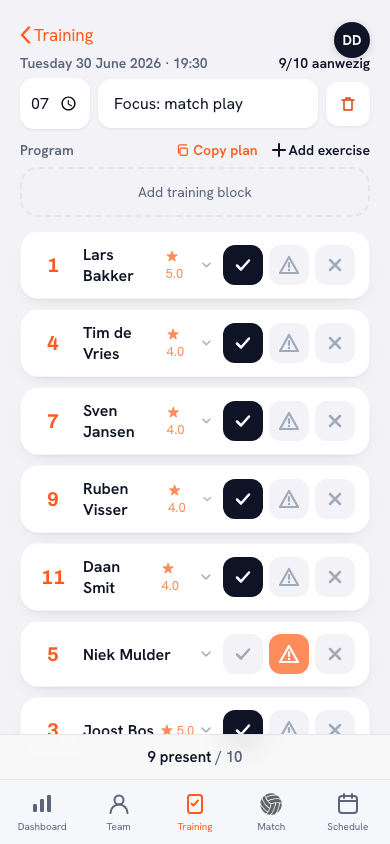
That is exactly why tracking helps: effort scores and playing time in Koach give you facts to open that conversation with, which keeps it about behaviour instead of character. A player who hears that his effort at practice has visibly dropped over recent weeks argues about that far less than about your impression. How to rate effort consistently without arbitrariness is in rating player effort.
The conversation: structure and sentences
- Pick the moment. Not straight after an incident and not in the hall. Five minutes before practice, in an empty room, beats a long conversation afterwards in the heat of it.
- Start with what you value. Dominant players are almost always engaged players. "You're one of the few who always says something on court" isn't an intro, it is a fact.
- Name the behaviour and the effect. "When you sigh after a mistake from Sanne, I see her avoid the next ball." The effect on teammates hits harder than a rule.
- Ask how he sees it himself. Plenty of players have no idea how their reactions come across. That discovery often does more than your whole speech.
- Make one agreement. Concrete and visible: "after a teammate's error, you are the first to say something positive." One agreement, and you come back to it within two weeks.
Give dominant behaviour a legal outlet
A player who wants to run the whole practice has energy you can use. Give him a real responsibility instead of only a restriction: he leads the warm-up, he is responsible for communication in the back court, he coaches one specific teammate during game play. That works for two reasons. First, the behaviour takes a form that helps the team. Second, the player experiences himself how hard it is to get a group moving — that produces more humility than ten conversations. Do be careful not to hand him the captaincy as a reward for difficult behaviour; how you do make that choice is in choosing a captain.
Put it in the team, not only in the conversation
Individual behaviour is half a team-culture issue. If nothing is ever said in your team about how you react to errors, the dominant player is simply the one showing it most clearly. So set out a few team agreements with the group about exactly that: how do we react to a teammate's error, who is allowed to coach on court, and what do we do when someone doesn't stick to it? Agreements a team formulates itself, the team also enforces itself — and then you don't have to step in every time. Formats that help with this are in team-building exercises.
If nothing changes
Sometimes nothing changes. Then build up in clear steps: first the conversation and the agreement, then a second conversation where you establish that the agreement wasn't kept and name a consequence, and only after that the consequence itself — sitting out a practice, a match on the bench, or with youth a conversation with the parents present. Be predictable about it: announced consequences that follow cost you one difficult moment; consequences you announce and don't carry out cost you the whole season. And always leave the door open. Most dominant players aren't problem cases but players with a lot of commitment and few brakes — that combination can be steered, as long as you stay with it.
Rule of thumb: talk about behaviour in the present tense and about the player in the future tense. This is what I see happening, and this is what I need from you opens a conversation; that is just how you are closes it.
Frequently asked questions
Should I remove a dominant player from the team?
Almost never as a first step. Start with observation, one concrete conversation and one agreement, and build consequences up step by step. Removal is a last resort you only use for behaviour that structurally damages other people's safety or enjoyment.
What if the dominant player is also my best player?
Then the conversation is more important, not less. A team learns above all from what you allow your best player; make an exception there and you can no longer enforce the agreements with anyone.
How do I handle it with a youth player?
Keep it concrete and short, use examples from that same week, and only involve the parents if a second conversation produces nothing. With youth, also explicitly give a positive role back, because children's behaviour changes faster through responsibility than through restriction.