
Making a quiet player visible with statistics
In every locker room, the loud player's presence wins: he claims his points, narrates his actions, colours your memory of the match. Meanwhile the quiet player simply does the work — and fades from view. Unless you measure.
The bias every coach has
Coaches judge partly from memory, and memory is sensitive to volume: the player who shouts something after every action gets remembered; the player who silently does their job fades. You need no research or records to recognise this — just ask yourself whose actions from last Saturday you still remember. That is exactly why data is not a luxury but a correction: statistics hear the ones who say nothing.
Where the quiet player lights up
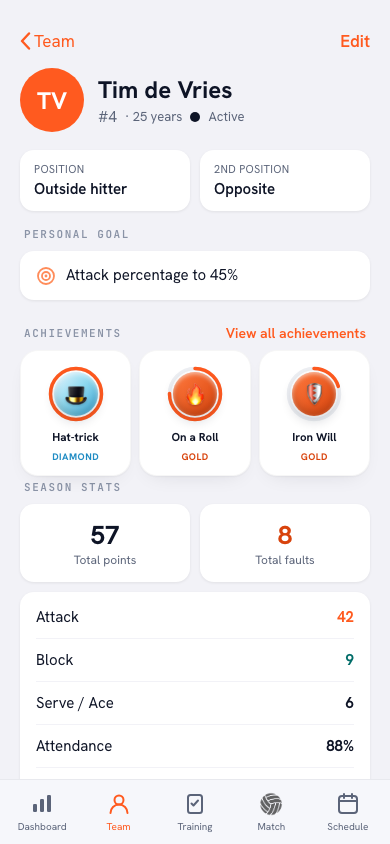
- The consistency numbers: attendance, average effort, every match played — the reliability statistics where quiet players consistently score high.
- The low error load: those who make little noise often also make few errors — a solidity that cheers in no ranking but carries every set.
- The quiet production: block points, serve share, the form line that has been rising for two months without anyone mentioning it.
Making them visible — their way
Hoisting a quiet player onto the podium in front of the group can backfire; choose fitting forms. Name their numbers in a small, concrete way ("you took the most block points again — that is four matches in a row now"), use the evaluation talk — where quiet players often turn out to have surprisingly much to say — and correct the locker room where needed: "everyone sees Ruben score, but look who was at 90% attendance again." The data gives you the facts; the dosage remains a human craft.
Check your own distribution of attention. Tally for one week who gets your feedback at practice. The outcome is predictably uncomfortable — and the quiet half of your team deserves half of your voice.
Frequently asked questions
How do I tell whether a quiet player is unhappy?
Not from their words — from their trends: falling effort, declining attendance, a form dip without an injury. With quiet players, the data is often the first and only alarm signal.
Should I encourage a quiet player to speak up more?
Only where the game requires it (communication on the court is functional). Their character is not a development point — a team needs carriers and shouters, and the art is valuing both.
Does public recognition work with introverted players?
In doses: a factual compliment in the group ('most block points this season') lands well, a spotlight moment with applause often does not. If in doubt, simply ask them — quiet players appreciate that conversation too.
Try it yourself in Koach
Less admin, more coaching — starting at your next practice.
Get started with Koach