
Serving drills: building pressure zone by zone
The serve is the only moment a volleyball player has the ball completely in their own hands — and yet many teams train it as an afterthought. Three drills that turn serving into a weapon.
First in, then targeted, then under pressure
Serving practice follows a fixed ladder. Skip a rung and you train the wrong thing: a player who cannot yet land 8 out of 10 in the court gains nothing from zone work, and zones without tension say nothing about the match. Determine where each player stands on the ladder and let them join the same drill at different levels.
Drill 1: Zones 1 and 5 (targeted, 15 min)
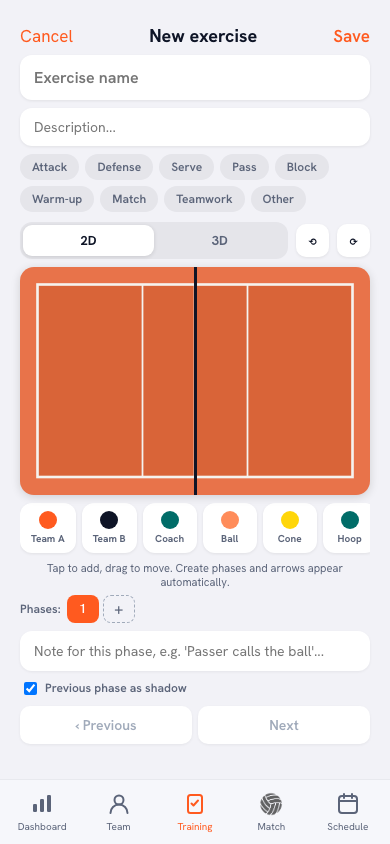
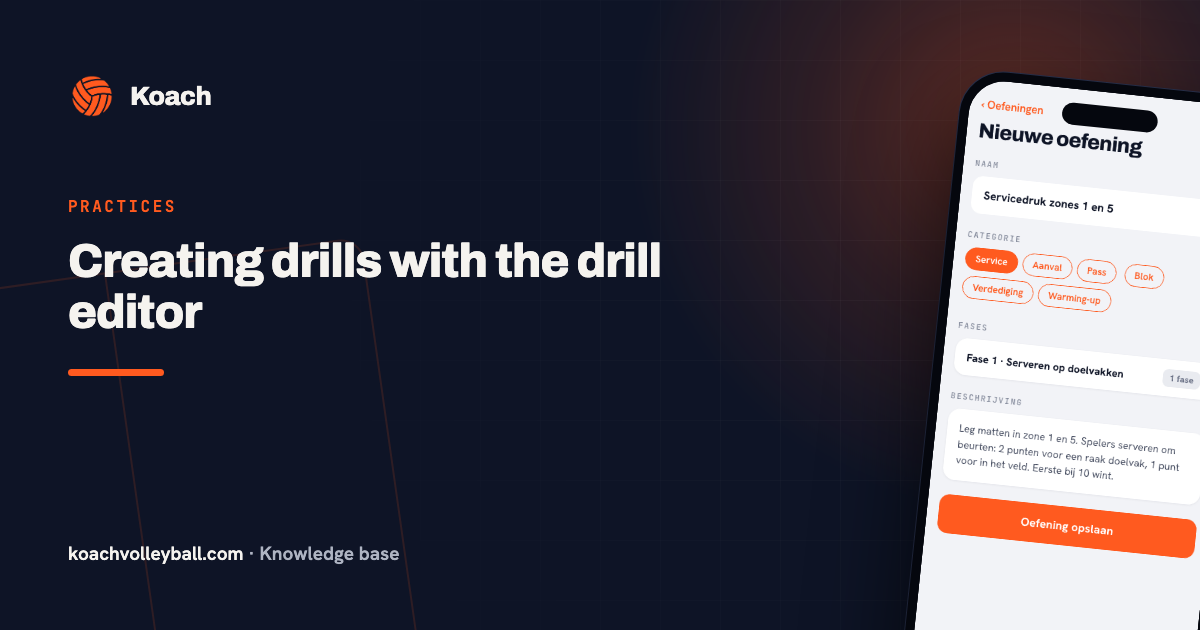
Setup: mats in zones 1 and 5 — the corners where the pass suffers most. Scoring: 2 points on the mat, 1 point in the court, out on a miss. First to 10 wins. Variation: have players call their target zone in advance; only the announced zone counts double.
Drill 2: Serving with consequence (pressure, 10 min)
Flow: the whole team serves simultaneously in series; whoever misses sprints a shuttle and rejoins. Why: a light physical consequence simulates match tension better than a hundred consequence-free serves. Keep it light — the goal is pressure, not punishment.
Drill 3: The 24-23 serve (match-real, 10 min)
Flow: a player gets one serve with an announced score ("24-23 for us"). Hit the agreed zone = point for us, miss = point for the opponent; the team counts along out loud. Why: this is the serve that decides the season — and the only way to train it is to rebuild the tension.
Count across weeks, not evenings. Note each player's score on drill 1 and compare monthly. Serving progress is slow and invisible — except in a series of numbers.
Frequently asked questions
How many serves per practice are enough?
Thirty to fifty targeted serves per player is a solid dose; spread them across blocks instead of one long line. Quality and context weigh more than volume.
Should everyone learn to jump serve?
No. A tight, well-placed float serve often scores more at amateur level than an inconsistent jump serve. Only let players with a stable foundation build up the jump.
How do I keep zone training from getting boring?
Turn it into competition: pairs against each other, announced zones, countdown scoring. The drill stays the same — the tension comes from the format.
Try it yourself in Koach
Less admin, more coaching — starting at your next practice.
Get started with Koach