
Volleyball 4 vs 4 formation: roles and serving order
Four players, one court and not a single agreement: that is how most 4 vs 4 starts. Everyone runs at the same ball, nobody puts up a second ball, and after ten minutes it has turned into a tipping contest. Yet 4 vs 4 is not a stripped-down version of six against six — it is a game of its own, with its own space, its own roles and its own serving order. Here is how to set that game up, whether you play in a recreational league or use it as a scrimmage on a Tuesday evening.
Why 4 vs 4 is a game of its own
Start with the floor. One side of the court is nine by nine metres, so 81 square metres. Divide that between six players and everyone is responsible for an average of 13.5 square metres. Divide it between four and it becomes just over 20 — half as much floor again per person, while the ball arrives just as hard. That single number already explains why a thinned-out 6v6 formation does not work: you keep the same jobs with two players fewer, and the gaps open exactly where somebody used to stand in six against six.
More changes. There is no libero, there is no middle blocker and usually there is no fixed setter. And you serve far more often: in a rotation of four you are at the service line every fourth turn instead of every sixth. For a team with one shaky server that is the difference between a problem and a leak. This article is about the indoor version — on sand the dimensions, the rules and the whole way of defending are different, as described in indoor and beach volleyball compared.
One more boundary: with the youngest age groups 4 vs 4 is not a scrimmage but the match format itself, on a smaller court and with a lower net. Which dimensions and numbers apply there is in the mini volleyball rules, and the step from four to six players is a route of its own that you will find in from mini volleyball to the full court. Below is about adult players: recreational and mixed leagues, 4v4 tournaments, and 4 vs 4 as a practice format for an indoor team.
Box or diamond: pick one base formation
There are two usable base shapes, and teams that do not choose end up playing both of them halfway. Describe them to your players in metres, not in names.
- The box. Two players just behind the attack line, about 3.5 metres from the net; two players at about 7 metres. All four stand roughly 2.5 metres from their sideline. Symmetrical, easy to remember and strong against a team that hits hard: you have two players who can block and two who are deep.
- The diamond. One player in the middle at the front, about 1.5 metres from the net, two players halfway left and right at about 5 metres, and one player in the middle at the back at about 8 metres. Strong against a team that places and tips: the short ball in the middle and the cross-court are covered.
The choice is not a matter of taste but a reaction to the opponent. If the other side is swinging away off a net-height set, you want the box. If mostly a high ball comes back that gets laid down somewhere in your court, you want the diamond. If you do not know the opponent, start in the box and switch after the first five points if it turns out nobody is swinging.
What you do not do is switch every rally: four players who half know two shapes are structurally in the wrong place. Pick one per set and call a change out loud during a stoppage.
Two roles instead of six
In six against six everybody has a position. In 4 vs 4 that does not work: there you have two roles that you spread over four players. The simplest workable split is the 2-2: two of your four players are setters, two are hitters, and the setters stand opposite each other in the rotation. That way there is always exactly one setter at the front — the same logic as the 4-2 system on the full court, only with two players fewer.
That one agreement solves the biggest problem in 4 vs 4: the second ball. Without a role split, one of two things happens by default — two players go for it together, or both of them leave it because each thinks the other is going. With the 2-2, everyone knows before the serve who takes the second ball, and during the rally a call is only needed when that player has to play the first ball himself.
If you play with mixed levels — recreational players, a mixed team, a tournament with fill-ins — a fixed setter is often not realistic. Use the free variant then, with one hard rule: the second ball belongs to the player closest to the net who did not play the first ball. Have that player call "mine" the moment the ball comes your way, so before the first contact and not after it. Calling after the pass is too late; by then the hitter is already standing still.
Give the setter a measurable target too, because otherwise every second ball becomes an emergency: the set lands 1 to 1.5 metres off the net and about 2 metres in from the sideline, high enough to get comfortably underneath. In 4 vs 4 that ball may be slow — there is at most one blocker anyway. If it does not work off a poor pass, deliberately choose a high ball to the sideline instead of a rushed ball in the middle — a hitter who can take three steps always hits better than a hitter who has to improvise.
Keeping the serving order without position numbers
In most 4v4 formats you simply rotate: win the serve and everyone shifts one place clockwise, and whoever ends up right back serves. The direction is therefore identical to the rotation order on the full court. What is missing are the position numbers and usually the scorer as well — and that is exactly where it goes wrong. Four practical measures:
- Have everyone memorise one name, not four. Each player only learns who serves before him: "I serve after Sanne." That is one fact per player instead of an order you have to reconstruct.
- Write the order down before the match. Four names in order on the score sheet or in the team app, and that note stays at the table. Takes ten seconds and settles every argument.
- The server calls his own name before he tosses. At tournaments without a scorer this is the only check you have, and it takes half a second.
- After every time-out and every substitution, the last server points out the next one. Stoppages are where the order dies, not the play itself.
If somebody does serve out of turn, the way it is handled depends on the rules you are playing under: in many recreational formats the order is quietly restored, in an official league it can cost you more than one point. What the rulebook says about it is in the wrong server — check per tournament whether that rule is applied there as well.
Where the gap falls: four agreements about the open space
Every formation leaves space open, and in 4 vs 4 that space is big enough to lose a match with. Make four agreements beforehand, in these words:
- The short ball in the middle belongs to whoever is moving forward. In the box the gap falls about five metres off the net, precisely between all four. Moving forward is easier than moving backwards, so that ball belongs by default to a back player — not to whoever happens to be closest.
- The ball on the sideline belongs to the back player on that side. Front players stepping out to the sideline only make the gap in the middle bigger.
- A ball between two players belongs to the one who sees it coming from the front. That is the same seam agreement as in six against six, and it applies all the harder here because the seams between four players are wider.
- You only block a swing off a good set. For everything else you pull back behind the attack line and defend with four.
That last one is the most important, and it comes with a sum. With four defenders you cover 81 square metres, just over 20 each. Take one out to block and three players share those same 81 metres: 27 square metres each. Every blocker therefore costs you roughly seven square metres of floor per remaining defender. That is only worth it if the block genuinely takes something away; against a tip a blocker is pure loss.
Recreational and mixed: six things to check beforehand
Outside youth volleyball, 4 vs 4 is mainly a recreational and tournament format, and there the rules are not fixed in one rulebook. They differ per federation, per league and sometimes per tournament. Get hold of the regulations and look up these six points before you design a formation:
- The court size. Some leagues play 4 vs 4 on the full nine-by-nine court, others shorten it. That difference determines whether the box or the diamond is the logical shape.
- The net height. In mixed leagues it is often somewhere between the men's and women's height, but the chosen height varies per federation.
- Rotation compulsory or not. Some regulations require rotating, others let you position freely as long as the serving order is right.
- The attack line. May back players attack in front of the three-metre line, or does the usual restriction apply? This is the point that causes the most arguments at tournaments.
- The mixed rules. Some regulations prescribe a minimum number of women or men on court, or require that with more than one contact at least one touch is made by a woman.
- Sets, scoring and substitutions. How many points per set, how many sets, how many substitutions — at tournaments, sets to 21 or a fifteen-minute playing time are perfectly normal.
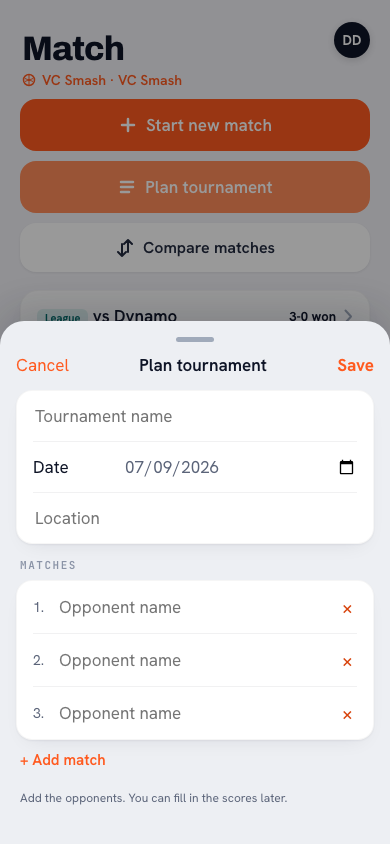
Then set a tournament day up as a tournament and not as a string of separate matches: one pool, several short games, and the same four agreements in every game. In Koach you plan such a day as one tournament with the matches underneath it, so afterwards you can look back per game instead of guessing which formation ran best. Note at least two things per game: which base formation you played and how many points you gave away on serve.
4 vs 4 as a practice format for your indoor team
Even if your team plays plain six against six, 4 vs 4 is one of the strongest scrimmage formats you have. The reason is arithmetic. Take a rally of three exchanges: each side touches the ball nine times. Spread that over six players and you are at one and a half contacts per player per rally; over four players it is a little over two. In a twenty-minute block with forty rallies that is the difference between roughly sixty and ninety balls per player. Those extra thirty balls are not tossed feeds either, but real game situations. The same principle sits behind the formats in more ball contacts per practice.
A workable set-up for a twenty-minute block:
- Court: bring the sidelines in to about seven metres wide with cones or lines. On a full court an average team turns it into a running race instead of a game form.
- Numbers: from eight players; with twelve you work with three foursomes that rotate through, so nobody is ever standing and watching.
- Start: beginner groups start with a tossed free ball, advanced groups with a real serve from the end line.
- Scoring: sets to 11 or 15 points, and the losing foursome comes off. Keeping it short works better than one long game.
Add three constraints to that, because without them the format teaches the wrong things: three contacts compulsory, the setter may not play the first ball and every rally starts with a call before the first contact. If you are structurally short of players at practice, this is your main format anyway; more forms for that are in practising with a small team.
What 4 vs 4 un-teaches your team
Here is the flip side, and it is real. Three habits that pay off in 4 vs 4 cost you points the moment you are back on court with six. Name them, and build a countermeasure in.
- Going for everything yourself. In 4 vs 4 the ball really is yours more often, so running through gets rewarded. In six against six that same behaviour produces two players on one ball and a gap elsewhere. Countermeasure: have players call before the first contact in the 4v4 format too, exactly as in a match.
- Setting high and safe. Without a double block a slow high ball to the sideline is always good enough. In six against six that exact ball gives the opponent time to get two blockers up. Countermeasure: in the last quarter of an hour only count sets that land within a metre and a half of the net.
- Attacking through the middle. Without a middle blocker the ball straight down the middle is the easiest point of the evening; on the full court that same ball hits the block. Countermeasure: score an attack through the middle as one point and an attack down the line or into the deep corner as two.
None of these three is a reason to drop the format. They are a reason to spend thirty seconds afterwards on what is different in a match — that costs you nothing and stops you seeing the format again on Saturday.
Key point: 4 vs 4 stands or falls on three agreements you make before the first serve — which formation you play, who takes the second ball and who serves after whom. Without those three it is not a game form but four people running at the same ball.
Frequently asked questions
Do you play 4 vs 4 on the full court?
That depends on the regulations of your league or tournament: some play on the full nine-by-nine court, others shorten it. Check beforehand, because the court size determines whether the box or the diamond is the logical formation. At practice you bring the sidelines in yourself to about seven metres wide.
Who takes the second ball when there is no setter?
Work with two fixed setters standing opposite each other in the rotation, so there is always exactly one setter at the front. If that is not feasible, agree that the player closest to the net who did not play the first ball takes the second, and have that player call before the first contact.
How do you keep track of the serving order without position numbers?
Have each player memorise only who serves before him, so one name per player instead of the whole order. Alongside that, write the four names down beforehand and leave the note at the table, and have the server call his name before he tosses. Stoppages are the risk: after every time-out or substitution, point out the next server.
How many players do you need for 4 vs 4 at practice?
Eight is the minimum, twelve is ideal: then you have three foursomes rotating through and nobody is standing and watching. With eight players you play two fixed teams and keep the sets short, to 11 points for example, so the intensity stays up.
Should you block in 4 vs 4?
Only against a swing off a good set. Every blocker takes a defender out of the court, leaving the remaining three to cover 27 square metres each instead of just over 20. Against a tip or a high ball over the net a block delivers nothing and costs you the floor.
Is 4 vs 4 useful preparation for six against six?
As a scrimmage format, certainly, because players get half as many ball contacts again and have to carry out every job themselves. Do watch out for three habits the format rewards that backfire in six against six: going for everything yourself, setting slow and high, and attacking through the middle. Build constraints against them and name the difference afterwards.