
What Is a Pipe in Volleyball? The Back-Row Attack
Three front-row attackers can be blocked; four cannot. The pipe is the cheapest way to add that fourth one, because you do not need an extra player for it — only an agreement and an approach that was there anyway.
What a pipe actually is
A pipe is a back-row attack through the middle: the player at P6 approaches through the centre of the court, takes off behind the ten-foot line and hits the ball somewhere between zone 3 and zone 6. The set travels flat over the net, about a meter and a half to two meters above it, and comes down at a point three to four meters off the net.
You will also hear the term 'bic': that is the same attack but at quick tempo, with the hitter already in the air when the setter touches the ball. For most teams the ordinary pipe is the achievable version and the bic is a goal for later.
The arithmetic of the block
The reason the pipe works is written on the opponent's whiteboard. Their middle blocker has to choose every rally: do I stay with your middle attacker or leave for the pin? Add an attacker who hits exactly between those two options and she cannot do anything right. Leave for the left and the pipe is free; stay in the middle and your outside hitter swings against a single block.
More important still: that effect kicks in the moment the threat exists, even when you do not play the ball. Two or three pipes a set are enough to keep their middle guessing all match — the same mechanism that makes the quick threat from your middle so valuable.
Who runs the pipe?
Almost always an outside hitter who happens to be in the back row, because she already has the approach and the swing. In a 5-1 there is at least one outside in the back row in every rotation, so you always have one available. Two practical notes. Your libero may not hit it: she is not allowed to attack the ball above net height. And if your outside hitter is at P5 or P1 instead of P6, she can still attack from the back row, but along the side instead of through the middle — a different attack with a different set.
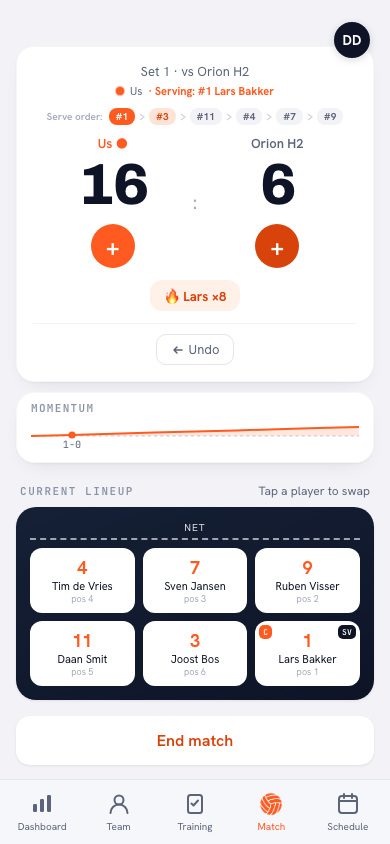
Log the pipe as a back-row attack in Koach and you will see after the match, in black and white, how much it actually produced.
The rule: take off behind the ten-foot line
A back-row player may attack the ball above net height, but only if she takes off behind the ten-foot line — and that line belongs to the front zone, so standing on it counts as being in front of it. Landing inside the line is fine. That is the only rule your hitter needs to know, and at the same time the mistake beginners make most: running half a meter too far out of sheer enthusiasm. All the details are in may a back-row player attack? While you are building the skill, feel free to lay a marker or a cone half a meter behind the line as a visual anchor.
The set and the timing
Three agreements make the difference between a pipe and a high ball in the middle:
- The approach starts early. The pipe hitter begins her approach the moment the setter touches the ball, or even a beat earlier — she has more ground to cover than an outside hitter.
- Straight, not diagonal. She runs straight at the net, in line with her take-off, so she does not collide with the middle running the quick. Agree who goes in front of whom.
- The set is flat and in front of her. The ball has to go to the point she is running toward, not to the point she came from. A pipe that lands behind the hitter is always a fault of the set, never of the approach.
When do you call for it?
- After a good pass. Without a pass in the setting zone the pipe does not exist — the ball has to be flat and precise.
- When your outside hitter is stuck against a double block. Two pipes move that block within a few points.
- In the rotations with only two front-row hitters. That is exactly where the fourth option is worth the most.
- In transition. After a dig your outside hitter is already in the back row and off the net — the approach comes for free.
How to build it in four sessions
- Session 1: approach and take-off without a ball, ten times, with the emphasis on taking off behind the line.
- Session 2: setter and hitter alone, off a tossed ball, until the set consistently lands in the same place.
- Session 3: out of a real serve receive, with the middle running her quick — only then do they learn to run past each other.
- Session 4: a game format with the agreement that every perfect pass produces at least one pipe approach, even when the ball goes somewhere else.
The pipe does not have to score to work. Even a pipe that gets blocked forces their middle to stay central the next rally. So do not just count the points from the pipe, count what your outside hitter gained in the same set.
Frequently asked questions
What is a pipe in volleyball?
A back-row attack through the middle: the player at position 6 approaches through the centre, takes off behind the ten-foot line and hits a flat set between zone 3 and zone 6. That gives you a fourth attacker alongside the three in the front row.
Who usually runs the pipe?
The outside hitter who is in the back row at that moment, because she already has the approach and the swing. The libero may not hit it, since she is not allowed to attack the ball above net height.
From what level can you play a pipe?
As soon as your pass regularly reaches the setting zone and your setter can deliver a flat ball. That is perfectly achievable across the club divisions — it is mostly a matter of repetition and daring to run the approach.
What is the difference between a pipe and a bic?
The same attack at a different tempo. On a bic the hitter is already in the air when the setter touches the ball, which leaves the block even less time. The ordinary pipe is the achievable first step.