
Can a Libero Set the Ball Overhand? The Front-Zone Rule
The pass goes astray, the libero takes the second ball and sets it up overhand for the outside hitter. The hitter swings hard, and the referee whistles — against the hitter. This is the most misunderstood libero rule of them all, and the confusion is about who is actually at fault.
The libero may set, full stop
Let us clear the misunderstanding up straight away: the libero may play the ball overhand anywhere. Nowhere in the rules does it say a libero may not set, not in the front zone and not anywhere else. The restriction in rule 19.3.1.4 is not about the libero at all, but about the player who attacks the ball afterwards.
That rule reads: a player may not complete an attack hit from anywhere if, at the moment of contact, the ball is entirely above the top of the net, when that ball comes from an overhand finger set by the libero in their front zone. So there are four conditions, and all four have to be true at once before anything is wrong.
The four conditions, listed
- The libero plays the ball overhand, with the fingers. If they play it forearm (a bump set), the restriction does not apply — however high or hard the attack that follows.
- They are in the front zone while doing it. What matters is where their feet are at the moment of contact. The front zone runs from the net to and including the three-metre line, and it extends sideways beyond the sidelines to the end of the free zone.
- A team-mate attacks that ball — they complete the attack hit, from anywhere on the court.
- The ball is entirely above the tape at that moment of contact. If any part of the ball is still below the top of the net, there is no problem.
Take one of those away and the attack is perfectly legal. And note who gets penalised: not the libero, but the attacker. It is an attack-hit fault, with the point and the serve going to the opponent.
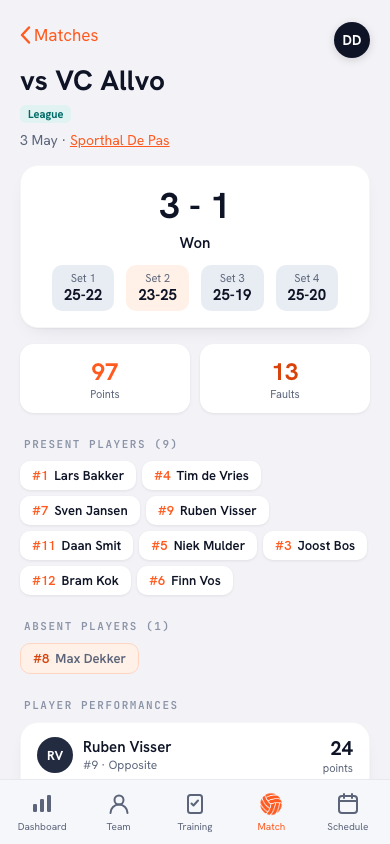
If your libero often ends up as the second contact, that shows up as out-of-system rallies — something you can spot back in Koach's per-set score progression, where those runs become visible.
Why this rule exists
The libero is a defensive specialist and always plays in the back row. Without this provision a team could use them structurally as a second setter at the net: they can be replaced in and out without limit, so you could have them pop up at the net every rally at no cost in substitutions. The rule blocks that without banning the set outright — they may still set, just not as the launch pad for a full-blown attack.
Four real cases
- Libero bump-sets the second ball from the three-metre line, outside hitter swings hard. Legal — it was not an overhand finger set.
- Libero sets overhand from two metres behind the three-metre line, middle blocker hits. Legal — they were not in the front zone.
- Libero sets overhand from the front zone, the hitter tips the ball over with part of it below the tape. Legal — the ball was not entirely above the net.
- Libero sets overhand from the front zone, the opposite smashes it high above the tape. Fault on the opposite: point to the opponent.
What does this mean for your build-up?
Practically it comes down to one agreement: if the libero takes the second ball near the net, they bump it. That is not only safe under the rules, it is usually the better option too — an overhand set under time pressure close to the net rarely produces a good attacking ball. Further back, anything goes.
If your libero is regularly taking the second ball, that is a sign your setter is having to play the first ball too often or your pass is overshooting. That is a build-up problem, not a rules problem: how to still finish those rallies is in out-of-system play. The technique of setting itself is covered in overhand setting.
Youth, mini volleyball and recreational leagues
The rule applies in full from under-15 upwards, even though it is rarely called there — in youth matches a ball contacted entirely above the tape after a libero set simply does not come up much. In mini volleyball the libero role does not exist. Recreational leagues often play without a libero or with their own arrangements; what applies there is in that competition's own regulations. All the other libero restrictions are in the libero rules and in the net rules for liberos.
Frequently asked questions
Can the libero set the ball overhand?
Yes, anywhere on the court. The rules nowhere forbid the libero from playing overhand. The restriction falls on their team-mate: that player may not attack such a ball if they contact it entirely above the tape and the libero set it from the front zone.
Who gets the fault on an illegal attack after a libero set?
The attacker. It is an attack-hit fault, with the point and the serve going to the opponent. The libero has done nothing wrong — they were entitled to play that ball.
Does the restriction also apply to a forearm pass by the libero?
No. The rule is exclusively about an overhand finger set. If the libero plays the second ball with the forearms, the attacker may hit that ball at any height, including from the front zone.
Where exactly does the front zone run?
From the net to and including the three-metre line, and sideways beyond the sidelines to the end of the free zone. What counts is where the libero's feet are at the moment they contact the ball.



Try it yourself in Koach
Less admin, more coaching.
Get started with KoachOr read first what the volleyball coaching app does.