Can You Reach Over the Net in Volleyball? Block vs Attack
Two hands hanging just above the tape on the wrong side: sometimes that is a perfect block, sometimes it is a fault that costs you the point. The difference is not in how far you reach, but in the moment you touch the ball.
The main rule: where you contact the ball decides everything
For the attack the rule is absolute: you may only hit the ball if the contact takes place within your own playing space (rule 13.2.1). Touching the ball on the opponent's side is always a fault, high or low. Your hand may follow through over the net after contact (11.1.2) — it is purely about the place where ball and hand meet.
For the block it works differently. Rule 11.1.1: a blocker may touch the ball beyond the net, provided they do not interfere with the opponent's play before or during their attack hit. And rule 14.6.1 draws the hard line: it is a blocking fault when the blocker touches the ball in the opponent's space before or simultaneously with the attack hit.
So when you may reach over the net
Translated into match terms: your hands may be over the net as soon as:
- the opponent has completed their attack hit — then you may block the ball above their side;
- the ball is clearly on its way to your side and the opponent can no longer play it, for instance on their third contact or on an overpass.
What you may not do is touch the ball above their side while they still have contacts left for it. The classic fault is the blocker who swats away the opponent's set: the setter puts the ball up, the blocker reaches across and knocks it away before the hitter has swung. That is a blocking fault — point and serve to the opponent.
Note: it is about touching the ball. Holding your hands over the net without touching the ball is not in itself a fault, not even during their build-up. It does become a fault if you thereby interfere with the player — more on that below.
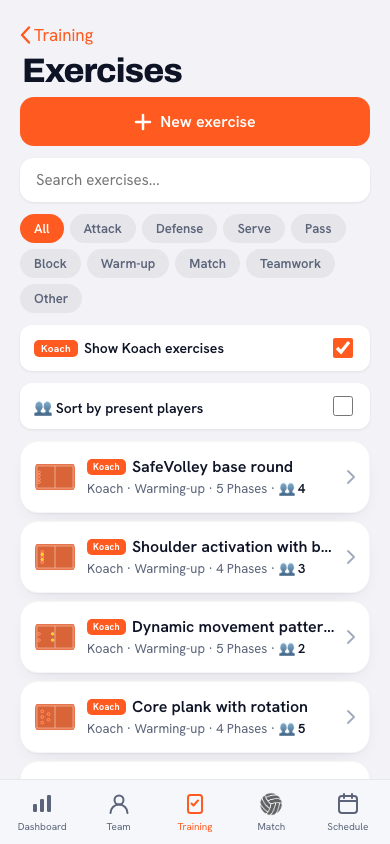
Koach's drill library includes blocking exercises with animations, so players learn to press over the net without touching it.
Interference: the other half of the rule
Alongside the ball contact there is a separate fault: interfering with the opponent. Crossing under the net is allowed, provided you are not in anybody's way (rule 11.2). Concretely:
- With your foot you may touch the centre line or even the far side, as long as part of that foot stays on or above the centre line.
- With other body parts (hand, knee, arm) you may touch the far side, provided you do not interfere with the opponent.
- Crossing fully into the opponent's court is always a fault, as is any action that prevents an opponent from playing.
That interference can also happen above the net: a blocker who hangs their arms over the net in the setter's face, or who pins the hitter's arm, commits a fault — even without touching the ball. The related net-contact rules are in the net-fault rules.
Four match situations
- Blocker touches the ball above their side, after the spike. Legal block — often a block point.
- Blocker knocks their set away before the spike. Blocking fault: point to the opponent.
- Blocker blocks a third ball already crossing the net. Legal: the opponent had no contacts left.
- Hitter contacts the ball on the far side of the net. Always a fault, even if a bad set put the ball there.
What you train from this
Two skills decide whether your team wins or gives away points here. The first is penetration: pressing over the net with straight arms and slightly angled wrists rather than holding the arms straight up. That closes the gap between block and net and sends the ball downwards instead of up. The technique is in blocking technique, and drills in blocking drills.
The second is timing: jumping too early means your hands hang over their side while their setter has not even set yet. Teach your blockers to read the ball rather than the hitter, and to jump only when the hitter starts the swing. How to organise that across your whole blocking front is in organising the block.
Youth, mini volleyball and beach
From under-15 upwards exactly the same rule applies. In mini volleyball the lowest levels do not block, so the situation does not arise. In beach volleyball the same provisions on reaching and interference apply, with one difference: crossing under the net is entirely allowed there, because there is no centre line — as long as you do not interfere with the opponent.
Frequently asked questions
Can you reach over the net when blocking?
Yes, as long as you do not touch the ball before or simultaneously with the opponent's attack hit, and you do not interfere with their play. After the attack hit you may block the ball above their side of the court.
Can you hit over the net on an attack?
No. On an attack the contact must take place within your own playing space. Your hand may follow through over the net after contact; it is purely about the place where hand and ball meet.
Can you block the opponent's set away?
Only if the opponent has no contacts left or the ball is clearly already coming to your side. Knocking a set away while the hitter still has to swing is a blocking fault.
Is reaching over the net without touching the ball a fault?
Not in itself. It only becomes a fault if you interfere with the opponent, for example by pinning the hitter's arm or blocking the setter's view.