
Free ball and down ball: the underrated moments
There are two moments when the opponent hands you a gift: the free ball and the down ball. Top teams unwrap that gift almost every time; amateur teams leave it lying around surprisingly often — because nobody agreed on what should happen next.
Free ball and down ball: the difference
A free ball comes when the opponent can't attack and sends the ball over the net gently, underhand or overhand — after a good dig on your side or a bad pass on theirs. A down ball sits just below that: an attacker does swing at the ball, but standing, without a full jump and threat. The difference dictates your response: on a free ball the block drops off the net entirely; on a down ball the blockers stay at the net but don't jump. Don't confuse the two: treating a down ball as a free ball means your block walks away from the net while a hit ball is incoming — exactly the meter of space a smart attacker needs.
The call: one word, six reactions
Everything starts with recognizing and calling. The first player to see it — usually a blocker who sees the attacker getting under the ball — calls 'free!' or 'down!', and the whole team switches:
- On 'free': the blockers drop off the net, the court shifts into a serve-receive-like setup and the setter is already heading for the setter zone. Your best passers claim the ball.
- On 'down': the block stays put without jumping (jumping against a down ball only opens holes), the back-row players stand actively ready in front of the ball and the defensive system simply stays in force.
The free ball is a mandatory chance
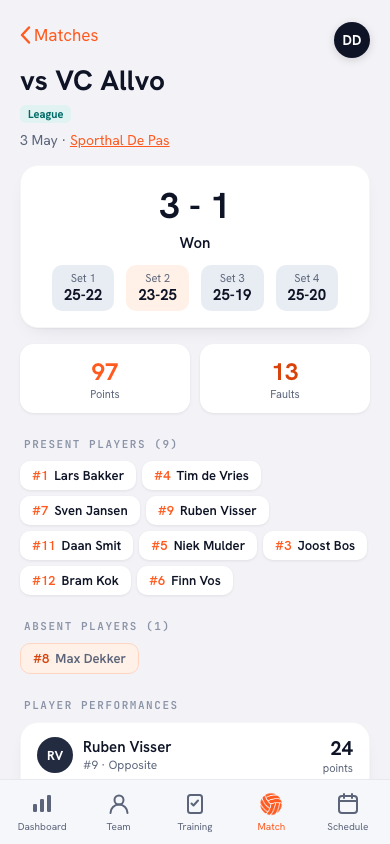
Do the math: a free ball gets you an easy ball, so a perfect pass, so every attacking option — including your fastest tempo. Strong teams score off free balls nearly every time; a team that structurally just 'plays the rally back' hands the biggest gift of the match right back. Make it a team standard: a free ball ends in our best possible attack, no compromises. And count it afterwards: if you log your matches, the score progression shows whether the easy moments actually turned into points.
After the call: the first three seconds
Between the call and the ball contact there are at most a few seconds — and precisely those decide whether the gift gets unwrapped. On 'free' the setter leaves for the setter zone immediately, before the ball even crosses the net. The middle blocker takes room for the approach: a free ball is the prime chance for a first tempo, because the pass is almost guaranteed to be perfect. The passer who claims the ball plays it deliberately a bit higher than usual into the setter zone — there is no need for haste, but every need for precision. The classic mistakes in these seconds: blockers who keep 'hanging' at the net and start their approach too late, and back-row players who stay so deep that the gentle ball just behind the net drops anyway.
Giving a free ball yourself: then do it right
Sometimes you have to send the ball over freely yourself — the rally got too messy; see playing out of system. Never make it a gift. Play the ball deep into the corner of zone 1 or 5, as low over the net as possible, preferably at the weakest passer or at the setter, who then has to play the first ball. A well-placed free ball still produces a scrappy pass surprisingly often — a sloppy free ball into the middle of the court guarantees an organized counterattack. And always consider first whether it really can't be done offensively: a standing down ball deep into the corner is often still available and at least keeps some pressure on the opponent.
Training it in ten minutes a week
This is the cheapest tactical training there is. Play a scrimmage in which the coach tosses in a free ball or down ball at random moments with the matching call. Count the free balls that end in a controlled attack; anything under eighty percent means there is work to do. Within three weeks you'll hear the calls come back in matches on their own — and watch the free points roll in.
Ban the call 'not mine!' on a free ball. Whoever calls 'not mine' only says what they won't do. 'Free!' means, for us: block drops, court shifts, setter runs — one word that triggers six jobs. That is the whole secret.
Frequently asked questions
What is the difference between a free ball and a down ball?
A free ball is played over the net gently, without an attack; a down ball is hit, but standing and without a full jump. On a free ball your block drops off the net; on a down ball it stays put but doesn't jump.
Why shouldn't the block jump against a down ball?
A standing attacker hits the ball flatter and with less threat; a jumping block rarely touches it and mainly opens holes in its own defense. Staying down and letting the back court defend earns more.
Where do I send a free ball when I have to give one myself?
Deep into the corner of zone 1 or 5, low over the net — preferably at the weakest passer or the setter. That maximizes the chance the opponent can't build their best attack.
How do I teach my team to use the calls?
Train them explicitly: in every scrimmage, have the coach toss in free balls and down balls and demand the call before the action. What's practiced out loud in training comes back in matches on its own.

