
How to Cover Your Hitter in Volleyball: Where to Stand
Your hitter swings, the block touches the ball, and a second later it lands on your own side of the net. Everybody watches. Nobody moves. That is not bad luck but a missing agreement, and it costs several points a set.
What happens in the second after the block touch
A blocked ball comes back fast, low and with a lot of spin, usually within a four-meter radius of your own hitter. After that you simply have three new touches — the rally is not over. But somebody has to be standing where the ball lands, and that only happens if your team moved during the attack instead of after it.
It is also one of the few situations in the game where you know roughly where the ball is going: downward, close to the net, on the side you are attacking from. There is no reason at all to leave that zone empty.
The two rings
Classic coverage consists of two shells around the hitter:
- The inner ring: two players, about two meters diagonally behind the hitter, low through the knees, hands open and in front of the body. They take the ball that rebounds straight back off the block.
- The outer ring: the remaining players at four to five meters, spread across midcourt and the depth. They take the ball the block knocks further away or that drops back over the block.
Who is in which ring depends on where the attack comes from. More important than the exact diagrams is the principle: everybody moves toward the hitter as soon as the set is out. Five players taking half a step toward the ball cover more ground than a perfectly drawn formation that only springs into action after the swing.
Who stands where, per attacking position
- Attack from P4 (left): the inner ring is the setter, who follows along the net to the left after her set, plus the back-row player at P5. Outer ring: P6 and P1 in the depth, with the middle coming off the net to cover midcourt.
- Attack from P2 (right): the inner ring is the non-blocking front-row player on that side plus the back-row player at P1. The setter is usually already there, unless she was in the back row.
- Attack through the middle: the coverage is narrower but closer — the setter and the other front-row player stand right behind the middle, and the back-row players move up to about the ten-foot line.
- Attack from the back row: the odds of a block rebound are lower here, but the ball that does come back often drops short by the net — so always leave one front-row player close to the net.
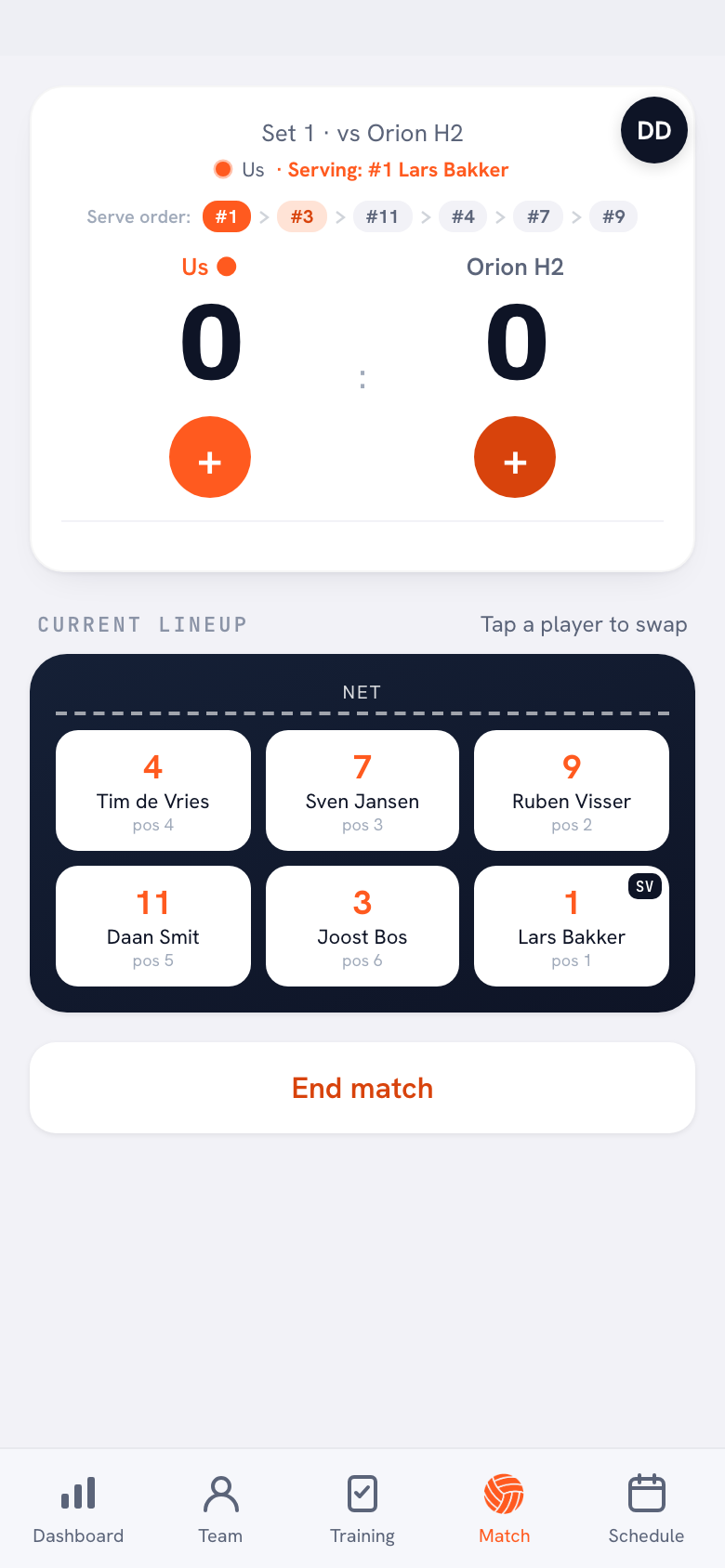
That is the fairest measure of poor coverage: blocked balls that die on your own side end up as attack errors in Koach against your hitter's name, which makes it painfully visible what went wrong behind her.
The posture: low, hands open, still
Covering is not defending. The ball comes from above and from close by, so the classic low defensive stance with the arms extended forward does not work. What does work: deep through the knees, chest low over the floor, hands open and separated in front of the body, ready to lift the ball up with the fingers or an open hand. And above all: be standing still at the moment the hitter contacts the ball. Anyone still moving then will never reach a ball that is on the floor within two tenths of a second.
The goal is modest. You do not have to deliver the ball neatly to the setter; keeping it high inside your own court is enough, because after that you still have two touches to make something of it — often ending in an out-of-system attack.
The four classic mistakes
- Watching instead of moving. The most common one: five players follow the ball with their eyes while nobody takes a step.
- Standing too close to the hitter. Directly behind her means the ball lands on your head. Two meters diagonally behind is the right spot.
- The setter who stays where she set. Her job is not finished after the set; on an attack from the left she is the first coverer.
- The middle who stays at the net. After her own approach she has to get off the net, otherwise she is standing in the space where the ball just does not land.
How to train it in ten minutes
Put a two-player block on a platform on the other side and have them deliberately block everything. Your team attacks according to the normal pattern and has to keep every blocked ball alive and play it out. Count only the rallies that continue after a block; start at one in three and work toward two in three. Then add the rule that every player has to be standing still at the moment of contact — that single detail delivers more than all the whiteboard diagrams. And after the match, look at the error load per player: if one hitter has strikingly many blocked balls, it is just as much a coverage problem as an attacking problem.
Coverage is also a message to your hitter. A player who knows two people are ready behind her dares to swing full at a big block. A player who does not feel covered starts tipping — and that is exactly what the opponent wants.
Frequently asked questions
How close should you stand to your own hitter?
About two meters diagonally behind her, low and with the hands open in front of the body. Directly behind is too close: then the ball lands on your head instead of in front of you.
May you play the ball again if the block knocks it back?
Yes. As soon as the ball comes back onto your side, your team simply has three touches again to handle it and attack once more.
Who covers the hitter when the setter is in the back row?
Then the front-row player on the attacking side who is not hitting takes over the inner ring, together with the nearest back-row player. Agree that per rotation, or nobody will be there.