
How to Play a Ball Off the Net in Volleyball
A ball that lands in the net gets treated by most club teams as a lost point. Wrongly: it is still in play, and with a little reading it is surprisingly savable. That is worth a couple of points a match that nobody was counting on.
The rule: it is still in play
A ball that hits the net is not dead. As long as your team has not used its maximum of three contacts, you may keep playing it - touching the net costs the ball nothing and does not count as a contact. In practice: if the ball hits the net on the first contact you still have two, if it happens on the second you have one left.
Two things are not allowed. You may not touch the net yourself during your action (the ball may), and you may not play the ball under the net into the opponent's court. All the nuance about net contact is in the net-fault rules. Beyond that it is an ordinary ball, and most teams only lose it because nobody knows where it is going to come out.
Where does the ball come out? Read the height
That is surprisingly predictable, because a volleyball net is tight at the top and slack at the bottom:
- Ball high in the net, against the band: the band is under tension and springs. The ball rebounds back into the court, up to half a meter or a meter away from the net, and it comes with speed.
- Ball in the middle of the net: the most predictable situation. The ball drops almost straight down along the net and lands close to the center line.
- Ball low in the net, just above the floor: the net hangs loose there. The ball almost sticks in it and falls vertically - you practically have to be underneath it.
Rule of thumb for whoever is going to get it: the lower the ball hits the net, the closer and the lower you have to be. On a ball in the band you actually back up a meter.
Stand parallel to the net
This is the detail that pays the most and that almost nobody does. The reflex is to run at the net face-on. Do not: turn so your shoulders are parallel to the net, facing the sideline. Two advantages. First, you are not in the net when you have to play the ball low. Second - and this is the win - your platform then automatically sends the ball up along the net instead of straight back into it.
The posture is a defender's: low, feet wide, weight forward, platform formed only once you know where the ball is going. Stay upright here and you will never get under it. The basics are in defending in volleyball.
Play it high and to the middle
The goal is not a pretty set, the goal is time. Play the ball high - three meters or more - and toward the middle of your own court, well off the net. From there your team can still build an attack, or at minimum get a decent ball over the net. A ball out of the net that you play tight along the band is a gift to the opposing block.
If two arms will not work, use one arm, or the flat hand on the floor if that is what is left. Every contact counts, and a ball that arrives high in the court out of an impossible position is a successful play even when it is ugly.
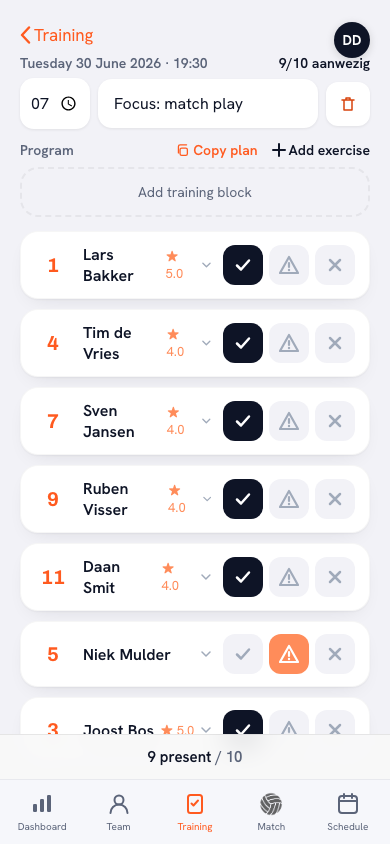
This is a situation you think through once and keep using all season. You can save a chaos-ball block, balls out of the net included, as a practice template in Koach and reuse it all season - so it is still there in March, and by then your team is picking up balls the opponent had already written off.
Who takes it? Make it an agreement
Most net balls do not drop because they were unreachable, but because three players are looking at each other. So agree in advance who goes:
- The player closest to the net who did not cause the ball goes for it - usually the hitter at position 4 or the middle.
- The setter stays away from the ball out of the net when it is the first or second contact, so they can play the next one.
- Whoever goes, calls. "Mine!" the moment the ball hits the net, not once it is already falling out.
- Everyone else backs up. A ball out of the net often comes soft and short - two players diving forward collide while nobody is covering the back.
What to do with the third ball
If the ball out of the net is your third contact, it has to go over. Choose deliberately: high and deep into a corner, not tight or hard. You are probably low and off balance, and a forced attack from that position almost always produces an error. Play the ball so your team has time to reset and organize for the counter-attack - the logic of playing out of system applies in full here.
Training: put them in the net on purpose
You only learn this situation by living through it a hundred times. Stand on the other side of the net yourself and throw balls deliberately into the net: high in the band, in the middle, low by the floor. Your players have to turn it into a playable ball that arrives high in the middle of their court. Then extend it into a full rally, so the save leads somewhere.
Make it a team rule as well that a ball in the net is never quietly given up. The simple fact that somebody goes after it is worth a few rallies a match that you would otherwise have handed over.
Frequently asked questions
Can you still play a ball that has been hit into the net?
Yes. As long as your team has not used its three contacts, the ball is simply in play. The ball touching the net does not count as a contact and is not a fault.
Where does a ball out of the net end up?
That depends on the height. High in the tight band the ball rebounds up to about a meter off the net; in the middle it drops almost straight down; low in the slack part it falls vertically close to the floor.
How should you stand for a ball out of the net?
Low, with your shoulders parallel to the net and your face toward the sideline. That way you play the ball up along the net instead of back into it, and you are not in the net when you have to go low.
Can you play the ball back under the net?
No. The ball has to cross the net between the antennas. Playing it under the net into the opponent's court is a fault, even though the ball itself is still in play.


