
New volleyball rules 2026: what has actually changed
Every four years a new FIVB rulebook appears, and every time the same thing happens: in the first weeks of the season you get whistles you weren't expecting, and nobody in the hall knows whether that is the rule or the referee. Most of the overviews you find online are a cycle out of date by then. This article is a changelog: what changed in the rule text, what stayed the same but is being judged differently, and what is still in the testing chamber right now.
Where the rules come from, and when they apply to you
The rulebook that forms the basis everywhere in the world is called the Official Volleyball Rules and is published by the FIVB, the international volleyball federation. The FIVB sets those rules per Olympic cycle. The previous edition ran from 2021 to 2024; the current edition is the Official Volleyball Rules 2025-2028, published at the start of 2025. That is immediately the answer to the question asked most often: there is no separate 2026 rulebook. Whatever feels new in 2026 comes from that 2025 edition.
Between the FIVB and your Saturday morning there is one more link: your own federation. National federations generally adopt the FIVB rules more or less one to one, but they decide themselves from when, and whether all divisions switch at the same time or only the highest. Competition matters that are not rules of the game either — the number of sets in your league, the youth format, additional agreements about the scoresheet — are also settled nationally. So always check the start date on your own federation's website before you teach your team anything new. The basic rules themselves, from three contacts to rotation, are set out unchanged in the complete volleyball rules overview.
Last checked on 26 August 2026, against the FIVB document listing the rule changes 2021-2024 → 2025-2028 and against the FIVB announcement of 27 February 2026 about the trial rules for the 2026 international season.
1. The serving team may stand where it likes (rule 7.4)
This is the change with the most practical consequences. The old text required both teams to be in the correct rotational order within their own court at the moment the ball was served. The new text splits that: the receiving team must still be in rotational order at the moment the server strikes the ball, but the players of the serving team may take up any position at that moment. Both teams must still be within their own court, the server excepted.
What that means: a serving team can no longer commit a positional fault. Your blockers stand at their blocking position straight away, your setter is already at position 2 and nobody has to make the familiar sprint the moment the ball is struck. What does not change is the serving order: whose turn it is to serve is still determined by the rotational order, and serving out of turn remains a fault — see the wrong server. The distinction between those two things is exactly what coaches mix up in the first few weeks. The rest of the positional rule is unchanged and is explained, with the rotational order alongside it, in the positional fault.
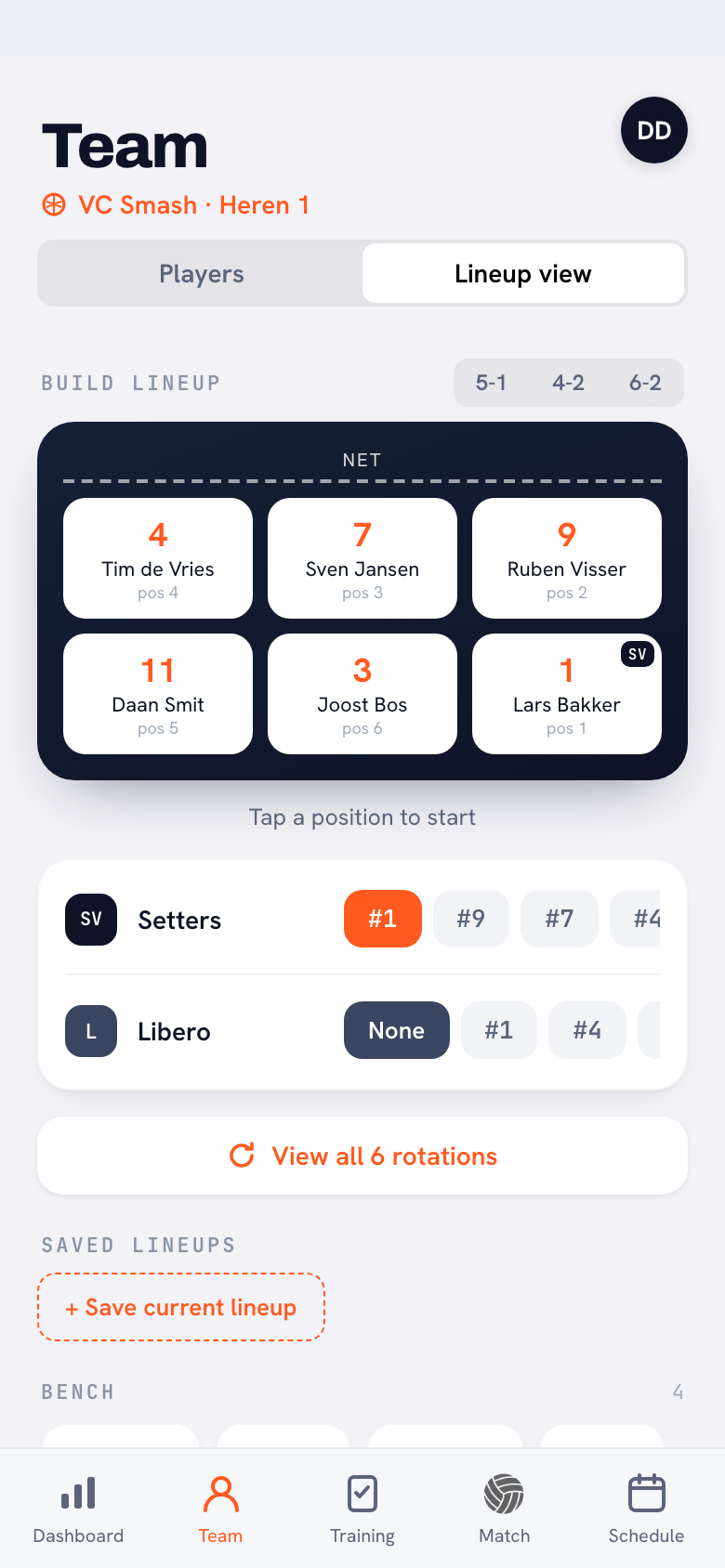
Practically: before the first match, walk through your six serving rotations once and put everyone where they should start rather than where the old rule forced them to stand. In the receiving rotations nothing changes — there the order stays binding, and a rotation check in Koach or on paper stays worthwhile to confirm your line-up is right.
2. Screening at the serve: hands down (rule 12.5.3)
Screening — a wall of players or raised arms that stops the passer seeing the ball until late — was always forbidden, but stayed hard to whistle: the referee had to judge whether the view of the ball was genuinely being taken away. The new edition therefore adds an objective criterion: no player of the serving team may raise their hands above their head during the serve until the ball has crossed the net. In addition, the first referee may warn a team through the game captain if they suspect deliberate screening.
This is the change you have to teach, because players do it unconsciously. A blocker who raises the hands early to be ready, a middle stretching while the serve is coming: that is now a fault. Three things to agree with your team:
- Hands below shoulder height until the ball has crossed the net. That is the moment the rule names — not the moment your own server strikes the ball.
- No two players in line in the path of the serve. Even without raised hands, collective screening stays forbidden.
- One fixed cue. Have your middle call "over" at the moment the ball crosses the net, so nobody has to guess for themselves when the hands may go up.
There is a tactical side too. Anyone serving with a target — at a weak passer, at the seam between two passers, at the hitter just coming off the court — may keep aiming there; only taking away the view is out. So the rule barely touches your serving tactics, but it does touch the line-up next to it.
3. Retrieving a ball outside the antenna is only possible after the first contact (rule 10.1.2)
The most spectacular rule in volleyball has been narrowed. Up to and including 2024 you could retrieve a ball that went outside the antenna into the opponent's free zone within your remaining contacts, whichever contact it was. Now that applies only to a ball coming from your team's first contact — so from the reception or the dig. If a ball from your second or third contact crosses outside the antenna to the other side, it is out the moment it passes the plane of the net. There is nothing left to save.
The second addition: if you are allowed to retrieve such a first ball but it does not come back through the same external space on the same side, it is now explicitly out. And the text now names the exception for a foot that stays on or above the centre line.
Because of this the officials' duties had to follow: the first referee, the second referee and the line judges now judge, alongside the serve and the third contact, the second contact as well when it goes over or outside the antenna. In practice you notice it in the tempo: on an overshot set the whistle comes straight away, where the hall used to wait a moment. The full rule around the crossing space and the external space is in the ball outside the antenna — keep this new restriction in mind while reading it.
For your training it means one thing: sprinting after an overshot pass is still worth it, sprinting after an overshot set is not. Say that explicitly, or players will keep chasing a ball that is already dead.
4. Three changes you only need to read once
- Reaching over the net after the attack hit (11.1.2). "During an attack hit" has become "After an attack hit". In practice nothing changes: the contact with the ball must take place in your own playing space and your hand may follow through afterwards. The text now simply says what referees were already doing — see reaching over the net.
- Prolonged contact above the net (9.1.2.3). On a simultaneous contact by two opponents above the net, play continues, including on prolonged contact. What is new is the addition that this also applies when the contact is completed above the opponent's court. That is the classic situation from the joust: play on, don't whistle.
- Designating a new libero (19.4). If your only libero goes off injured, the coach — or, if the coach is not there, the assistant coach or the game captain — designates another player. For the designation itself the assistant coach was already in the old text; what is new is that he is now also named as the person who may inform the second referee. All the remaining libero provisions are in the libero rules.
What did not change, but is being whistled differently
This is the part that causes most of the confusion, because you can get a different whistle on exactly the same action without a single word in the rulebook having been altered. The best-known example is the double contact on the second ball. The rule text on that has not changed in this cycle, but the judgement of a set played overhead has clearly become more lenient in recent years. The FIVB confirmed that in February 2026 by including in the trial rules for the international season that a double contact on the setting action remains allowed, as long as the ball stays on the same side of the court.
Two things follow from that. First: if your players are told that "the ref is suddenly whistling differently", that is often literally true — the rule is where it was, the interpretation shifts. Second: interpretation does not shift everywhere at the same speed. A referee who did their course this season may judge differently from someone who has been refereeing for twenty years with the picture from their own era. That is no reason to argue during the match, but it is a reason to teach your players that the second ball is looked at more strictly in one hall than in another.
So don't go to the referee with the rulebook. If you want to know something, use your game captain and ask one question between rallies — that is the only route the rules give you, and it is also the only one that gets you anywhere.
What is coming: the 2026 trial rules
On 27 February 2026 the FIVB board approved a series of trials for the 2026 international season. They are being tested in the Volleyball Nations League, the U17 World Championship and the continental championships — not in your club league. So they are not rules, but they are the best prediction of what may end up in a future edition. The most notable:
- Eight substitutions per set instead of six, and a team list of 12 to 14 players with at least one libero.
- The receiving team may move earlier: the rotational order is checked at the first referee's whistle, and leaving your position is allowed as soon as the serving motion begins — currently only at contact with the ball.
- Ball against the structure above the playing area: if that happens on the first or second contact and the ball stays playable on the same side, the rally continues.
- Stricter on the attack: attacking actions in which the ball changes direction, two-handed attacks, pushing, carrying and playing the ball off the block with an open hand would no longer be allowed.
- Less whistling: no whistle signal any more on clear in or out balls, serves that don't reach the net, and clear block touches after which the ball goes straight out.
- Coach and referee: the head coach may approach the first referee to have a decision or a challenge type explained.
- A separate 90-second serving warm-up, with each team getting its own time on court.
For you as a club coach the conclusion is short: change nothing for this. But if you see something on television in the spring that your rulebook says is impossible, you now know where it comes from.
What to do with this at your next practice
Twenty minutes is enough to bring your team up to date. Do it at the start of the season, not after the first argument in the hall.
- Reset the serving line-up. Six rotations, everyone at their end position. Takes ten minutes and immediately gives you a better organised block.
- Hands down at the serve. Serve three turns in which one player deliberately raises the hands, so the team sees the fault. Then five minutes with the agreement in place.
- One sentence about the antenna. "We run after an overshot pass, not after an overshot set." Nothing more is needed.
- Say what you don't know. Check with your own federation from when the rules apply in your division, and tell your team honestly that the second ball is judged differently from referee to referee.
For youth and mini volleyball teams, most of these changes are barely relevant anyway: in most mini volleyball formats there is no blocking and children play with their own simplified provisions — see the mini volleyball rules. The hands rule at the serve is immediately usable there, if only because children otherwise carry that habit with them for years.
Key point: there is no 2026 rulebook — there is one FIVB edition 2025-2028 with six real changes, of which exactly two touch your training: the serving team stands free, and the hands stay down until the serve is over the net. Everything else that feels "new" is interpretation shifting, and nobody wins an argument about that during a match.
Frequently asked questions
Are there new volleyball rules for 2026?
There is no separate rulebook for 2026. The edition in force is the FIVB's Official Volleyball Rules 2025-2028, published at the start of 2025, with six changes compared with the previous cycle. Whatever feels new in 2026 comes from that edition or from a shifting interpretation.
Can the serving team now stand anywhere on the court?
Yes. At the moment of the serve only the receiving team has to be in rotational order; the players of the serving team may take up any position, as long as they stay within their own court. The serving order itself does not change: serving out of turn remains a fault.
What is the new rule on screening at the serve?
No player of the serving team may raise their hands above their head during the serve until the ball has crossed the net. In addition, the first referee may warn a team through the game captain if deliberate screening is suspected. Collective screening also remains forbidden.
Can you still retrieve a ball outside the antenna?
Only if that ball comes from your team's first contact, so from the reception or the dig. A ball that crosses outside the antenna to the other side from the second or third contact is out as soon as it passes the plane of the net.
Do the FIVB rules apply immediately in my own league?
Not automatically. National federations generally adopt the FIVB rules more or less unchanged, but decide the start date themselves and whether all divisions switch at once. Check that on your own federation's website before you teach your team anything new.
When are the next rule changes due?
The FIVB sets the rulebook per Olympic cycle, so the next edition is expected after 2028. During 2026 a series of trials is running in international competitions, including eight substitutions per set and less whistling; those do not apply in club leagues.