
Volleyball 5-1 or 4-2: is your team ready to switch?
Every season a share of 4-2 teams switches to a 5-1, and a share of those quietly switches back halfway through. The difference is rarely in the system and almost always in the timing: the team wasn't ready, or the switch got three sessions instead of eight. This article isn't an explanation of the two systems but a decision guide — four tests you can work through in a few sessions and one friendly, and the plan for what comes after.
Not "what level", but "what can my team already do"
The question is nearly always framed as a level question: from which division or which age should you be playing a 5-1? That is the wrong way in, because there are teams playing high up the league who perform perfectly well with a 4-2, and youth teams running an excellent 5-1. What does count is four things you can measure: do you have one setter who can set through six rotations, do you have enough players who can carry the reception, does your pass reach the target zone often enough, and do you hold up in the rotations with two front-row attackers?
Below is a measuring protocol for each test that you can run in a few sessions and one friendly. How the systems themselves work — rotations, roles, pros and cons — is in the 5-1 system in detail and the 4-2 system in detail. Read those first if you are unsure about the basics; from here on this article assumes you know them. The broader choice between systems is in building your lineup.
Test 1: one setter who can set through six rotations
This is the heaviest test, and the only one you can't compensate for. Measure it like this: collect thirty second balls from your candidate setter across three sessions, spread over the six rotational positions — so five per position. Do it in a game format with a real serve, not off tossed balls. Give every set one of three ratings:
- Good: the attacker could swing full and had a choice of direction.
- Usable: an attack followed, but not at full power or in only one direction.
- Unusable: a high emergency ball, a set that goes over the net, or an error.
The test is passed if at least twenty of the thirty balls are good or usable, and no single rotation has more than two unusable ones. That second requirement is the whole point: five rotations running flawlessly and one collapsing still produces twenty-five usable balls — comfortably above the threshold of twenty, while in that one rotation you give points away in every single set.
Add one thing that needs no number: the run. In the three rotations where he starts in the back row, your candidate sprints to the net every time you receive — across a full match that runs into the dozens. A setter who is structurally late to the ball late in the match fails this test, however good his hands are. Where exactly he has to come from and how to shorten that distance is in positioning the setter.
Test 2: enough players who can carry the reception
The moment one player claims the second ball, he drops out of your reception in the three rotations where he is in the back row. So alongside your libero you need at least two players who can handle the serve in every rotation, and preferably three — that third name is your only margin on the evening one of them is ill or out of form. If you have only one besides your libero, you are passing with two players in every rotation, and that is exactly the gap an opponent serves at.
Measure it per candidate with twenty receptions against a real match serve, preferably in a friendly. The test is passed if that player concedes at most one ace in twenty balls and delivers at least twelve balls a setter can work with normally. If you only have two players who get through that — including your libero — you fail this test. That is no reason to abandon the idea, but it is a reason to adjust your reception formation first: with three passers and a tight division of responsibility you sometimes rescue what four passers can't manage.
Test 3: does your pass reach the target zone often enough?
A setter arriving on the run can repair less than a setter already standing at the net. So this test doesn't measure whether your pass is "good", but whether it arrives where a running setter can use it. Put down two cones marking a zone roughly three metres wide, from the middle to the right, one to two metres off the net. Then tally two sets of a friendly — that gives you roughly forty receptions.
Rule of thumb: 24 out of 40 or better and the test is passed. Between twenty and 24 it isn't passed, but it is within reach after a few weeks of targeted passing work. Stay under twenty and your setter will be setting on the move in more than half your rallies, and precisely the gain you are chasing with the switch disappears. Do expect to play out of a mediocre pass more often in the first weeks than you do now, and agree in advance what your setter does then: a high ball to the outside, or the second ball over the net himself.
Test 4: do you hold up with two front-row attackers?
This test isn't about your setter but about your attack. Play a practice game in which you reset the team to the same rotation after every point and always let the opponent serve: ten rallies per rotation, so ten times out of your own reception. Do that first for the three rotations where the setter is in the front row — thirty rallies — and then for the other three, another thirty. If that doesn't fit into one session, spread it over two. Note per block of thirty how many rallies you won.
The test is passed if you win at most five rallies fewer in the three rotations with the setter in the front row than in the other three. If the difference climbs to ten or more, you have no answer yet to a block that knows there are only two net attackers. Thirty rallies per block is not many, so read the outcome as a signal and not as a number: it is the direction that matters. In practice, passing this test almost always means you have at least one working back-row attack; how to build one is in the pipe. How to measure and read differences per rotation structurally is in finding your weakest rotation.
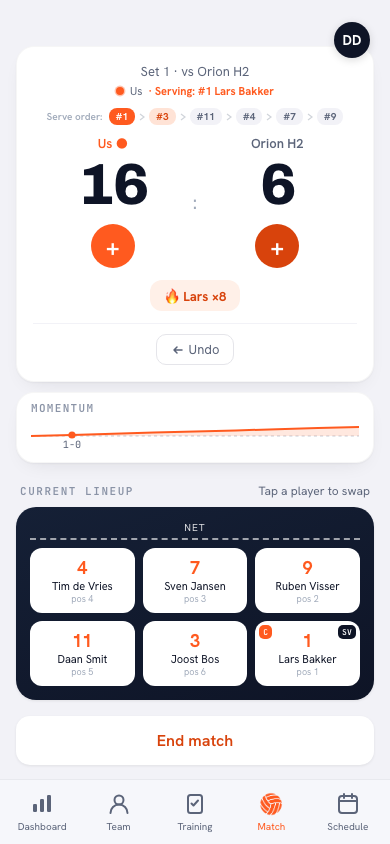
Anyone scoring live in Koach doesn't have to tally test 4 separately, because the score progression and the server are already recorded. Test 3 stays handwork: no app records where the pass lands.
Reading the result — and the middle way nobody mentions
Add up your four answers and act on them:
- All four passed: switch in pre-season and follow the plan below.
- Three passed, including test 1: switch, and make the failed test your training theme for the first two months.
- Two passed, including test 1: do the half switch below instead of the full one.
- Test 1 not passed: no switch, not even the half one — however many of the other three you pass. See the box.
- One test or none passed: stay where you are, train the failed tests and measure again in half a season. A 4-2 that runs delivers more points than a 5-1 that stutters.
That half switch is the option missing from most discussions. Instead of handing all six rotations to one setter at once, you let him take the three rotations where he is in the back row, and at the moment he would rotate to the front you bring in your second setter with a double substitution. You are then playing three rotations as a 5-1 and three as a 6-2: three net attackers everywhere, your first setter goes round only half the rotations, and your second setter from the 4-2 keeps a real role instead of a seat on the bench.
Two things come with that. Your second setter sets from the back row in those three rotations, and that is something different from what he did in the 4-2 — build that into his training time. And you pay the price in substitutions: there and back costs four, so under a rulebook allowing six per set you get one full cycle and keep two spare for the rest of the set. How many substitutions you have is in your federation's rulebook; the arithmetic is in the article on the double substitution.
There is a third route that costs little: play 5-1 in friendlies and cup matches for the first month, and 4-2 in the league. Your team learns the movement patterns under real pressure without a learning error costing points immediately. Deliberately book friendlies for that rather than hoping something turns up.
Key point: three of the four tests is the minimum for a full switch and two for the half one, but test 1 is a hard requirement in both cases. Fail that one and it isn't a switch but a gamble — you don't build a setter who can handle six rotations in eight sessions.
Six to eight sessions: the plan
The switch belongs in pre-season, and failing that in the winter break; changing over mid-season costs you exactly the weeks when you need points. Reckon on six to eight blocks of twenty to twenty-five minutes inside your normal sessions — not your whole session, because the rest of your game has to keep running alongside it. One of those blocks is a friendly. A workable order:
- Block 1 — walk it dry. The setter runs his three penetration routes to the net without a ball, and walks dry through the three rotations where he is already in the front row; the other five stand still in position. Aim: everyone sees where he comes from and therefore where he no longer is.
- Block 2 — covering the hole behind the setter. Name, per rotation, who takes over the departed setter's spot in defence. Play ten rallies per rotation in which the opponent deliberately attacks that zone.
- Block 3 — reception in the three heavy rotations. Only the rotations with the setter in the front row, with a real serve. This is where you find out whether test 2 was right.
- Block 4 — the second ball the setter can't reach. One fixed stand-in per rotation, called out loud. Have the coach deliberately serve balls at the setter himself.
- Block 5 — the back-row attack. At least one agreed ball per rotation with the setter in the front row, so the block can't guess for free.
- Block 6 — play the full rotation through. Game format with compulsory rotation, without stopping to correct. Note where it stutters; together with the friendly, that is your material for block 8.
- Block 7 — friendly. Against an opponent who actually serves. Tally your won reception rallies per rotation, as in test 4, but now without being able to steer the rotations yourself.
- Block 8 — repair. One theme out of block 6 and the friendly, not three.
If you only have six, merge blocks 1 and 2 and let block 5 be absorbed into block 6; the friendly and the repair after it are the two you never skip. Lock those blocks into your season plan as well, so they aren't the first thing to go on the evening four players drop out. If the switch falls in the winter, a winter break is usually your only unbroken window — how many sessions fit into it depends on your own competition calendar.
The first matches: what you will almost certainly see
Expect the first matches to go worse than your 4-2 went at its worst. That is not a sign the switch is failing; it is the bill for new movement patterns. How long that phase lasts differs per team, but the order in which the problems surface is a good deal more predictable:
- First: the hole behind the penetrating setter. The opponent tips or pokes into it within a set. Repair: one name per rotation, agreed beforehand and called out loud during the rally.
- Almost simultaneously: the ball that goes at the setter himself. He passes it, and then nobody plays the second ball. Repair: a fixed stand-in per rotation, and there is only one.
- As soon as the opponent works it out: the block reads the rotations with two attackers. Your attacking percentage drops visibly in exactly those three rotations. Repair: that one agreed back-row ball, at least twice a set, even when it doesn't score.
- Last: fatigue in your outside hitters. They hit extra balls in the rotations with two net attackers and pass more at the same time. Expect less return in the closing sets. Repair: targeted substitutions, and adjust your training load in that direction.
Meanwhile measure two numbers per match: your side-out percentage in the three rotations with the setter in the front row, and the number of unforced errors per set. Together those two tell you within five matches whether the trend is going the right way, even when the results don't say so yet.
Agree the fallback in advance
Coaches without a stopping criterion keep going out of pride until the season is over. So before the first league match, put two things on paper: when you measure, and what you do then. A workable agreement: after five league matches you lay the two numbers side by side. If your side-out in the three rotations with the setter in the front row is more than fifteen percentage points below the other three, and your error load per set has risen compared with last season, you take a step back.
A step back is not back to square one. First go to the half variant with the double substitution; if that doesn't work either, play the rest of the league in a 4-2 and pick the switch up again in pre-season with the failed test as your theme. Discuss this scenario beforehand with your setter, because he will otherwise experience a step back as a personal demotion. And discuss it with your second setter: he needs to know he hasn't become a reserve but is manning a plan B you hope not to need.
Finally: keep a record of which system you played in which match, so that at the end of the season you can still see when the turn came. Without that note the review becomes a conversation about feelings, and that is exactly what this decision should not be about.
Frequently asked questions
Can I switch from 4-2 to 5-1 halfway through the season?
Preferably not: the changeover costs six to eight sessions of movement patterns and agreements, and those weeks then fall in the middle of the league. If there is no alternative, do the half switch with a double substitution: your setter then goes round only half the rotations and you keep three net attackers in every rotation.
What if my best setter is also my best attacker?
Then a 5-1 costs you your most dangerous attacker in three rotations, because the setter plays the second ball there. Work out how many attacks that player makes per set now; if that is your biggest source of points, a 4-2 or an in-between form with the double substitution is almost always wiser.
Does my second setter have to go to the bench now?
No, and that is exactly why the half switch is so attractive: in it he stays a setter in three of the six rotations, although he sets from the back row there instead of at the net. If it does become a full 5-1, give him a second position he can play, otherwise you will lose him within half a season.
How long before a 5-1 pays off?
Reckon on a run of matches that go worse than your 4-2 at its worst; how long that run lasts depends on how often you train and play. So measure your side-out per rotation rather than looking at the results — that is where you see the trend turn before the table does.
Isn't a 6-2 a better intermediate step than a 5-1?
It can be, provided you have two setters who can penetrate from the back row and set — which is physically and tactically more demanding than what they did in a 4-2. If both setters are of equal quality, a 6-2 is a serious alternative; if one clearly stands out, the 5-1 is the logical route.