What Does a Middle Blocker Do in Volleyball? Six Moments
The middle blocker covers the most ground per set, jumps the most often and shows up least in the statistics. Break her role down moment by moment and you see why: most of what she does produces points for somebody else.
The role in brief
The middle blocker — middle, middle hitter, or just 'the middle' — plays at P3 when she is in the front row and is responsible for two things that look unrelated: your team's fastest attack and the centre of your block. She stands in the middle of the net and therefore has to be able to move both ways, rally after rally. Her role breaks down into six moments that repeat in the same order every rally.
The six moments
- The opponent's serve: she stays out of serve receive and takes room for her approach.
- Your own attack: she runs her approach for the quick — whether she gets the ball or not.
- The block: she reads the setter and moves to the attacking side.
- Transition: she lands, gets off the net and makes her approach again.
- Coverage: she covers her own hitter when the ball is blocked.
- The serve and the substitution: she serves from P1 and usually leaves the court for the libero straight afterwards.
Three of those six deserve explaining, because they are the ones that go wrong most often.
The approach that always comes
This is the most underrated part of the whole position. A middle who only makes her approach when she expects the ball is invisible to the opponent: their middle blocker can leave for the pin immediately and your outside hitter spends the whole match swinging at a double block. A middle who runs her approach every rally — including the forty times she does not get the ball — pins that blocker in the middle.
The return on that threat therefore does not appear under her own name. It appears in your outside hitter's attack percentage, which is exactly why middles sometimes feel undervalued. So say it out loud in the debrief. How the tempos differ from one another is in attack tempos: from high ball to quick.
The block: the busiest work on the court
On the opponent's attack the middle is the pivot. She starts centrally, reads the pass and the setter, and moves with side steps and a crossover to the left or right to close with the pin blocker. That is dozens of three-meter sprints per set, each followed by a jump — and immediately after that another approach for the counter-attack. No position is physically heavier.
Her job in that is not 'block everything' but to take away the angle the floor defense cannot cover. A block that consistently shuts one direction is worth more than a block that is vaguely near everything — provided your defense knows which direction that is.
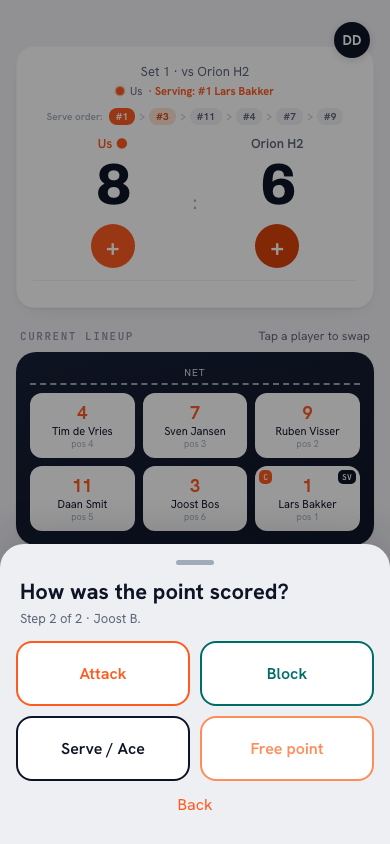
Block points are the most undervalued stat in volleyball, and Koach counts them per player, so your middle finally shows up in the match report too.
Transition: off the net
The third sticking point. After her block jump the middle lands right by the net, while her next approach needs room. A player who stays where she landed cannot approach any more and disappears from the offense. The rule is simple and has to be drilled in: land, two steps back immediately, and only then look for the ball. Teams that train this suddenly have a middle attack again in long rallies — exactly when the opponent is not expecting one.
Back row and serving
When the middle rotates to P1 she serves, and at most teams she leaves the court for the libero straight afterwards. That is defensible, but it has a price you should know: she barely serves, never passes and rarely defends. When that swap is and is not sensible is in why the middle leaves the court in the back row.
What to look for in a middle
- Footwork over height. A quick middle of 1.80 blocks more balls than a slow one of 1.95 who is always half a step late closing.
- Timing with the setter. The quick is an agreement between two people; it only grows through repetition with the same setter.
- Work rate without reward. Forty approaches a set for five balls — a player has to want that.
- Reading. See the setter, not the ball. That is learnable and it separates the good middle from the tall middle.
How to train her
Two drills cover eighty percent. The first: block left, land, move right, block, land, get off the net and make an approach — ten repetitions in a row, without a ball. That is exactly the rhythm of a real set. The second: setter and middle alone, a hundred quicks a week, always to the same point. The rest — coverage, serving, passing — you pick up in normal game formats, provided you do not automatically pull the middle out of them.
Count how often your middle runs her approach without a ball. Under thirty times a set she is not a threat, and their middle simply blocks your outside hitter as well. That number changes faster than her vertical does.
Frequently asked questions
What is a middle blocker's most important job?
Blocking. She stands in the centre of the net and has to close to both sides, which makes her the pivot of the blocking scheme in every rally. Her attack matters, but her block decides how many balls the rest of the team has to dig.
Why should the middle run her approach when she is not getting the ball?
Because the threat only exists as long as the opponent takes her seriously. A middle who skips her approach frees their middle blocker, who then arrives early at your outside hitter — with a double block as the result.
Does a middle blocker have to be tall?
It helps, but footwork and timing weigh more. A quick blocker who closes on time blocks consistently more balls than a tall player who is half a step short every rally.
How do I train the quick with a new middle?
Setter and middle apart from the group, lots of repetitions to one fixed point, without a block and without match pressure. Only once the ball lands in the same place ten times in a row do you add a blocker and then the game format.