
What Does the Off Blocker Do in Volleyball? Three Jobs
Next time you watch a club match, stop following the ball and watch the third front-row player instead — the one who is not blocking. Nine times out of ten she is standing at the net with her hands up, waiting for the rally to end. There are points lying there.
Who exactly is the off blocker?
On almost every opposing attack, two of your three front-row players block: the middle slides to the side the ball is going and joins the pin blocker. The third front-row player — on the other side of the net — does not block. That is the off blocker, sometimes called the free front-row player. If the opponent hits from their left side, your P2 and P3 block and your P4 is the off blocker; if the attack comes from their right, your P2 is the one who is free.
That player is not a spectator but a defender and the next attacker. She has three jobs in a single rally, and they come in a fixed order.
Job 1: get off the net
The first movement is the most important one, and it goes in exactly the opposite direction to what instinct suggests: away from the net. The guideline is two to three meters, roughly on or just behind the ten-foot line, low, with the hands in front of the body. Why? Because the ball that comes her way is almost never a hard spike, but a tip behind the block, a blocked ball rebounding back, or an attack deflecting off the block and spraying wide. All of those land in the zone she has just vacated — provided she actually left it.
An off blocker who stays glued to the net covers nothing and, on top of that, gets in the way of her own back-row defender. She also cannot play a single ball forward from there: everything arrives on her instead of in front of her.
Job 2: the tip and the deflected ball
Once she is off the net, she is responsible for a small but very busy patch of court: the zone diagonally behind the block, where tips and roll shots land. In most defensive systems that is explicitly her zone — not that of a back-row player standing ten meters away. Assign it out loud: one name on the tip on the block side, one name on the tip on the free side.
Her second piece of work is the ball that comes off the block. When the attack ricochets sideways off your blockers' hands, it very often drops on her side. A player who is low with the ball in front of her keeps those balls alive — and those are exactly the rallies that get the crowd on its feet.
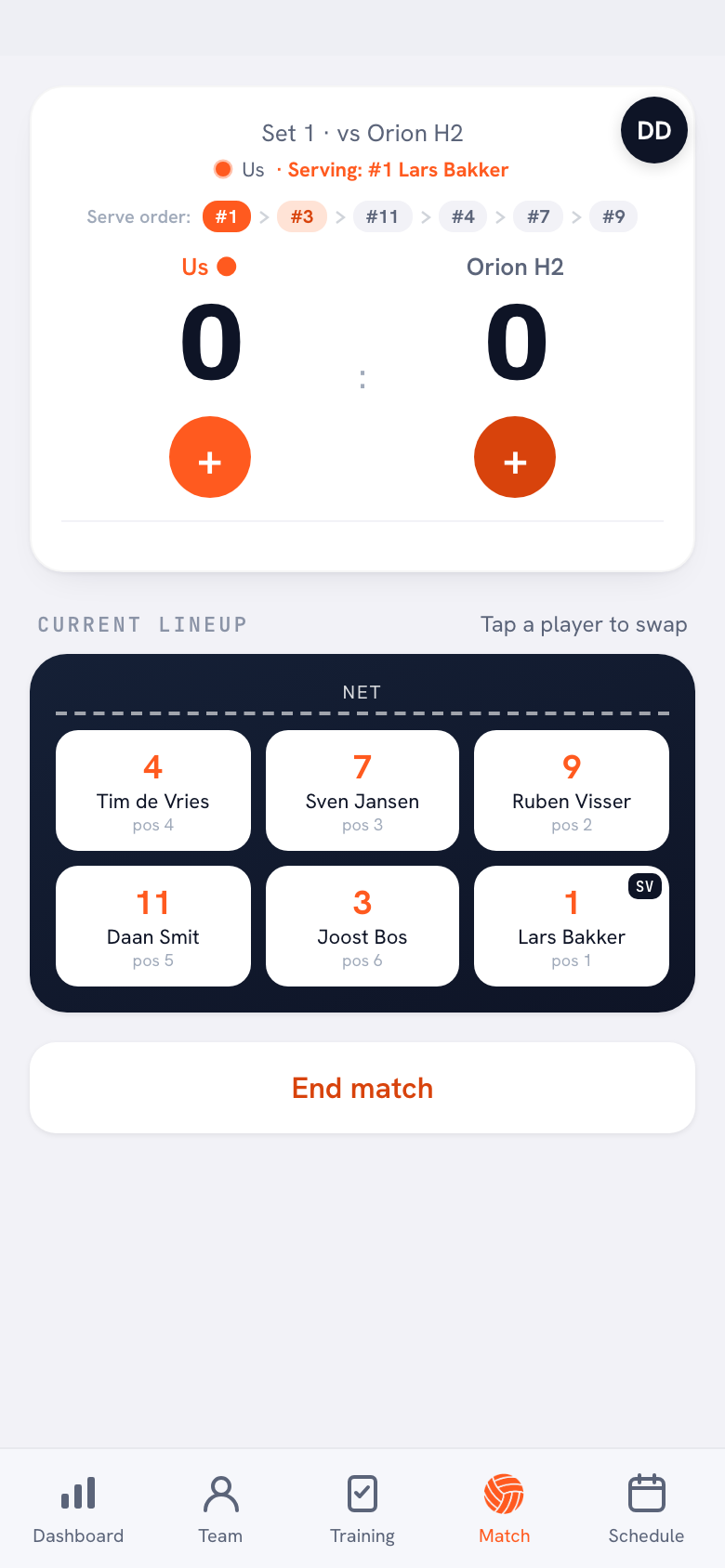
That last part is surprisingly easy to measure: attacks per player in Koach show whether your off blocker really comes back into the rally or keeps standing at the net — a player who barely gets any attacks in transition is nearly always leaving the net too late.
Job 3: the approach, and right now
The third job is the reason those first two meters matter so much. If your team digs the attack, the off blocker is the most logical counter-attacker: she is the only front-row player who does not have to land from a block jump first. But she needs room to approach — and that room is exactly the two or three meters she took in job one.
So the sequence is: release, defend whatever comes, and the instant your own defense sends the ball up, start the approach. Teams that train this visibly win more long rallies: the opponent expects a free ball after a dig and gets a real attack instead. That is out-of-system play at its best.
The four classic mistakes
- Standing there with the hands up. Jumping along 'just in case' never produces a block and always costs you a defender.
- Releasing too far. Five meters back is just as wrong: then the tip drops right behind the block with nobody near it. Two to three meters is the range from which you can still move forward.
- Watching the ball instead of the hitter. The opponent's arm and approach give away the tip far earlier than the ball does.
- Forgetting that the rally continues. Freezing after the dig is the costliest mistake: the counter-attack evaporates and the opponent gets a free second chance.
How to train it in ten minutes
Put three front-row players in, and have the coach attack from a box or platform, alternating hard-driven balls and tips. The rule: before the hitter contacts the ball, the off blocker must have both feet on or behind the ten-foot line, and after every dig she must make her approach — even when the ball does not go to her. Do not count points won; count the number of times the approach actually happened. Within three weeks that movement is automatic, and that is exactly the goal: the off blocker should not be thinking, she should be running.
Give the off blocker her own call. Have the blockers shout 'two!' as soon as it is clear who is blocking. That is the starting gun for the third front-row player to release — without a call she hesitates, and hesitation at the net always costs two meters.
Frequently asked questions
How far off the net should the off blocker be?
Two to three meters, roughly on or just behind the ten-foot line. Far enough to get the tip and the deflected ball in front of her, close enough to still be able to move forward.
Does the off blocker cover the tip, or is that a back-row player?
In most defensive systems the tip behind the block on her side is explicitly her job, because she is closest to it. More important than the system is that one name is on that ball in every rotation.
May the off blocker jump along if she is unsure?
Better not. A third blocker who arrives late rarely touches the ball and leaves a big hole behind her. Not blocking and defending well produces more points than half-blocking.