
When does the volleyball season start? The full calendar
Every spring the same question comes in, from new players, from parents and from coaches who have just started: when does the volleyball season actually begin? The annoying answer is that it isn't a date, it's a sequence. The first practice falls weeks before the first match, the league start is confirmed late, and the finish differs by division. Below is the whole calendar in order, including the places where your dates will differ from the standard.
The short answer: mid-September, with a run-up in August
At the vast majority of clubs the indoor league starts in the second half of September. The first practices come a few weeks before that, so somewhere in the second half of August. League play runs until April, and in the higher divisions into May, because play-offs or promotion and relegation matches are tacked on the end there. In between sits one fixed interruption: the winter break around the holidays.
That is the answer you fill a calendar with, but not the answer you can sail on blindly. Every federation sets its own match-day calendar, and within that calendar the start date differs by division, by region and by age group. The national divisions almost everywhere start earlier than the regional competitions, and at many federations the youth start later than the seniors. What you have to organise in each of those periods isn't here but in organising the volleyball season — this article is purely about the dates.
The seven dates that shape your team's calendar
- Team registration closes — at many federations in the spring, and sometimes even earlier.
- The pool draw appears — usually somewhere in August. Only now do you know who you are playing.
- The full match schedule goes online — shortly after the pool draw, so often late August or early September.
- The first practice — mid to late August. This is the only date on this list your club picks entirely for itself.
- The first league match — as a rule the second or third weekend of September.
- The winter break — from the last playing weekend before Christmas until the first or second weekend of January.
- The last playing weekend — April, running into May for teams still playing post-season.
Notice how lopsided that split is: six of the seven dates are set by your federation and one by you. That is exactly why summer feels so unsettled at so many clubs — you are planning the run-up while the matches you are working towards haven't been fixed yet.
Spring: forming teams and registering them
The real start of a volleyball season isn't in August but in the spring before it. Somewhere between March and June a club does three things back to back: decide which teams there will be next year, register those teams with the federation, and tell the players about it. The registration deadline is the hard date on that list. Miss it and you don't make the regular draw, after which you depend on whatever is still free.
For coaches and players that means something uncomfortable: team allocation is often locked in earlier than players expect. Anyone who signs off or signs up in August walks into a line-up that was submitted before the summer. At clubs that hold tryout sessions that moment comes even earlier — how you put a squad together is a separate story, but the calendar around it is simple: it happens before the summer holidays, not after.
The exact deadline differs by federation and sometimes even by region. You'll find that date in your own federation's club calendar, and usually the technical committee or the match secretary knows it by heart. Ask for it once and put it in your diary for next year.
August: first practices and friendlies
A few weeks before the first league match the hall opens again. With a league start in mid-September, at most clubs that works out as a first practice in the second half of August. Some clubs deliberately start later — not until September, with only a couple of practices as a run-up — because the hall rental doesn't begin until then, or because too many members are still away to get a decent group together.
In August the calendar changes almost weekly: players trickle back from holiday, the hall isn't always available yet, and the first friendlies are arranged between clubs rather than scheduled by the federation. That is why a team calendar is worth more in this month than in the whole rest of the year: every change hits everyone, and messages in a group chat disappear. You schedule friendlies yourself, and for most teams they land in the last two weeks of August and the first week of September.
September: the league start and the moment the schedule appears
At most federations the first league match falls on the second or third weekend of September. There is one catch in that which causes confusion every single year: the pool draw and the full schedule only appear shortly beforehand. Until that moment you know when you start, but not against whom or where. In regional competitions it is not unusual for the complete schedule to go online only just before the first playing day.
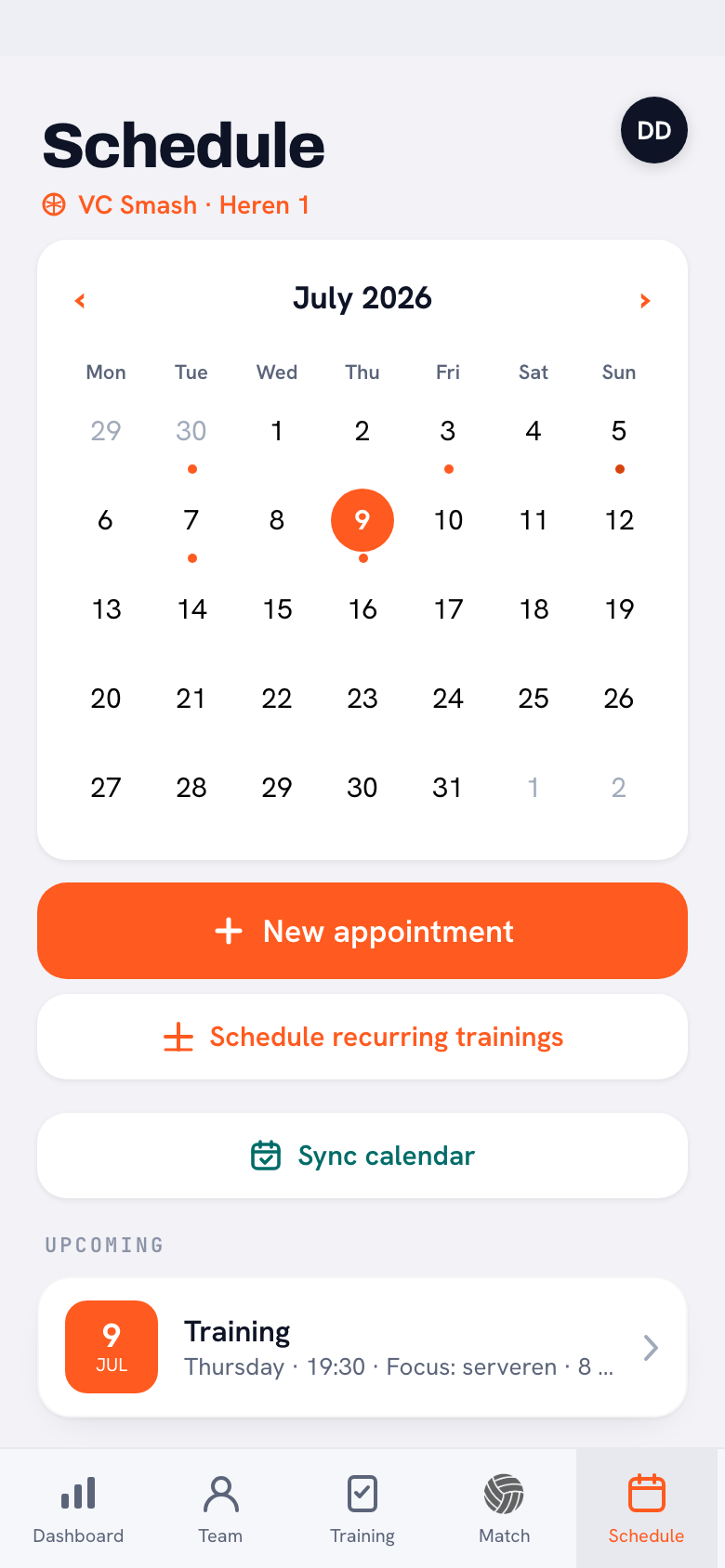
The moment that schedule lands, your whole season is fixed in one go: all playing dates, times, halls and home or away. That is the moment to move it into your own planning in one action instead of turning it into twenty separate entries — in Koach you import your pool's schedule in one go, and matches you had already entered yourself are recognised rather than added twice.
Count on things still moving in the first few weeks. Hall rental that isn't finalised, teams withdrawing after all and referee appointments changing produce a handful of rescheduled matches in September and October in virtually every competition. After those first weeks the schedule settles down at most federations.
Cup alongside league: a second calendar
Alongside the league, some teams play cup competitions. That is a separate calendar with its own logic: no fixed playing day every other week, but rounds scheduled across the season, often on weekday evenings or on weekends when the league is idle. At many federations the first round falls in the autumn, the later rounds in spring, and the finals weekend usually at the end of the season.
Two things worth knowing. First, entering the cup is often a club decision taken at registration in the spring, not something you arrange in October. Second, the cup calendar sits apart from your league schedule: at most federations it is its own pool or its own bracket with its own standings, which you have to fetch separately. Import only the league pool and you miss your cup matches — and you usually find that out on the day itself.
December and January: the winter break
Every indoor league has one built-in interruption around the holidays. In practice the last playing weekend falls just before Christmas and the first one after it in the second week of January, which comes down to two to three weeks without matches. At some federations that gap is longer, because an extra weekend without a schedule is slotted in right before or after.
What most teams underestimate: the practice break is usually shorter than the match break. Many halls only close the days between Christmas and New Year, so two practice evenings. Some clubs deliberately take a longer break, others keep training. That is a club decision, not a federation date — check your own club's hall calendar for which evenings really drop out. How to use those weeks well is in making the most of the winter break.
In the youth game a second interruption sometimes runs through it: a February half-term that varies by region, and which federations often build into the youth schedule but not into the senior one.
April or May: where the season ends — and the summer after
At most federations the regular schedule is finished in April. After that the calendar splits. Teams that won their pool or finished at the bottom play promotion, relegation or play-off matches in April or May. Teams that finish mid-table are done after their last playing day and suddenly have an empty calendar while the hall is still rented.
The indoor period itself often runs a few weeks past the last match weekend: many clubs rent until late May or mid-June, covering the final practices, a team evening, the club tournament and possibly the first taster sessions for next season. And then comes summer: from June through August indoor league play stops and volleyball moves outdoors. Beach tournaments run roughly from May through August, and summer grass tournaments with six against six sit in the same window. That isn't a replacement but a different sport, with its own court, its own scoring and its own rules.
For your admin, that ending is the practical tipping point. If your season in the app runs through April, an empty statistic appears in May while you are still training; if it runs through June, everything falls neatly inside it. How to set that boundary and archive the old season is in setting up a new season.
Why your dates differ from this calendar
Everything above is the average pattern. Four things push your calendar away from it, and it pays to know which:
- Your federation. Every country sets its own match-day calendar, through the national or regional federation you play under. Whatever is on that calendar always outranks any overview, this one included.
- The division. National and top divisions usually start earlier than regional competitions and play on longer, because post-season play is added at the end.
- The age group. Youth competitions often start later, sometimes run in half-year blocks with pools redrawn after the winter break, and follow the school holidays more closely than the senior league does.
- The region. Within one federation, regions can run their own opening weekend and their own holiday arrangements, certainly in the lower divisions and in recreational leagues.
So the practical rule is short: use this overview to plan your summer, and check the hard dates in your own federation's calendar as soon as it appears. In the end only one document governs your team, and that is your pool's schedule.
Key point: the question "when does the volleyball season start" has two answers six weeks apart. For players it starts with the first practice in August; for the league it starts with the first playing weekend in September. Always communicate those two separately, or half the group turns up in the hall on the wrong date.
Frequently asked questions
When exactly does the volleyball season start?
At most federations the indoor league starts in the second half of September, usually on the second or third weekend. The exact date differs by country, by region and by division: national divisions generally start earlier than regional competitions, and the youth often a little later. Your own federation's calendar is what counts.
When do volleyball practices start again after the summer?
At most clubs mid to late August, a few weeks before the first league match. That is a club decision rather than a federation date, so it differs from club to club — often it depends on when the hall rental begins. Ask your club instead of deducing it from the league start.
When is the winter break in volleyball?
The league is idle from the last playing weekend before Christmas until the first or second weekend of January, so two to three weeks. The practice break is usually shorter: many halls only close between Christmas and New Year. Whether your club keeps training is a club decision.
When does the volleyball season end?
At most federations the regular schedule ends in April. Teams still playing promotion, relegation or play-off matches carry on into May. At many clubs the hall rental and the final practices run on until late May or mid-June.
When do I find out which pool my team is in?
Usually somewhere in August, with the full match schedule following shortly after. In regional competitions it is not unusual for the schedule to be complete only just before the first playing day. Until then you can only fix practices and friendlies.
Can I still take up volleyball halfway through the season?
Joining practices is possible at virtually any club all year round. Playing league matches depends on your eligibility and your federation's transfer rules, which generally have a cut-off date somewhere during the season. Check with your club's match secretary, because this differs by federation.