Why Do Middle Blockers Get Subbed Out in the Back Row?
You see the same little scene in almost every match: the middle blocker rotates to the back row and walks straight off, the libero steps in. It happens so automatically that hardly anyone still knows why. Or whether it is the best call for your team.
What actually happens
The libero may replace back-row players an unlimited number of times, outside the normal six substitutions per set. Most teams use that right for one fixed pattern: as soon as a middle blocker rotates from P2 (right front) to P1 (right back) and therefore becomes a back-row player, she leaves the court and the libero comes on in her place. Three rotations later, when that same spot rotates to P4 (left front), the middle steps back on and the libero goes off.
In a team with two middles opposite each other, that means one middle is always in the front row and the libero is permanently on court, just for a different player each time. One detail gets forgotten a lot: the libero may not serve. If your middle rotates to P1 while your team holds serve, the middle serves her own turn first; only when the serve is lost does the libero come in. Get that wrong and you concede an illegal libero replacement.
Why almost every team does it this way
- Defense. The libero is by definition your best passer and defender. Replacing your weakest passer with your best one for three rotations is the cheapest quality upgrade in the sport.
- The middle is usually the weakest back-row player. Tall players trained for blocking and quick attacks are rarely the quickest diggers — simply because they get the least practice at it.
- Recovery. Blocking is the heaviest job on the court: moving along the net and jumping, rally after rally. Three rotations on the bench are three rotations of recovery for the legs you need again next rotation.
That is a strong list, and at performance level the discussion is closed. At club and junior level it is more nuanced.
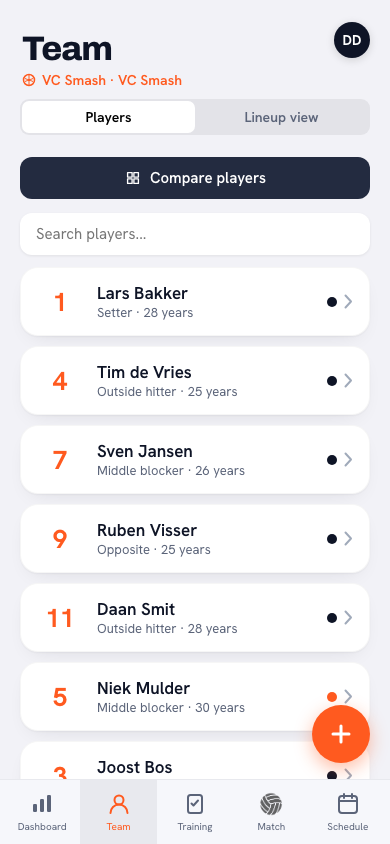
That swap quietly costs your middle playing time, which you can check in Koach's playing-time overview well before a parent asks about it.
What the swap quietly costs
Do the maths. Of the six rotations, your middle is on court for three and off for three. Over a full set that is roughly half the playing time, and over a season it is dozens of hours. That on its own is defensible — but there is more.
Your middle barely serves. She arrives at P1, serves that one turn and disappears; in practice she serves once or twice per set, against four or five times for an outside hitter. So she never learns to serve under pressure. She rarely passes and rarely defends, so her secondary skills do not grow. And with a junior who may not end up as a middle at all — a growth spurt at fifteen decides a lot — you have developed half a volleyball player. It is worth dividing playing time deliberately instead of letting the default substitution decide it for you.
When you are better off not doing it
- With juniors. Under sixteen, development matters more than the third ball of a set. Let middles play the back row, at least in some of your matches.
- When your middle is a good server. A player with a jump serve that produces two points a turn does not come off for the sake of half a dig. Let her finish her serving turn.
- When your libero is not genuinely better. A libero who 'is the libero because she is short' adds nothing. Compare the passing numbers of both players honestly before you make the swap law.
- With a thin bench. If you are playing with eight players, every minute of court experience is worth more than tactical optimisation.
A middle ground that works well
You do not have to choose between 'always' and 'never'. Three workable in-between options. Swap only in the rotations where your middle would be at P5 — the zone that draws the most deep serves — and leave her on at P6 and P1. Or swap only in decisive sets and let the middle play the back row in the first set. Or do it per player: your experienced middle stays on, your young middle gets swapped out so she stays fresh for blocking. Whatever you choose, agree it in advance and write it down, because a libero replacement invented rally by rally is guaranteed to produce a substitution fault.
Ask your middle what she actually wants. A surprising number of middle blockers regret never passing and rarely serving, but say nothing because 'that is just how it works'. One conversation can hand you a motivated extra server.
Frequently asked questions
Why is it the middle blocker who gets replaced by the libero?
Because the middle is usually the team's weakest passer and defender while also carrying the heaviest job at the net. Replacing her in the back row therefore buys you defensive quality and recovery at the same time.
Can the libero stay on when the middle has to serve?
No, the libero may not serve. If your middle rotates to position 1 while your team is serving, the middle serves herself and the libero only comes on after the serve is lost.
Does that swap use up one of my six substitutions per set?
No. Libero replacements are entirely separate from the six regular substitutions and are unlimited, as long as a completed rally sits between two replacements.
Is it wise to swap junior middles as well?
Usually not. Young players who never pass, dig or serve develop one-sidedly — and with juniors you have no idea yet whether they will stay middles at all.