
Youth coordinator duties: eight teams you never see
You are responsible for eight teams. You see two of them with any regularity, and you hear about the rest only when a parent emails or when three players quit at the same time at the end of the season. The reflex is to walk around more. That doesn't work, because the arithmetic doesn't add up — and it isn't necessary either.
The arithmetic that defines your role
Eight teams that each train twice a week for ninety minutes add up to sixteen sessions a week, twenty-four hours in total. Across a season of some thirty-four weeks that is well over eight hundred training hours in your section. Sit in on one session a week — already a lot for a volunteer with a job — and you are beside the court for around fifty of those eight hundred. Just over six percent. Matches only help so much: they tend to fall in the same part of the day, sometimes simultaneously.
One conclusion follows from that: walking around is not a method. You will never see the vast majority of what happens in your section with your own eyes. Your job is therefore not supervision but organising signals — making sure information reaches you without you having been there, and knowing which information matters.
That is immediately the difference with the question of who decides what. That split — entering teams, assigning coaches, selecting squads, evaluating — is covered in who decides what at your club. This article is about the weeks in between, when nobody decides anything and things still go wrong.
Complaints are a poor alarm system. By the time a parent calls or a coach resigns, the problem has usually been running for weeks. Three signals tip earlier, and you can read all three without setting foot in the hall. Walk through them monthly, in this order.
Signal 1: training attendance is dropping
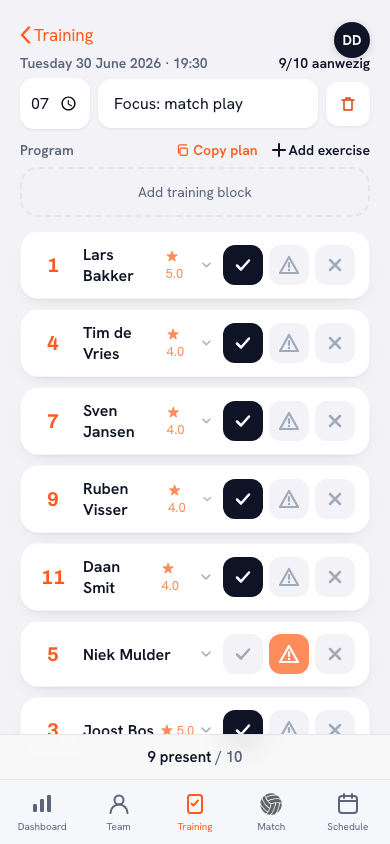
Look per team per four-week block, never week by week — one flu wave or one school trip makes a weekly figure worthless. Two things count. The level: for a youth team, put the line at around seventy-five percent attendance — if a team drops structurally below that, it is a signal. And the direction: two blocks lower in a row matters more than one low block. A team of twelve going from ninety to eighty to seventy percent will, at that rate, have six players at practice in eight weeks' time, and then the coach starts running drills he never planned.
One refinement makes this figure far more usable: also count how many players missed at least twice in those four weeks. In a squad of twelve, three such players is simply life; six means the training evening has lost its self-evidence, even if the average still looks reasonable. That distinction determines what you ask: with three names the conversation is about those three, with six names it is about the session itself. What a coach can do about it is in improving training attendance — that is his job, not yours.
Signal 2: playing time concentrates on four players
This is the signal that is easiest to miss, because a team that wins looks healthy from the outside. Work it out monthly across the last five matches. Five matches averaging four sets each, with six players on court, produce one hundred and twenty player-sets — if you play a different match format, use your own set count. In a squad of twelve, an even split is therefore ten sets per player. Look at two thresholds: do the four most-used players together have more than half of those one hundred and twenty, and are the bottom four together under ten percent? Two yesses mean a third of that team is effectively not playing.
Why this comes before the complaint: players who play little say nothing about it for months. They skip a practice, then two, and quit towards the end of the season — and it looks like a sudden exodus. The number was there months earlier. Raise it as a question and not as an accusation, because there are good explanations: injuries, a squad of ten, a run of fixtures against the top teams. Recording it in the first place is covered in tracking playing time, and how a coach handles it sensibly in dividing playing time fairly; your job is to put it on the table before player eleven's mother does.
Signal 3: the coach who stops asking
Keep one line per coach, with one question a month: has this coach asked me, told me or sent me anything this month? Yes or no, nothing more. That list takes two minutes and is the only signal you have to build yourself. A coach who called three times in the opening months about balls, hall slots and a difficult player, and then nothing for two months, need not have become more independent. More often he has checked out, or he has decided that asking gets him nowhere.
Note the nuance: some coaches structurally ask for nothing and run excellent sessions. So it isn't about the level but about the change. Two empty months in a row from someone who used to seek contact: that is the team you visit first — ahead of the team with the worst numbers. Numbers can wait; a coach who walks away has to be replaced in mid-season, and that is the worst possible moment.
You don't have to scrape the numbers together yourself: attendance and playing time per team are already there as soon as your coaches record them, and in Koach the club report puts them side by side — see managing several teams as a coach. Collecting them is not the work. The conversation afterwards is.
The monthly rhythm: two hours a month
A coordinator who works on instinct does a lot at the start of the season and nothing in midwinter — exactly the opposite of when it is needed. Put a fixed rhythm on it: four moments a month, two hours in total.
- Week one — twenty minutes of numbers. Attendance per team over the last block, the playing-time split across the last five matches, and your yes/no contact list. Write down per team: green, amber or red. You don't need more nuance than that.
- Week two — one hall visit of an hour. To the team with the reddest signal, not the team where you feel at home. Announced, and with one viewing point named beforehand.
- Week three — two ten-minute phone calls. With coaches you didn't visit. Rotate them: together with the monthly hall visit that is nine contact moments a quarter, just enough to speak to all eight of your coaches once without anything being wrong.
- Week four — twenty minutes of writing. One line per team in a logbook: what you saw, what was agreed, when you look again. Plus the one or two points that need to go to the committee or the board.
That logbook is not bureaucracy but your memory. At the end of the season somebody asks why that one team changed coach halfway through, and eight lines — one per month — are then the difference between a decision and a row. It is also the only thing your successor can genuinely use.
The question you approach a coach with
The hardest part of this role is that you have to raise something with someone that you didn't see yourself. Two openings rarely work. "How's it going?" produces "fine" almost every time. And "why has your attendance dropped?" is an accusation with a question mark after it; everyone defends against that, including people who did nothing wrong.
What does work is a sentence with three parts: an observation without judgement, a question that acknowledges he knows more than you, and an offer:
"I can see that over the last four weeks an average of eight out of twelve were at practice; the block before that it was ten. I don't know whether that means anything — you see them every week. Does that match what you see, and is there anything I can arrange for you?"
The difference sits in that middle part: you position the coach as the person with the most knowledge, and that is exactly what he is. Close every conversation with the same question: "What do you need from me in the coming month, and when does it have to be there?" If nothing comes out of it, fine. If something does, that is an agreement with a date, and it goes in your logbook.
Three rules keep such a conversation clean. One: you announce a visit in advance. Turning up unannounced is an inspection, turning up announced is interest. Two: you never use information whose source you won't name. No "I hear things" — either you say who said it, or you don't use it. Three: you pass on a parent's complaint in the same form: "A parent came to me about her daughter's playing time. I said I would speak to you first. This is what she said, and I want to know how you see it." How to handle those parents without taking sides is in parents on the sideline.
The line between coordinating and taking over
Every coordinator who has coached knows the temptation: you see something that could be better and you say it to the player. From that moment on, that team has two bosses. So there are five things you don't do, however well meant:
- You don't correct a player during somebody else's practice. If you see something, you say it to the coach afterwards — one thing, not a list of eight.
- You don't discuss the lineup with players or parents. Not even when you disagree with it. You have that discussion with the coach or not at all.
- You never side with a parent against a coach before you have spoken to that coach. Do it once and the rest of your coaches will hear about it, and you have lost exactly the trust you need.
- You don't take over a session "just this once". Covering for illness is fine; covering twice a month means you are hiding the vacancy instead of solving it.
- You promise nothing about next season's squads. Not to a player, not to a parent, not to a coach — that is a decision with a fixed order and several people in it.
The test of whether you are on the right side of that line is one question: would anything change about how that team trains if you stopped tomorrow? If nothing changes, you have coordinated. If everything changes, your departure has become that team's problem.
Youth coordinator, team manager or committee member?
These three roles blur in practice, usually because one person does two of them. The dividing line is easy to draw. The team manager works for one team and arranges everything around the volleyball: schedule, lift rota, forms, kit. The youth coordinator works across teams and owns the sporting line: coaches, progression, level, and whether a team is coping. A committee member has a say in decisions about teams, divisions and squads — a vote in a decision, not a weekly task.
Turn that split into a three-sentence routing rule and share it once with all parents and coaches. Transport, times, kit and money go to the team manager. Playing, training and behaviour within the team go to the coach. Anything that crosses teams — squads, progression, level, or a complaint about a coach — goes to the coordinator. Without that rule everything lands with you, and within two months you are your section's complaints desk instead of your coaches' support.
Where you really do own the job
Three tasks can't be passed on. The first is supporting new coaches. Recruiting them is a separate craft — recruiting coaches is the starting point for that — but what comes afterwards is yours, and it is four contact moments. Before the first session: what is this team, what does the club expect, who do you call if something comes up. After week three: ten minutes on the phone with one question, what was disappointing? Around week six: an announced hall visit with one agreed viewing point. Around week twelve: twenty minutes with the question of whether this is continuing until the summer. Deliberately put that fourth moment after the first losing run, because that is where the decision sits that you want to see coming.
The second is moving players between levels during the season. A player joining a higher team's sessions sounds like a small gesture and isn't. Arrange three things before that first session: how many weeks it runs and when you review it, whether the regulations allow it — whether a player may play in two teams or switch mid-season differs by federation, so look it up once in your own rulebook — and who tells the original team's coach. That last one is you, before the player does it himself. How to back up such a recommendation is in backing up a progression recommendation.
The third is what you deliver to the board each year. Boards can do nothing with "things aren't going well in the youth section", but plenty with numbers and a question. One page, three lines per age group — the number of members and the difference with last year, the number of coaches and how many of them have confirmed in writing that they are continuing, and the average training attendance per team — with at most two questions underneath, each with a cost attached, such as budget for two course places. A page like that gets read; a six-page policy document usually gets pushed to the next meeting. Deliver it before the teams are entered for the new season, not after.
Key point: you hear about a problem as soon as somebody complains, and by then it is usually too late. The three signals you walk through monthly — attendance per team, the playing-time split, and who sought contact with you — tip weeks earlier. They cost twenty minutes and they are the only part of your role that doesn't depend on whether you happened to be in the hall.
Frequently asked questions
How many teams can one youth coordinator handle?
Don't count in teams but in coaches. The fixed monthly rhythm costs two hours regardless of the number of teams; what scales with size is the contact outside it — reckon on about a quarter of an hour per coach per month. With eight coaches that comes to roughly four hours a month. Above that, split by age line with a fixed check-in, because beyond ten teams you lose sight of who you haven't spoken to for two months.
Does a youth coordinator need to have been a coach?
It helps in the conversations, but it isn't a requirement and it is also the biggest risk. People who have coached cross the line most easily and start coaching in somebody else's hall. More important than volleyball knowledge is being able to raise something you didn't see yourself, without it feeling like an inspection.
What if a coach experiences my visit as an inspection?
Announce the visit in advance, name one thing you are coming to look at, and stick to it. Don't follow up with a list of improvement points but with one observation and one question. And visit the teams where nothing is wrong too, because a coordinator who only turns up when there are problems makes every visit a verdict.
Who calls the parent back: the coordinator or the coach?
If it is about playing, training or behaviour within the team, the coach. If it is about squads, progression, level or about the coach himself, the coordinator. What you never do is side with a parent before you have spoken to the coach — agree that you will call back within a set period and then do exactly that.
What is the difference between a youth coordinator and a team manager?
The team manager works for one team and handles the organisation: schedule, transport, forms and equipment. The youth coordinator works across teams and owns the sporting line: supporting coaches, progression, level and squad advice. The roles only clash when nobody has written down which question goes where.
Can I step in with a team that loses everything?
Losing on its own is not a reason to intervene; a badly built squad or a coach who is stuck is. So look at the three signals rather than at the table, and talk to the coach about what he needs. Only really step in when safety or behaviour is involved, and then together with the technical committee or the board.