
“A pass rated zero is a point for the opponent. The app had to know that by itself”
Koach founder Dennis Boekhout on ratings from 0 to 5 during the match: why a 0 or a 5 scores the point by itself, why that lives in Expert, and what you see per player afterwards.
A pass that cannot be played ends the rally. Since October Koach knows that too: a 0 on the pass now scores the point for the opponent by itself. A club asked for it by email, and Dennis Boekhout first thought it already worked that way.
He explains how ratings and points have been tied together since then, why that lives in Expert mode and not in Simple, what the coach has seen per player per match since version 3.1, and why the phone now gives a short buzz on a point.
What did that club ask?
“Whether a pass rated 0 could count as the opponent’s point straight away. And the same the other way round: a serve rated 5 is an ace, a serve rated 0 is a serve error. The moment you give that rating, you actually already know who has the point.
“My first reaction was: surely it does that already? Well, no.”
You thought it already worked that way. So what did the app do?
“Only the reverse route. If you tapped the Ace shortcut, the server got a 5 automatically. If you tapped Serve error, a 0. That worked fine. But if you gave the rating yourself first, it stayed a rating, and you still had to tap the point in separately.
“And you forget that. You give the pass a 0, you look back at the court, the next serve is coming. Then you have a rating without a point, and a score that no longer matches what actually happened.”
How does it work now?
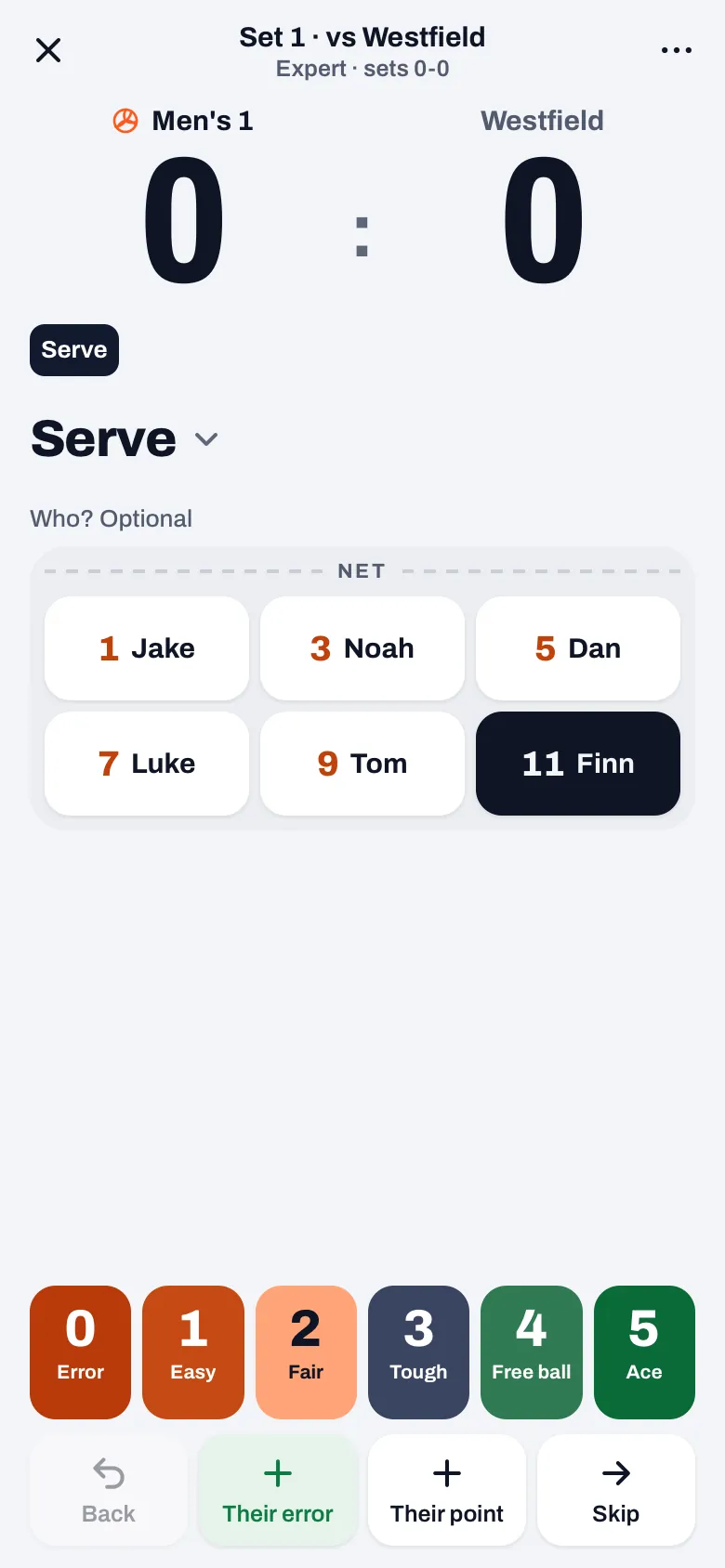
“A 0 on the pass now scores the point for the opponent by itself, as a bad pass by whoever received. A 5 on the serve is an ace, a 0 a serve error. Rating and point are one tap.
“These days you give those ratings in Expert, and there it goes even further: every 0 is a point for the opponent, and a 5 on the serve, the attack or the block is a point for you. Everything in between simply keeps the rally going.”
Why should a rating be able to score a point by itself?
“Because some ratings end the rally. A pass that cannot be played is a point for the opponent, whatever else you think of it. If you have to tell the app that in two taps, you are asking the coach to say the same thing twice.
“It also keeps your ratings honest. If it is one tap, the point that was scored and the rating that was given can no longer drift apart.”
And if you tap the wrong thing?
“Then you undo it once, and point and rating disappear together. That was the condition. An automatic rating that stays behind when you take the point back is an orphan in your stats: a 5 for an ace that never happened.
“And there is a brake on it. If you tap another 0 or 5 within two and a half seconds of a point being scored, the app does not score a second point. You get the message ‘A point was just recorded. Another point? Tap again.’ If it really was a new rally, you tap once more and then it does count.”
Why is this in Expert and not in Simple?
“Because in Simple you do not give ratings. There you tap who won the point and how, or why the opponent scored: an attack error, a bad pass, a serve error. Expert is for anyone who also wants to rate every rally, with six buttons from 0 to 5.
“That split was my own choice, in October, separate from that email. Simple has stayed what it was. Expert asks more of you per rally, and that is why it is one question per screen: the first version put too much on one screen at once. At the start you choose Simple or Expert, and during the match you can still switch.”
Did that split work properly straight away?
“Not entirely. On an ace or a serve error, Simple still created an automatic rating in the background, so that undo could take it along. Only those ratings then counted as assessments in the overview. So after a match in Simple there was a Serve block with nothing but fives and zeros, while nobody had given a rating.
“I only noticed when I played a match all the way through in Simple and then looked at the overview. Since 17 October those automatic ratings only count in Expert.”
Why 0 to 5, and no longer 0 to 3?
“Until 12 October you could only rate the pass, from 0 to 3. Then defence and serve were added, and later in Expert the set, the attack and the block as well. Six steps give you more distinction than four, and every step now has a name.
“For the pass, each button says what the rating means: error, back over, 1 option, no quick, good, perfect. And the app converts old matches rated 0 to 3 in your season figures, so the two scales do not quietly get mixed up.”
What do you see per player afterwards?
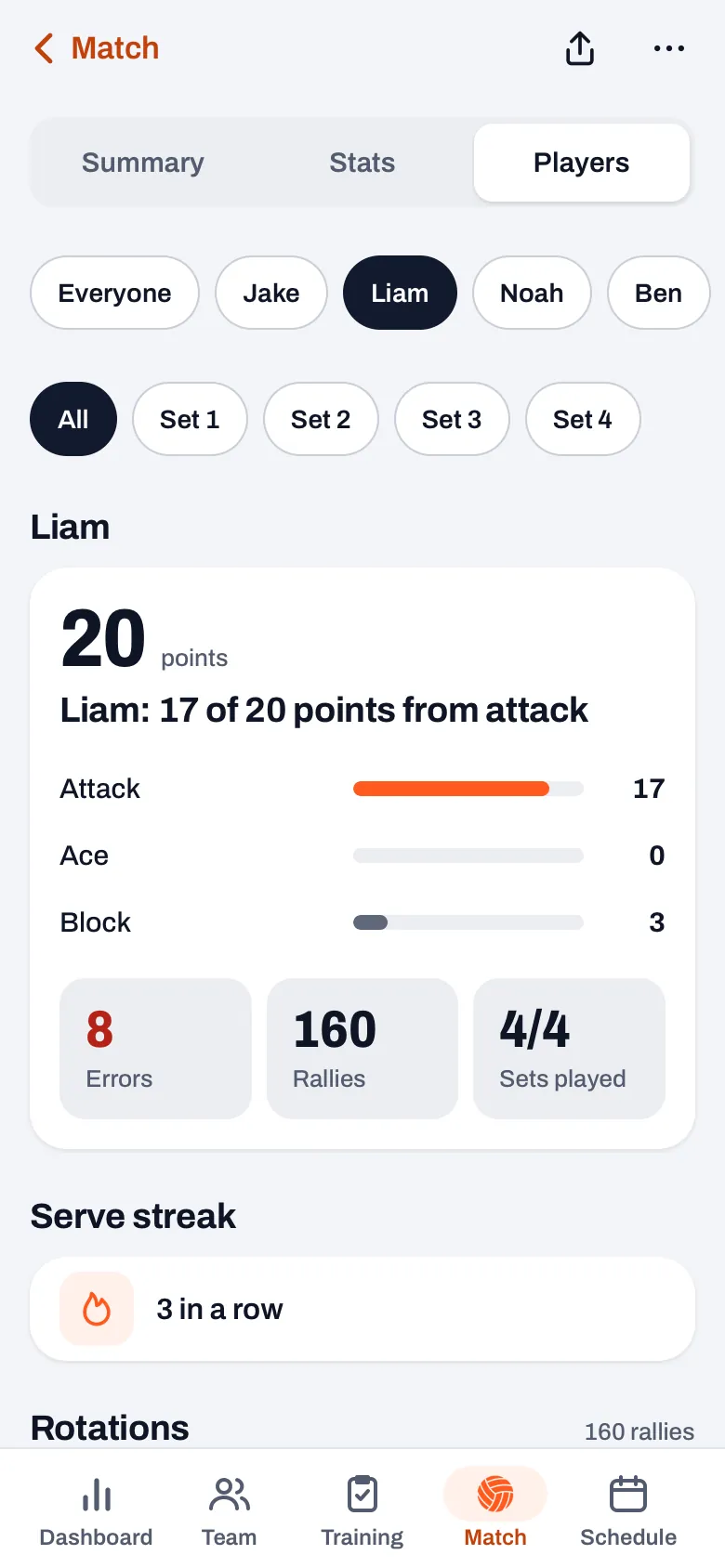
“Since version 3.1 you can pick one player under Players in a match that has been played. Then you see only their numbers from that match: points, ratings, their serve streak, the rotations, plus and minus, and all of that per set too.
“That is for the conversation after the match. A season average tells you something about a player, but if you want to talk about Saturday, you need Saturday. A player could already see that overview of themselves. Now the coach sees it for everyone.”
The phone now vibrates on a point. Why?
“Because during a rally you are not looking at your screen, you are looking at the court. A light tap in your hand tells you the point is in. Undo feels like a double tap, and if the app refuses something, like that second 0 just after a point, you feel a different pattern.
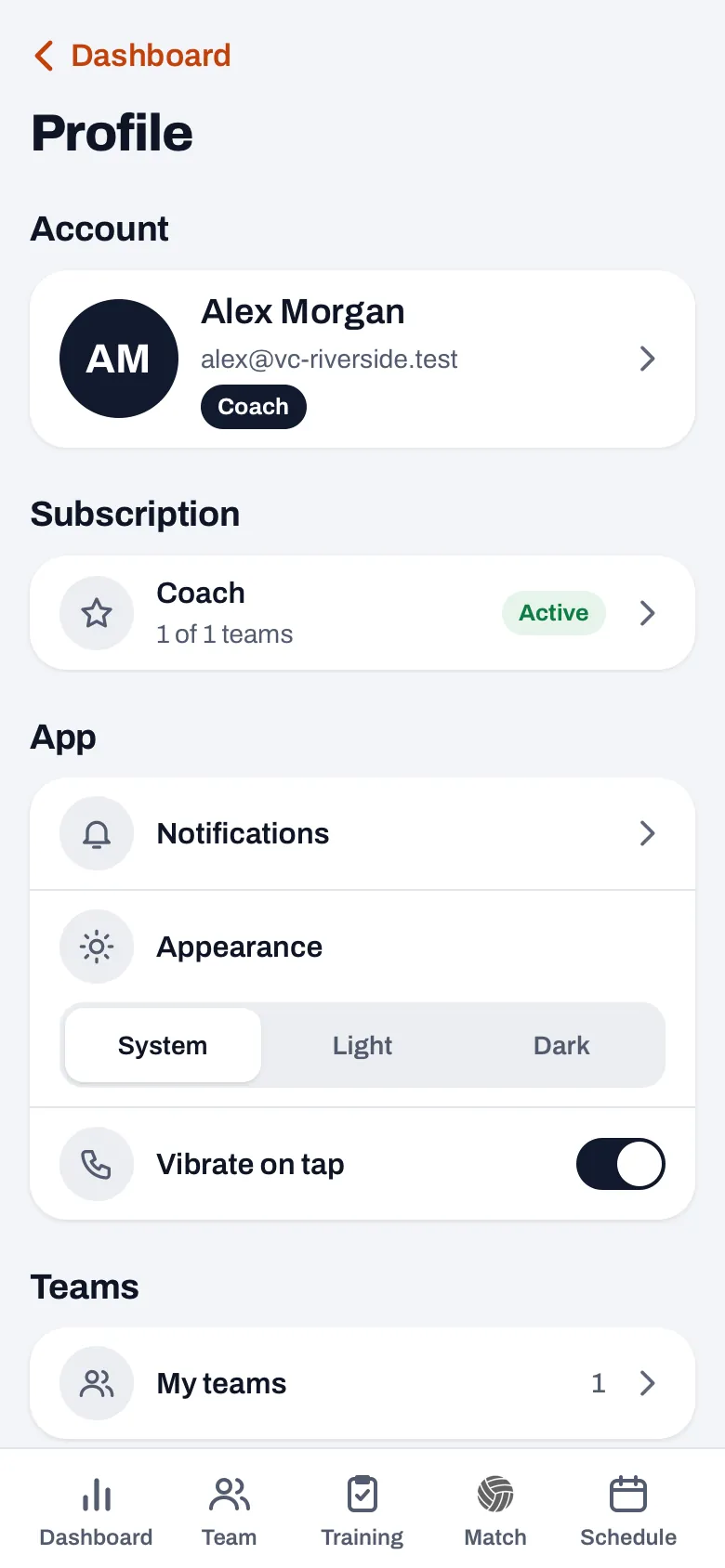
“That works from version 3.1 in the app for iPhone and Android. In a browser only where the browser allows it, and Safari on the iPhone does not. If you do not want it, switch off ‘Vibrate on tap’ in your profile, right under Appearance. It is on by default.”
What does the app deliberately not do with those ratings?
“A rating between 1 and 4 never scores a point. Then the rally is still going, and the app should not decide that for you.
“And in a played match a player sees only their own ratings, not those of their teammates. The coach sees everyone. I wanted that distinction: a rating is working material for the coach, not a league table for the team.”
Give a rating, and the point is on the board
In Koach’s Expert mode you give a rating from 0 to 5 per rally, and a 0 or a 5 scores the point by itself. Afterwards you see per player what they did in that match. Free to try for 14 days.
Try Koach free