
Recording point types: attack, block or serve
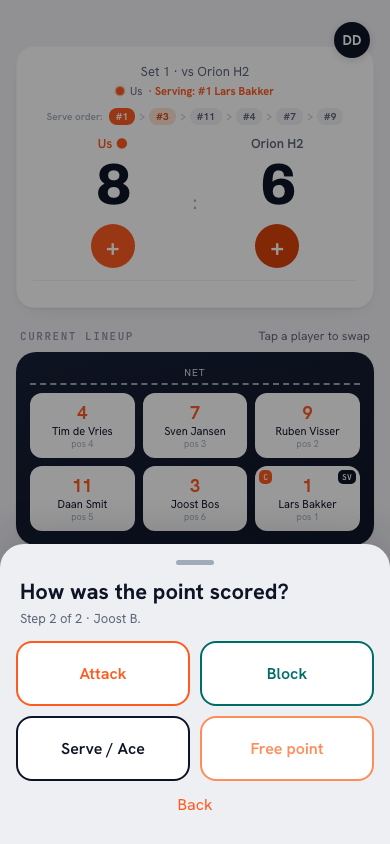
Eighteen points for your opposite — nice. But was that eighteen attacks, or twelve attacks, four blocks and two aces? The point type is the second tap that turns a tally sheet into an analysis.
The three types (and why exactly these three)
- Attack: every point from an attacking swing, from the hard cross-court hit to the clever tip. The volume type: for most teams good for 60–75% of their own points.
- Block: the kill block that scores directly. Rarer, but the most honest measure of your net defence — see measuring block points.
- Serve: the ace, including the serve that bounces unplayably off the passer. The return on your serving practice, in black and white.
More detail (direction, tempo, zone) is a trap for amateur tracking: every extra question per point costs speed and therefore consistency. Three types is the balance between insight and input you can sustain.
What the distribution tells you
Per player the mix becomes a profile: the middle blocker with plenty of block points is doing his job, the outside hitter who also scores on serve is doubly dangerous. At team level the strength analysis shows where your points come from — and thus what to train when a source dries up. A team that gets 80% from attack and hardly anything from serve is leaving its easiest growth area on the table.
Agree on the edge cases in advance. The attack that goes out off the block is an attack point; the serve the passer still touches but cannot play is an ace. One agreement, always the same tap — that keeps season numbers comparable.
Frequently asked questions
Does a point from an opponent error count as a point type?
No — you record that via the separate 'opponent error' button, without a player and without a type. The three point types are reserved for your own scoring actions.
What is a normal split between attack, block and serve?
As a rough guideline at amateur level: 65–75% attack, 10–15% block, 10–15% serve of your own scoring actions. Big deviations are not wrong, but they are worth a conversation.
Why can I not record defensive actions?
Because a dig never scores a point directly — the rally continues. If you want to value defence, look at the team result and your notes; point tracking stays with the finishers.


Try it yourself in Koach
Less admin, more coaching — starting at your next practice.
Get started with Koach