
Can a Back Row Player Block in Volleyball? The Setter's Trap
Your setter is in the back row, jumps up at the net to stop an overpass — and the referee whistles. Fair enough, but not always: whether this is a fault depends on one thing, and that is whether they actually touched the ball.
What a block is under the rules
Before you can judge whether somebody blocked illegally, you need to know what a block is. The FIVB rule (14.1.1) is exact: blocking is the action of players close to the net intercepting the ball coming from the opponent by reaching higher than the top of the net, regardless of the height at which the ball is contacted.
Two terms matter here. A block attempt is a blocking action without touching the ball (14.1.2). A completed block is a block where the ball is touched (14.1.3). That distinction determines everything that follows.
The rule for back-row players
A back-row player — the player in position 1, 5 or 6 — may not complete a block and may not be part of a completed collective block (rule 14.6.2). The moment they touch the ball in such an action, it is a blocking fault: point and serve to the opponent.
The flip side is less well known: a back-row player who jumps at the net with their hands above the net but does not touch the ball commits no fault. A block attempt by a back-row player is therefore allowed. There is nothing illegal about your middle-back going up once; it only becomes a problem the instant they make contact.
For the libero the rule is stricter: they may neither block nor attempt to block (19.3.2.2). Jumping at the net with hands above the tape is already a fault for a libero, even without touching the ball. All the other libero restrictions are in the net rules for liberos.
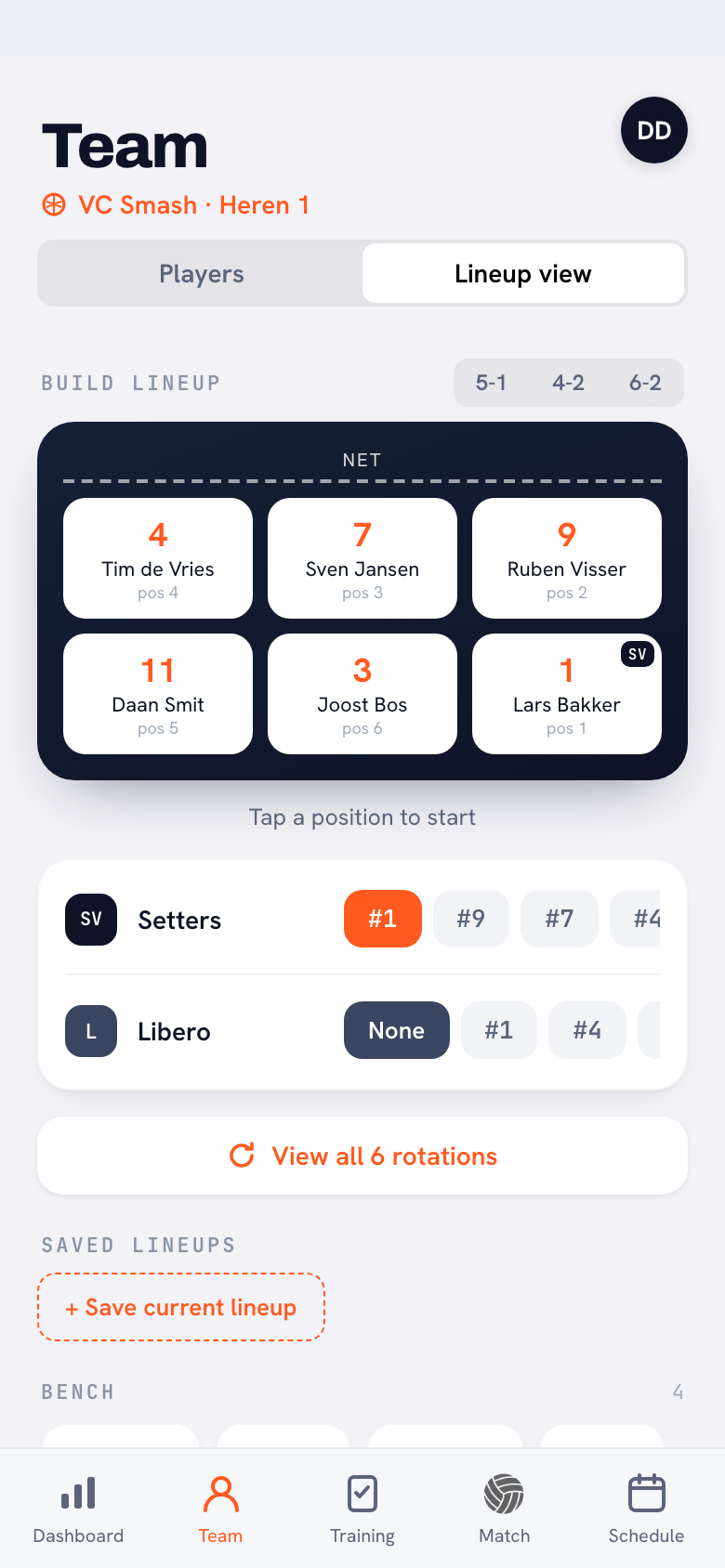
Koach shows per rotation who is front row and who is back row, so your setter knows exactly which rotations allow them to go up at the net.
Why setters in particular get caught
In a 5-1 system the setter is in the back row for three of the six rotations. That is precisely where the fault appears: they are standing close to the net to take the second ball, they see a sloppy pass coming over from the other side, and their hands go up on reflex. Touch the ball above the tape and that is a completed block by a back-row player — a point against, on a rally that looked like a free point for you.
What is allowed: playing that same ball with the hands below the top of the net. Then there is no block, just an ordinary first team touch. Your team still has two touches left and can send it back properly. One caveat: do not immediately push it back over above the tape, because then the back-row attack restriction from the three-metre line rules applies. Where to position your setter is covered in positioning the setter.
Four situations, four outcomes
- Back-row player jumps and touches the ball above the net. Blocking fault: point to the opponent.
- Back-row player jumps and touches nothing. No fault. Not even if they visually complete the block alongside their team-mates.
- Back-row player swats the ball away with hands below net height. Not a block, but the first of three team touches.
- Libero jumps at the net and touches nothing. Still a fault: for the libero the attempt alone is banned.
None of this applies in the front row
All three front-row players (positions 2, 3 and 4) may block, alone or together, and may reach over the net once the opponent has completed their attack hit — the limits of that are in reaching over the net. A block touch also does not count as a team touch, which leaves your team three full contacts afterwards; we work that out in does a block count as a hit.
Youth and mini volleyball
From under-15 upwards exactly the same rules apply as for seniors, including the ban on back-row players. In mini volleyball the lowest levels do not block at all — so the question does not arise, and that is deliberate: children learn to play the ball first and to defend the net later.
How to get it out of your team
This fault is a reflex, not a knowledge problem. The best correction is physical: teach your back-row players that their hands stay at shoulder height near the net and that they play overpasses out in front of them instead of above them. Build it into the warm-up: throw balls half over the net and have back-row players deliberately play them low. Two sessions is usually enough — after that nobody jumps.
Frequently asked questions
Can a back row player block in volleyball?
No, a back-row player may not complete a block and may not be part of a completed collective block. If they touch the ball in such an action, the point and the serve go to the opponent.
Is jumping without touching the ball also a fault?
Not for an ordinary back-row player: a block attempt without contact is allowed. For the libero it is — they may not even attempt to block, with or without touching the ball.
Can a back-row player swat an overpass away at the net?
Yes, provided they do it with their hands below the top of the net. Then it is not a block but an ordinary first team touch, and the team still has two contacts left.
Why do setters run into this so often?
Because in a 5-1 system they are in the back row for three of the six rotations while still operating close to the net to take the second ball. A reflex movement of the hands above the tape is made in an instant.