
Does a Serve That Hits the Net Count in Volleyball?
The serve clips the tape, loses all its speed and drops straight down on the other side. Three receivers look at each other, nobody gets there, point. Unsporting? No — entirely within the rules for more than twenty years now, and one of the few rule changes that genuinely altered the game.
The rule: touching the net is allowed
A serve that touches the tape and then crosses the net within the crossing space is simply in play. If it lands in the opponent's court untouched, it is a point — and statistically an ace. No replay, no second chance, no exception.
It was not always so. Until the rally-point system arrived around 2000, a serve that touched the net was simply a fault. The FIVB scrapped that provision to speed the game up and strengthen the serve as a weapon: since then every rally is worth a point, and an aggressive serve that grazes the tape is straightforwardly an advantage.
When a net serve is a fault after all
The ball may touch the net, but there are limits (rule 12.6.2):
- The ball does not cross. If the serve stays in the net or drops back on your own side, it is a service fault: point and serve to the opponent.
- The ball touches the antenna. Out immediately, even if it then drops into the court.
- The ball crosses the net outside the crossing space. Wholly or partly outside the antennas is a fault — see ball outside the antenna.
- The ball touches the net outside the side bands, or a post or a guy wire. That is out too.
In short: the net itself, between the antennas, is fine. Anything alongside it is not.
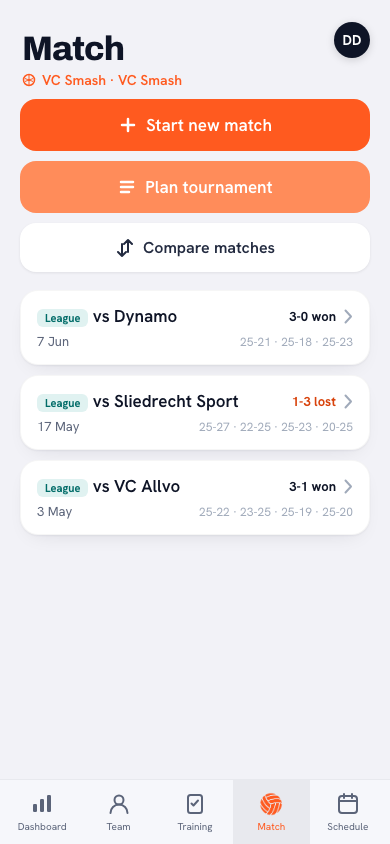
A net serve that lands in is worth the same point as any other — and Koach tallies aces and service errors per player automatically.
And during the rally?
The same logic runs through the whole rally: the ball may touch the net as often as it likes, roll along it and still cross. What is not allowed is a player touching the net during the action of playing the ball — that is a net fault, with all the nuances in the net-fault rules. So the distinction is ball versus player: the ball may do anything with the net, the player nothing.
One situation regularly causes debate: the ball that settles on the tape and slowly rolls over. As long as it comes down on the other side between the antennas, that is simply play — even if it was your third contact. If it rolls back onto your own side, the usual rule applies: it is still in play as long as you have touches left, and only a fault if that was your third.
How to receive a net serve
A net serve is awkward because it does two things at once: it loses speed and it changes direction, usually dropping more steeply. Three agreements that work:
- The middle passer steps forward as standard. Almost every net serve drops short, in the triangle between the three-metre line and the net. Whoever feels responsible for that area in advance is also the one who gets there.
- Keep calling until the ball is down. A net serve creates doubt, and doubt creates two players stopping at the same time. Have your passers keep calling right up to contact.
- Overhand is allowed. A short, slow ball is often easier to take overhand than with the forearms — provided your players train it. The technique is in overhand setting.
- Train it deliberately. In serving drills, have players deliberately hit the tape and let the receiving side play them out. Then the net serve stops being a surprise and becomes a familiar situation.
What it means for your servers
The net serve is not a tactic — nobody can aim it. But it is an argument for serving flat over the tape. A float serve that just misses the band creates the most reception problems; the fact that it occasionally clips the tape is not a risk but a bonus. Serve high and safe over the net and you hand the receiving team an easy ball. How to teach that flat trajectory is in the float serve, and where to aim it in serving with a target.
Youth, mini volleyball and beach
The rule is identical everywhere: from under-15 upwards the FIVB rules are used and the net serve simply counts. In mini volleyball it is no different, although at the lowest levels the ball is put into play from closer in. In beach volleyball too, a serve that touches the net and crosses is entirely valid — the old rule was dropped there just the same.
Frequently asked questions
Does a serve that hits the net and goes over count?
Yes. Since around 2000 the net serve is simply valid: if the ball touches the net between the antennas and crosses within the crossing space, it is in play. If it lands untouched in the court, it is a point and an ace.
When is a net serve a fault?
When the ball does not cross the net, when it touches the antenna, when it crosses the plane of the net wholly or partly outside the crossing space, or when it touches the net outside the side bands, a post or a guy wire.
Was a net serve replayed in the past?
No, in the past a serve that touched the net was simply a fault. That provision was scrapped when the rally-point system came in, to speed the game up and give the serve more weight.
May the ball touch the net during a rally?
Yes, as often as it likes: the ball may touch the net, roll over it and still cross. Only a player may not touch the net during the action of playing the ball.