Electronic Volleyball Scoresheet vs Paper: Which Counts?
There is a sheet on the score table, numbers on the scoreboard, and someone on the bench tapping along in an app. All three are tracking the same match, and all three have a completely different status. Knowing which one is for what will save you a lost protest.
Three things that all keep 'the score'
At almost every league match three records run side by side, and they get mixed up constantly.
- The scoresheet — the federation's document, filled in by the scorekeeper and signed by the referee and both captains. This is the official result. Paper or electronic makes no difference to that.
- The scoreboard — the board on the wall or the flip numbers by the court. Pure communication to players and spectators. If the board is wrong that is annoying, but the sheet still rules.
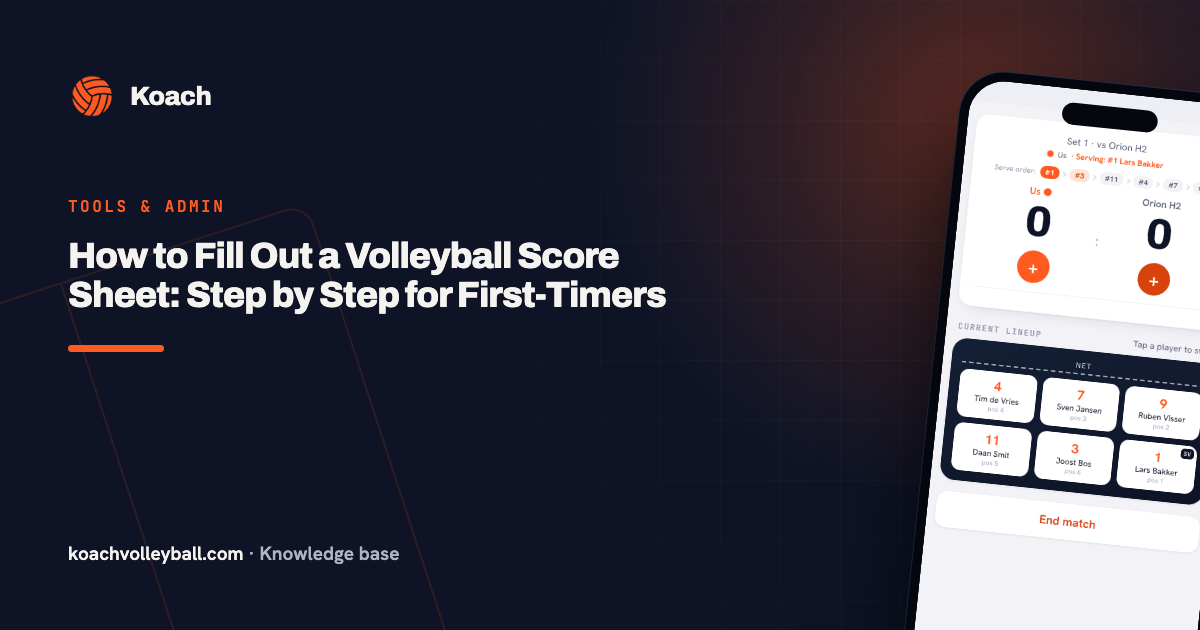
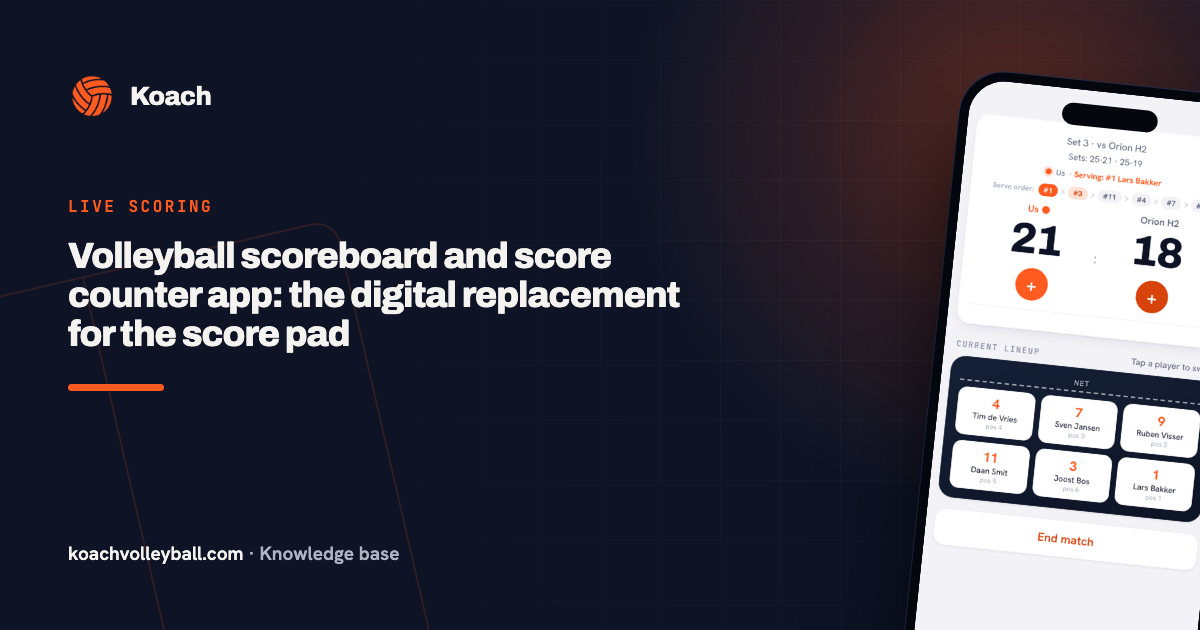
- The scoring or stats app — the coach's own record. Officially it does not exist; it is there for the analysis.
Get that distinction straight and you also know exactly where every argument ends: at the signatures under the sheet.
What is and is not on the sheet
A scoresheet is surprisingly complete as administration and surprisingly empty as analysis. On it: both rosters with jersey numbers, the liberos listed separately, the captain, the starting lineup for each set, the running score, the serving order, every substitution with the score it happened at, the time-outs, the set scores with finish times, any sanctions, and the remarks box. How to fill in each box is covered in the score sheet step by step.
What is not on it: who scored the point, whether that point came off an attack, a block or a serve, how the serve receive held up, and how many errors a player made. So the sheet tells you perfectly what the result was and almost nothing about how it came about.
Paper, electronic scoresheet or app: the differences side by side
| Paper scoresheet | Electronic scoresheet | Coach's scoring app | |
|---|---|---|---|
| Who fills it in | Home team's scorekeeper | Scorekeeper, on a tablet or phone | Coach, sub or parent |
| Status in a dispute | Evidence | Evidence | No status |
| Reporting the result | By hand, afterwards | Submitted automatically | Not applicable |
| Produces statistics | No | No | Yes, per player |
| Works without signal | Always | Varies | Usually, see below |
An electronic scoresheet is therefore not an upgrade of your scoring app but a replacement for the paper: same fields, same job, less retyping. The official sheet stays the official record, and an app like Koach runs alongside it for the score progression and the per-player numbers that never make it onto that sheet. One practical point about going electronic: gyms are concrete boxes, and signal is not a given — the same precautions as in scoring live without wifi apply to the scorekeeper at the table.
What happens in a dispute
Say the opponent plays an ineligible player, or the teams switch ends a set too early in the third. The order of business is always the same, and your app plays no part in it.
- Report it to the first referee immediately, through your captain, at the moment it happens. Raising it afterwards is almost always too late.
- Get it written into the remarks box on the sheet. What is not written there does not exist later.
- Sign under protest if your captain disagrees with what happened; that is exactly what the option is there for.
- Follow your federation's protest procedure, usually within a few working days and with confirmation from the club.
A screenshot from your own app is not evidence. At best it helps you reconstruct your own version of events — useful if you have to explain at which score something went wrong — but the sheet decides.
Rule of thumb: once the sheet is signed, the result is final. Anything you find afterwards in your app, your video or the group chat changes nothing. So check before you sign — it costs thirty seconds.
Running all three without duplicating work
On a team that has this sorted, nobody does two jobs at once. The scorekeeper does the sheet and nothing else. The scoreboard is operated by someone sitting next to the scorekeeper who calls the score out loud at every time-out — that is the moment board, sheet and reality get lined up again. And the app runs on the bench with a substitute or a parent, exactly as described in handing off live scoring.
The coach, ideally, taps nothing at all in that list. Whoever is tapping is only half watching. And the only record you genuinely need as a coach during the match is the one in your head: who is struggling, who is on the floor. The rest you can read back afterwards.
Frequently asked questions
Can I use my scoring app instead of the official scoresheet?
No. For league play only your federation's sheet counts, paper or electronic. Your own app is an analysis tool and has no official status.
What if the scoreboard and the sheet disagree?
The sheet rules. The referee has the board adjusted to match the sheet, not the other way round. Report a discrepancy straight away; the longer you wait, the harder it is to reconstruct.
Does a screenshot from my app count as evidence in a protest?
No. In a protest the federation looks at the signed sheet and at the remarks box. So make sure your objection lands there before anyone signs.
Who is responsible for the scoresheet?
Formally the home club, which supplies the scorekeeper; the referee checks and signs it. Both captains sign to confirm they agree with the final score.