
Fear of failure in sport: the player who plays it safe
Almost every team has one: the player who hits hard at practice and tips on Saturday. Who can serve overhand and does it underhand anyway. Nothing stands out on the scoresheet: few points, but hardly any errors either. Which is exactly why this can run for months without anyone naming it.
You can't see fear, you can see choices
You cannot read off a player that he is afraid of failing. What you can see is what he chooses the moment there is something to choose. Risk avoidance isn't a feeling but a series of decisions, and every one of them is visible from the bench. These are the six you meet most often in volleyball:
- The serve drops a level. Underhand when she can serve overhand, or overhand from two metres inside the end line at half power. The ball always goes in and never produces anything.
- Tipping instead of hitting off a good set. Not as a choice against a closed block, but as the default — including on the ball nobody is standing in front of.
- Letting the ball drop in the seam. Two players look at each other; watch closely and it is always the same player who turns half a step away.
- Leaving the hard ball to the neighbour. The tough serve lands between two passers and consistently goes to the other one.
- Stepping out of the rally after an error. Still moving with play, but not asking for the next two balls.
- Disappearing on the big points. Involved while the set is being built, invisible from 20-20 onwards.
Important: one such choice is nothing. A player who picks a tip against a double block is playing smart volleyball. What matters is repetition, over weeks, in situations where the safe option isn't the best option.
Three weeks of numbers: the pattern before the conversation
The tricky thing about risk avoidance is that it looks fine on the results sheet. A player who tries nothing also gets nothing wrong. So you need two numbers side by side, over three matches, not over one.
A worked example. Outside hitter A gets 42 attack attempts across three matches, kills 9 and makes 2 errors. Teammate B gets 44, kills 18 and makes 8 errors. In the error column B is the sloppy one and A the tidy one. Work out the efficiency per attack and A delivers the team three points a match less — and of those 42 balls, well over thirty went back as a soft ball to a defence that was ready for it. A isn't tidier, A is doing less.
The same comparison works on the serve. Don't look at a norm, look at your own team: whoever sits well below the team average in both service errors and aces isn't serving better, just safer.
No app and no stats keeper? Then do it with a slip of paper and two columns per player you suspect. Column one: attack driven through, or soft ball. Column two: serve in play, ace or error. That is about twenty tally marks per set. Do it three matches in a row: one match can be a bad day, three pointing the same way is a pattern. The distinction between errors that produce something and errors that only cost is worked out in error load per player — read it alongside this, because without that distinction an error column draws exactly the wrong conclusion.
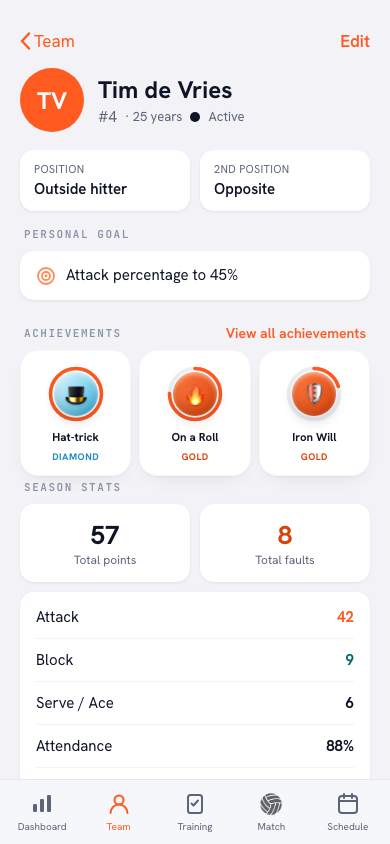
Log the numbers per match and this pattern shows up on its own: a flat points line with an error line creeping towards zero. In Koach those two sit next to each other by default, because either number on its own says nothing.
The coach keeps it going
This is the uncomfortable part. Within a few weeks a player learns where your attention goes. React only when something goes wrong, and the safest way to avoid your attention is to try nothing. That isn't a character flaw in the player but a logical response to the climate in the hall.
Measure it on yourself once. Put your phone in your bag on record at the start of practice and listen back to the first twenty minutes. Count two things: how many remarks were about something going wrong, and how many about something somebody attempted. There is no norm for that ratio — use it as a mirror, not as a score. But if you hear twenty corrections and two mentions of an attempt, you know why people play it safe in your hall.
Then watch which kind of error you respond to. Most coaches react just as strongly to an aggressive serve that misses by twenty centimetres as to a pass that flies away with no pressure on it. To the player those are two completely different things, and if you treat them the same he learns that trying costs as much as being careless. Make the difference audible: name the brave error as something you wanted to see ("that serve is good, just too flat"), and save your correction for the error that produced nothing. How to phrase such a correction without it turning into a verdict is in correcting without shouting.
Two sentences you are better off scrapping. "Not into the net" makes the player think about the net. And "just take it easy" sounds like support but is literally the instruction to take less risk — precisely what this player was already doing.
The conversation: start with what you saw, not what you think
Don't have this conversation in the changing room and not after a match. Take ten minutes before a practice, sitting down, out of earshot of the rest. And don't stick a label on it: "you have a fear of failure" turns a habit into a trait, and that is much harder for a player to shake off.
Open with the observation and check it straight away:
- "These last three matches I've seen almost every attack go as a tip, while at practice you drive it through. Do you recognise that?" Factual, checkable, and the player can correct you if you have it wrong.
- "What would you do if it made no difference whether that ball went out?" Almost everyone can answer this question, and the answer is the target you work towards.
- "And what is stopping you now?" This is where the real answer comes: afraid of teammates' reactions, afraid of being subbed off, a remark from a previous coach, or pain nobody knows about.
What you don't do: reassure with "you can do it, though", or say he needs more confidence. Both hand the problem back to the player without giving him anything to do. Instead, finish with one agreement small enough to actually carry out on Saturday, and let the player put it into words himself — for example: the first two attacks of every set I drive through, whatever happens. Fix that agreement as a personal goal, so you can come back to it in three weeks without it needing to become a whole new conversation.
If it goes beyond the court — stomach ache before every match, not wanting to come any more, crying after an error — this is no longer a coaching problem. Refer them to a sport psychologist or, with youth, to the GP via the parents. How that is arranged at your club and who pays for it differs by country and by club; check with your board before you offer it.
How to set the drill up so that daring pays
Talking changes little as long as the drill itself rewards the safe choice. In a normal attacking game where you count points, tipping is simply the smartest option. So flip the scoring in the drills where you train daring:
- Score the attempt, not the outcome. Ball driven through, in: 2 points. Driven through, out: 1 point. Soft ball in: 1 point. Soft ball out: 0. Use this only in the daring drill — not in the drill where you train smart attacking, or you'll coach a weapon out of your players.
- Set an error quota. Write it on the board: quota 6. Everyone may make six errors this practice in the attacking and serving drills. Whoever finishes under two hasn't trained well, they've trained safe — and you say that out loud, because that is the whole point of the quota.
- Serve to an error percentage. Instruction for a set of ten: at least seven in play, but also at least one error. A player who lands ten out of ten has not completed the task.
- Build the audience up in three steps. This player will dare it with just a tosser, often in a 2 v 2 on half a court, and not in a six against six with everyone watching him. Work in that order and skip no step.
- Never let a drill end on his ball. Hit the last ball of practice into the net and go home, and that image travels with you until Tuesday. Just give three more.
Build these formats into a rally, not into a repetition set. Taking risk off a tosser is a different skill from taking risk in play, and only the second one transfers to Saturday.
Key point: as long as your drill rewards the safest choice, nothing about the behaviour changes — however well the conversation went. Change the scoring first, then the behaviour.
The team agreement: a brave error is not a loss of face
A player won't stop playing safe while six pairs of eyes swing his way after every miss. So make it a team agreement rather than an individual one. Three rules are enough:
- After an error where someone took a risk, the nearest player says one word. "Good" or "next" — regardless of the outcome. One word, because a motivational speech is worse than silence.
- After a careless error nobody says anything. That is your job, later, and not the job of teammates during the rally.
- Three gestures are out: sighing, hands in the air, and looking at the bench after someone else's error. Those three do more damage than any remark, because they address nobody and hit everybody.
Write this into your team agreements at the start of the season and give your captain the job of guarding it — the group accepts it more easily from him than from you. In the youth game the sideline is part of it: one parent reacting audibly to a service error removes in two seconds what you have built in six weeks.
The 24-hour rule after a lost match
Agree that in the first 24 hours after the last ball, nobody says anything substantive about an individual action. Not you, not the parents, not the player himself in the group chat. What is allowed is one factual sentence about the team: "we played well to 18-18 and then we started forcing it." The analysis comes at the next practice, with the numbers alongside.
For this player that rule matters more than for anyone. He replays the match in the car home anyway, and precisely then one remark from a parent or a teammate decides which choice he makes the following Saturday. On a long away trip that vulnerable hour coincides exactly with the journey back.
Announce the rule in one sentence at the start of the season and be the first to keep to it. A coach who drops a two-minute voice note into the group chat late that evening abolishes it in one go. The reset ritual for the error during the match is a different subject; that sits with the serving routine and the breathing in mental training.
When it isn't risk avoidance
Before you start a process that runs for weeks, rule out four other explanations. All four produce the same picture.
- Technique. She tips because she can't get her timing on the high ball. Test it in a calm drill with a fixed toss and no audience: if she does drive it through there, it isn't technique.
- An old instruction. Surprisingly often a player says: "my last coach told me to just play it over." Then all you have to do is give permission.
- Pain. A nagging shoulder or an ankle they don't trust produces exactly the same pattern. Ask explicitly; players only report this unprompted when it really has stopped working.
- Fear of the ball itself. With young children the complaint usually isn't failing but the hard ball coming at them. That needs a different approach; it is in a child who is afraid of the ball.
How you know it is working
Count on weeks rather than one conversation, and on a course that doesn't feel like progress. In the first weeks you mainly see the errors go up: the player is trying things he hasn't done in months, and it goes wrong. That isn't a relapse but the proof that something is changing; the efficiency follows later.
So look at three things instead of at the result. One: the share of attacks driven through versus soft balls — that is the behaviour you wanted to see. Two: the number of serves that genuinely apply pressure, errors emphatically included. Three: whether the player asks for the next ball after an error, because that is the habit that takes longest. If those three are moving the right way while the points totals are still flat, you are on track and it is too early to change anything.
Frequently asked questions
How do I know whether a player is avoiding risk or just playing smart?
Playing smart is a choice that fits the situation: a tip against a closed block, a safe serve at set point down. Risk avoidance is the same choice in every situation, including when nobody is standing in front of the ball. Ask beforehand: a player who can tell you what he is going to do and why is choosing; a player who says afterwards that he 'had to play it safe for a moment' is retreating.
Should I use the words fear of failure with the player?
Better not. A label turns a habit into a trait and gives the player nothing to do. Describe what you see — the choices on court — and ask what is stopping him. If there turns out to be more going on, that is a conversation for a professional, not for the hall.
What do I do with a player who dares at practice but not in matches?
That is the normal picture, and it means you have made practice too safe. Build up audience and consequences: first with a tosser, then 2 v 2, then with the whole team watching and a score that counts. A player who dares in no format with an audience still has a step to take before Saturday comes into it.
Doesn't an error quota backfire on players who already make plenty of errors?
The quota is a ceiling and a floor at once. For the player who forces too much it is a limit, for the player who tries nothing it is an instruction. So discuss it briefly per player at the start of the drill, in one sentence, instead of leaving it hanging as a group rule.
How long before a player takes risks again?
Longer than you hope: a pattern that has lasted half a season doesn't disappear in one practice, and there is a stretch where the errors go up first. Judge progress on the behaviour — the share of attacks driven through, the pressure on the serve — and not on the points, because those only follow once the execution is back up to level.
Should I sub this player off if it isn't working in a match?
Substituting at the first error after a daring agreement is the fastest way to make the agreement void. Agree in advance how much room there is ('the first set you do it your way, whatever goes wrong') and stick to it, including at 12-18.