
How to break a losing streak with your volleyball team
After two losses nothing is wrong. After five, something shifts in the locker room: players start playing safe, they glance at each other quicker and they hear your instructions differently. The temptation then is to change everything. That is almost always the wrong response.
Diagnose first, intervene second
A losing streak feels like one big vague problem, but it usually has a single measurable cause. Before you change anything, answer four questions about the last three matches. One: what was your side-out percentage — how often did you win the rally on your own serve receive? Two: how many points did you give away with unforced errors, and which type (serve, attack, pass)? Three: in which rotation were you behind? Four: at what point in the set did it tip — straight away, or consistently between 15 and 20?
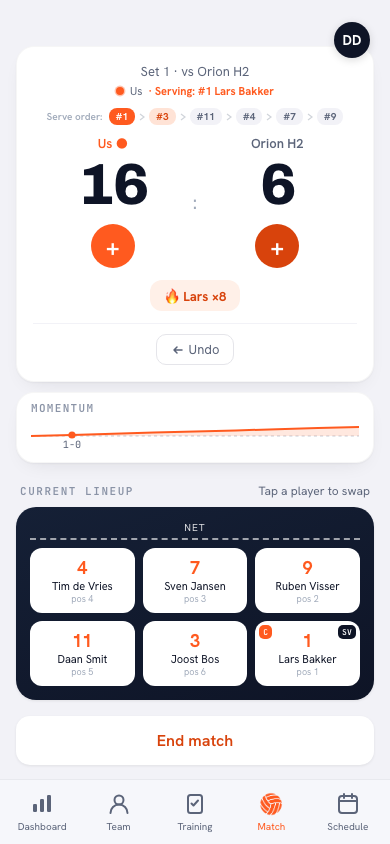
Those four answers almost always tell you where the leak is. Check side-out percentage and error load in Koach first rather than trusting your memory: a losing streak usually has one measurable cause, not five vague ones. How to read that percentage and which values are normal at club level is in side-out percentage.
The three causes you usually find
- Side-out collapses. You win too few rallies on your own reception. It is nearly always the pass under serving pressure, not the attack. Recognisable pattern: plenty of points after a good pass, almost nothing after a mediocre one.
- The unforced error count climbs. Twenty to twenty-five unforced errors per set is a losing scoreline, however good the rest is. Work out which type dominates; a team stacking service errors is usually tight, a team stacking attack errors is forcing.
- The serving pressure has gone. A team that serves safe to avoid errors hands the opponent a perfect pass. That is the most common side effect of a losing run: fear makes teams obedient.
Notice that all three causes are about execution, not system. That is no coincidence — teams rarely lose five in a row because their tactics suddenly stopped working.
What not to change
The reflex when things go badly is a full rebuild: a different lineup, a different system, a stricter regime. Don't. A new starting lineup costs two to three matches of adjustment — exactly the period in which you need a result. Switching from 5-1 to 6-2 mid-streak is worse still: you remove the last certainty from players who are already doubting. And punishment sessions ("we'll run it out of you") confirm precisely the feeling that it is their fault.
Change one thing at a time, and pick something small and measurable: one serving agreement, one reception formation, one rotation you start differently. Then in two weeks you also know whether it worked.
The week after the fifth loss
Build your session around two things: success and one concrete theme. Start with a drill the team does well — a long rally exercise, a game with a reachable team score — because confidence is built with ball contacts, not with words. Then put down the theme that came out of your diagnosis and train it with match pressure on it: passing against hard serving, serving with a target instead of safe, or closing out a set from 20-20. Finish with something the team enjoys. And keep the session short and sharp; the mood benefits from tempo, not from an extra half hour.
The team meeting: short, factual and one agreement
At some point you have to name it — players know perfectly well there are five losses on the board. Keep it short and businesslike. Start with the facts ("we're losing, and it's mainly because we no longer dare to serve under pressure"), then ask what the players see themselves, and end with one agreement for the next two matches. What to avoid: an emotional meeting where everyone gets things off their chest without anything coming out of it, and naming individual players as the cause. Swap your objective temporarily as well: not "we have to win", but a process goal the team controls itself, such as fewer than fifteen unforced errors per set. A team goal like that gives a losing side something to win again.
Check the calendar as well
Sometimes the cause isn't technical at all. Five losses in a row strikingly often coincide with a hard period: exam weeks, a flu wave, a run of long away trips or three matches against the top four in the division. Lay your results next to the standings and your attendance — if you played the top of the league with half a squad, nothing is broken and there is nothing to repair. A coach who says that out loud takes more tension out of the room in five minutes than any tactical adjustment.
Rule of thumb: during a losing streak change at most one thing a week, and leave the lineup standing as much as you can. Teams don't climb out with more news, but because something familiar starts working again.
Frequently asked questions
Should I overhaul my lineup after a run of losses?
Usually not. A new lineup costs two to three matches of adjustment and removes certainty from a team that is already doubting. Change one position or one rotation start sooner than the whole structure.
How do I talk about it without making the team gloomier?
Describe the problem in numbers and behaviour instead of judgements, and attach one concrete agreement to it straight away. Players get gloomy from vagueness and blame, not from a clear analysis with a task in it.
When is a losing streak simply the level of the division?
If you lose around 25-20 to the top teams and beat the rest, you don't have a problem, you have a schedule. Look at the margin per set and at who you played before drawing conclusions about your team.