How to Help a Kid Who Is Afraid of the Volleyball
A child who turns their head away the moment the ball arrives is not lazy and not uninterested. Fear of the ball is a learnable problem with a predictable solution, as long as you do not try to cheerlead it away. Here is what you see, where it comes from, and how to fix it in a matter of weeks.
How to tell fear apart from a technical fault
A child who has not mastered the skill yet arrives late but keeps moving toward the ball. A child who is afraid does something different: turns the head away, squeezes the eyes shut, takes a last-second step backward, or throws the hands up with the palms facing the ball — a protective reflex, not a volleyball movement. You often see it in where they stand, too: the kid consistently picks the line the ball does not come to, or takes just a bit too long at the water bottle.
Notice what does not happen, either. A child who simply cannot do it yet shouts, "wait, one more!" A child who is scared says nothing.
Three causes, three different fixes
- A painful experience. One hard ball in the face or off the forearms, and the body remembers. Fix: equipment — a lighter or softer ball, and nobody hitting hard anywhere near this kid.
- Too much, too soon. The ball arrives faster than the child can handle, so they are late every time and are quite reasonably startled. Fix: pace — throw slower, from closer, and only step it up once it works.
- Fear of failing in front of everyone. The ball is not the scary part, the watching group is. Fix: context — work in pairs off to the side rather than in a circle where everyone waits their turn.
In practice two or three of these are usually running at once. Just ask the kid: "what's the worst part, that it comes fast or that it comes high?" Eight-year-olds are surprisingly good at naming it.
The ladder: from soft and slow to the real thing
You remove fear through repeated experiences in which nothing bad happens. So work with a ladder, and only climb a rung once eight out of ten balls go well. A five-minute block per session is enough.
- Roll and catch. A soft ball along the floor, the child catches it. The goal is not technique but touching the ball without tension.
- Arcing toss from three meters, catch. You throw soft and high. The child catches with two hands in front of the body.
- Arcing toss, forearm pass back. Same distance, now passing instead of catching.
- Regular ball, soft toss. Only here do you move from the soft ball to the match ball.
- Out of a live rally. The child plays in a small-sided game, but the other side may only put the ball over underhand.
What to say, and what to leave out
"Don't be scared" does not help, because it confirms there is something to be scared of and offers no cue at all. "Come on, it's only a ball" is worse still: it turns a normal reaction into a character flaw. What does work is rewarding the step instead of the outcome: "you held your ground, exactly right" — even if the ball then drops next to them. So reward moving toward the ball, not the successful pass. On top of that, give a role that keeps the child in the game no matter what: scorekeeper, tosser, or the player who puts the ball into the rally. That way sitting out never costs face.
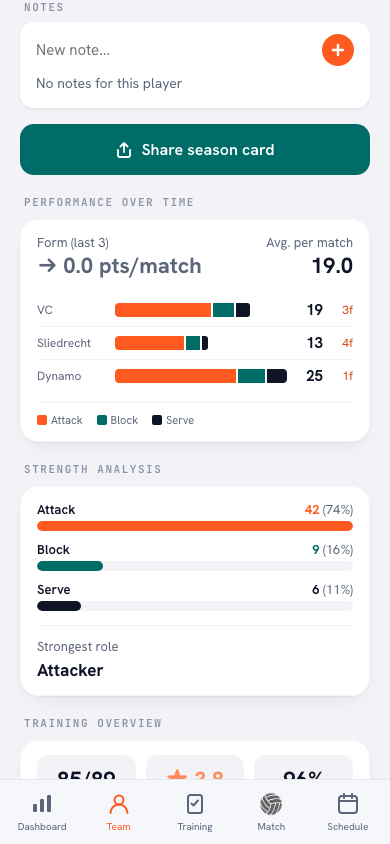
A short note per kid after practice is worth its weight in gold here, because progress comes in small steps that you forget in the moment. In Koach a single line per player records whether this child dared to step in this week or backed off again. Six of those lines side by side tell you exactly whether your approach is working — and give you something concrete for the conversation with the parents, which is covered in setting expectations with parents on the sideline.
Five things you should never do
- Throw an unexpected ball "just to see whether it's really that bad". That confirms exactly what the child is afraid of.
- Joke about it in front of the group, however kindly it is meant.
- Pull the child out of a drill. Adapting is fine, excluding is not.
- Ask parents to practise at home with hard-driven balls. That only moves the pressure somewhere else.
- Quietly work around it by never sending this kid a ball again. Then the visible problem disappears and the real one stays.
How long it takes and when to step it up
Count on four to eight weeks at five minutes per session, not on one session. If you see no movement at all after two months, or the fear shows up outside the gym too — crying while getting changed, stomach aches on practice days, refusing to go — then it is no longer a volleyball problem. Discuss it calmly with the parents and keep it small: often a temporarily adapted role or a group with less pace is enough. How to catch that signal in time with kids who do not say much is in mental training in volleyball.
Frequently asked questions
Do children grow out of fear of the ball on their own?
Sometimes, but usually not without an adjustment. Kids who keep flinching build faulty technique in the meantime and start avoiding more and more situations. A few minutes of targeted work per session beats waiting it out by a distance.
Does a softer ball genuinely help, or is it coddling?
It demonstrably helps. A lighter ball flies slower and does not hurt, so the child dares to get the hands up in time. As soon as that works eight times out of ten, you move to the regular ball — it is a stepping stone, not a destination.
Should I mention it to the group?
No. Treat it as an ordinary individual adjustment, exactly like giving a tall player something different to do than a short one. The less attention it gets, the faster it goes away.