
How to Read the Setter in Volleyball: Five Tells
A blocker who only starts moving once the ball is on its way is almost always late. Good blockers leave earlier — not because they are faster, but because they knew earlier where the ball was going. Reading is a learnable skill, and it comes down to five concrete tells.
Why reading beats reacting
Run the numbers. A set to the outside hitter travels about five meters and takes roughly six tenths of a second. A middle blocker who has to get from P3 to P4 needs considerably more than that for the movement plus the jump. So a blocker who only leaves once the ball has left the setter's hands is permanently half a movement short — and is still landing when the attack arrives instead of blocking it.
The difference, then, is not leg speed but the moment of departure. Every tenth of a second you win by spotting a tell earlier is a tenth of a second more travel. Winning four tenths, in practice, is the difference between a half block and a closed double block.
The looking order: pass, setter, ball
Before you go hunting for tells, the looking order has to be right. It is the same for every blocker and has three steps. First the pass: where does the ball end up? A pass that lands three meters off the net or behind the setter already rules out the fast options — the odds of a high ball outside are immediately large and you barely need to look at the setter. Then the setter: her posture, hands and hips, the tells below. And only third the ball, to fix your last step and your jump timing.
The classic mistake is the reverse order: blockers who stare at the ball from start to finish and never see the setter. They have no choice but to react, because they have gathered no information at all.
Five tells in a row
- The shoulder line. The most reliable tell there is. A setter can hide her hands, but her shoulders almost always point to the side the ball is going. Facing a setter with a pronounced shoulder turn, you know before the ball even touches her hands.
- Leaning back. A back set — to the hitter on the right — requires an arched back and a torso tilted backwards. Almost no club-level setter can hide that. If she stays upright over the ball, the ball is going forward.
- The hands relative to the head. Hands above the forehead means forward; hands above or behind the crown means back. Always combine this tell with the shoulders — one tell on its own is not enough.
- The distance to the net. A setter further than a couple of meters off the net rarely still runs a quick in the middle; the risk of putting the ball in the net is too big. When you see her drifting back, you can release the middle and leave for the pin straight away.
- The middle's approach. Strictly speaking not a setter tell, but the fastest one to see. A middle who does not make her approach, or only half of it, is not getting the ball — so the quick is off the table before the setter has done anything.
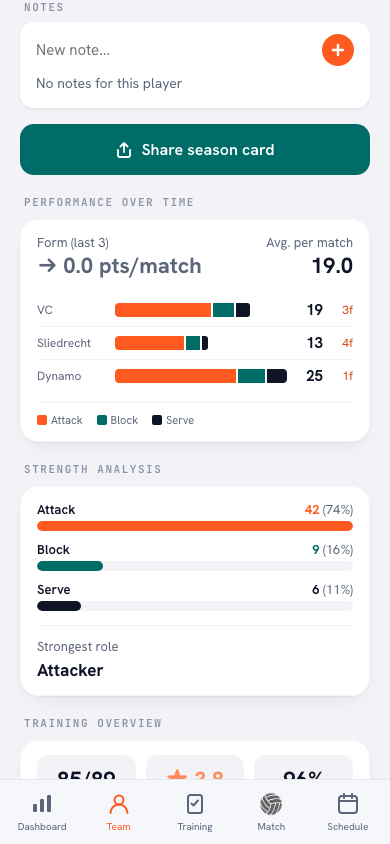
A tendency you have spotted is worth gold, but only if you keep it: note what you saw in your opponent notes in Koach, so your middle blocker starts the next match already knowing it.
Tendencies: what you know before the first serve
Alongside body language there is a second source, and it is even more reliable: habits. Almost every setter has fixed patterns, and they can be scouted in a single match. Watch these four:
- The first ball after a time-out. Nine setters out of ten pick their safest option there — usually the go-to outside hitter.
- On big points. From 20-20 onwards the variation disappears: the ball goes to the player who has the trust.
- After a poor pass. Does she always go left, or does she dare to set back? Most setters fall back on one fixed side.
- Her own place in the rotation. A setter in the front row often plays differently than when she is penetrating from the back corner — note which rotation makes her most predictable.
What you should definitely not do
Reading is not guessing. Two traps. The first is committing too early: a blocker who picks a side on one tell before the setter has even touched the ball gets played out of the match by the first double move. Move only when you have seen two tells saying the same thing. The second is having everybody read: let your middle blocker read and decide, and agree that the pin blockers simply follow her. Three players reading independently produce three different answers and a block full of holes. How to write those agreements down is in organising your block.
How to train it
Put a setter to work and have the blockers only point — no jump, no touching the ball, just an arm out toward the side they think the ball is going, at the moment the setter contacts it. Count the hits. Then flip it: have the setter deliberately deceive them, so blockers learn that two tells are stronger than one. Only in the third stage do you build toward the full block with movement and a jump, otherwise you are training speed instead of reading. Finish with a game format in which your middle blocker calls out loud, every rally, what she expects — being loudly wrong teaches faster than quietly guessing right.
Have your blockers sit out one whole set. Put them on the bench with one instruction: call out loud, before every set, where the ball is going. After twenty rallies they recognise the patterns — and after that they see them on court too.
Frequently asked questions
Which setter tell is the most reliable?
The shoulder line. Hands can be hidden, shoulders almost never: they point at the side the ball is going virtually every time. Leaning back is the second strong tell and gives away the back set.
From what age can you teach blockers to read?
As soon as players can put up a block without tripping over their feet, usually around twelve to fourteen. Start with the pass-setter-ball looking order and with pointing instead of jumping — that can begin much earlier than the full block.
Should all three blockers read?
Let the middle blocker read and decide, and agree that the pin blockers follow. Three players reading independently reach three different conclusions and therefore an open block.
How do I remember a setter's preferences until the next match?
Write them down straight after the match in a sentence or two — which hitter on big points, what happens after a bad pass. Without a note that knowledge is gone in three weeks.