
Back set in volleyball: technique, disguise and drills
The short answer
In a back set in volleyball you play the ball overhead behind you to a hitter at your back, usually the opposite in position 2. You take the ball in the same spot above your forehead as for a front set, push your hips forward only at contact and extend your arms upward, so the block sees it late.
The back set in volleyball turns your setter into a problem for the block: as long as the middle blocker does not know whether the ball goes forward or backward, they have to wait. This article explains the technique, shows how to disguise the set and gives six drills to build it up.
What is a back set?
In a back set, often just called a backset in the gym, the setter plays the ball overhead behind them to a hitter at their back. The setter faces position 4 with their back to position 2, so every set to the right is a set backward. The usual targets:
- The opposite in position 2. A high ball or a quicker, flatter ball to the right side of the net. What that player does beyond this is in what an opposite hitter does.
- The middle behind the setter. A short, quick ball just behind the setter, or the slide, where the middle runs past behind the setter and takes off from one leg.
- The attack from position 1. If the opposite is in the back row, they can attack on the right side from behind the attack line.
Why it matters: a setter who only sets forward is easy to read. The block then shifts left early and keeps an eye on the middle. Only when the back set is a real option does the block have to wait until the ball leaves the hands. The basics of the set itself, hand position, footwork and power from the legs, are in overhead setting, and how all the fundamentals fit together in learning volleyball technique. This article is about what is different when you set backward.
Back set technique
- The same start as a front set. Get under the ball in time, with your chest and feet to position 4 and your hands already above your forehead. Whoever is late has to reach and lean, and that is visible on the other side.
- The same contact point. Take the ball above your forehead, just like the front set. Not above the top of your head or behind it: that gives away the direction and raises the chance that the ball comes to rest in your hands.
- Hips forward at contact. Only when the ball arrives in your hands do you push your hips forward, under the ball. Your back arches slightly and your chin goes up a little. That arch gives the ball its direction, not your arms.
- Arms up, not back. Extend your arms towards the ceiling, with thumbs and index fingers the last to touch the ball. Your hands finish above your head, palms up. Whoever throws their arms backward produces a low, flat ball that keeps on flying.
- Less power than you think. From the setter's spot, between positions 2 and 3, the distance to position 2 is shorter than to position 4. Extend your legs just as smoothly, but with less power, or the ball flies past the antenna.
- Turn and cover. After the contact, turn towards your hitter and drop into coverage: a blocked ball comes back close to you.
Where the ball should arrive is something you agree on with your hitter. As a rule of thumb it lands at the same distance from the net as your front set, along the net and not on it, and for a high ball a little inside the antenna. For the referee the backset is a set like any other: the ball must not be caught or thrown and must not be touched by the two hands one after the other (Rules 9.2.2, 9.3.3 and 9.3.4 of the FIVB Official Volleyball Rules). In a back set your hands travel with the ball over your head, which makes it easier for the ball to come to rest for a moment. One more reason to keep the contact above your forehead and short.
Disguising the set: how to keep the block from reading you
A good blocker watches your shoulders, whether you lean back and where your hands take the ball. How that reading works is in how to read the setter. If you want to hide the set, you keep exactly those signals the same:
- The same posture on every set until contact. Chest and shoulders to position 4, whether the ball goes forward or backward. If your shoulders already turn to the right, the blocker knows enough.
- Arch late. The hips only go forward at contact. Whoever already leans back under the ball announces the set.
- Always above the forehead. Do not let the ball drop to the top of your head for a backset.
- The same timing. Be under the ball equally early for every set. A setter who is just a bit late on every back set has a pattern any opponent spots after one set.
A simple test: put a blocker on the other side who points, at the moment of your contact, to where the ball is going. If they keep pointing correctly, the signal is in your posture, not in your hands.
Common back set mistakes
| Mistake | What you see | What you do about it |
|---|---|---|
| Ball taken behind the head | Leaning before contact, the block leaves early, risk of a carried ball | Ball above the forehead, hips only at contact |
| Arms thrown backward | Low, flat ball that flies on towards the antenna | Extend the arms towards the ceiling |
| Too much power | Ball goes past the antenna or out of the court | Shorter leg extension: short distance, small legs |
| Chest not square to position 4 | Ball drifts towards the net or into the court | Chest and feet to position 4, ball along the net |
| Head far back | Unclean contact, ball spins | Chin up a little, eyes on the ball until it is gone |
Six back set drills
Only start on the back set once the front set is solid: a player who can put a series of balls from a calm toss onto a mat in position 4 is ready. Then build up from tossing to playing, and from no opponent to an opponent.
- Backward in threes. A, B and C stand in a line, about three meters apart. A tosses high to B, B back sets to C, C catches and throws the ball past B back to A. After ten balls B switches. Watch for contact above the forehead and arms to the ceiling.
- Front or back on a call. The same line, but now B sets to A or to C. Only once the ball is in the air does A call "front" or "back". B shows nothing in their posture: the same start, and the choice at the last moment.
- To the target in position 2. The setter stands in their zone between positions 2 and 3. A coach or player tosses a ball from position 6 like a pass, and the setter back sets to a target in position 2: a player on a box with arms raised, or a hoop. Fifteen balls, count the hits.
- The blocker guesses along. Like drill 3, but the setter chooses front or back, and a blocker on the other side points to a side at contact. Every time the blocker is wrong, the setter gets a point.
- With a hitter on 2 and on 4. An outside hitter approaches in position 4 and an opposite in position 2. The setter chooses, the hitters attack for real. After every ball, have the opposite say briefly how the set was: too tight, too far or good.
- Game form with a bonus. Six against six or four against four, in which a point after a back set counts double. That way the setter looks for the backset under match pressure, instead of only playing it in drills.
More formats for the whole position, not just the set, are in how to train a setter.
Count the backsets in your next match. Have someone on the bench tally how often your setter sets backward, and in which rotations. If in the rotations with the opposite at the net almost no ball goes to the right, the block on the other side knows that too.
Does your opposite get the ball? How to see it in Koach
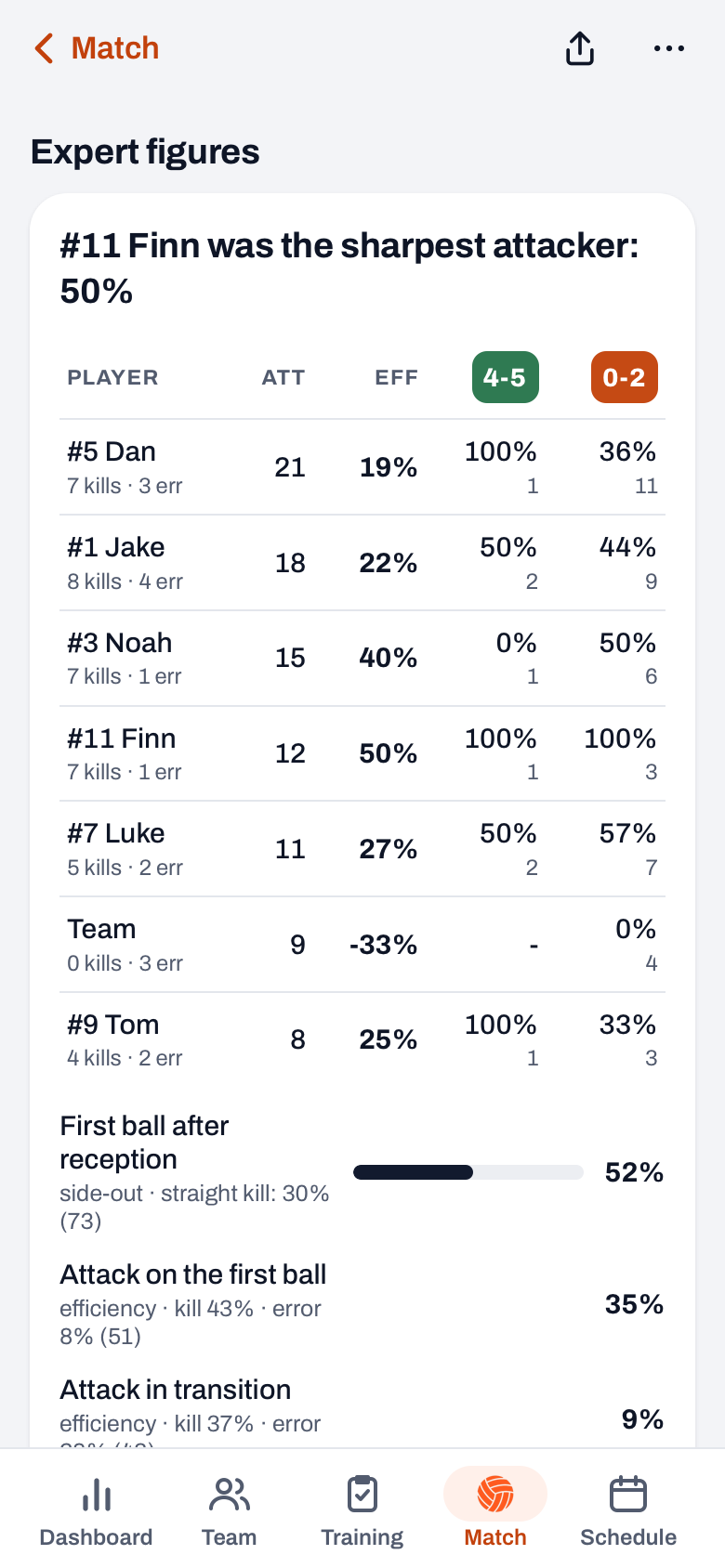
Whether your setter uses the back set, you only see once you track it. If you track a match in Koach in Expert mode, you rate every set from 0 to 5 at the Set step, and afterwards the Expert figures block shows per hitter how many attempts they got and with what efficiency. If your opposite gets few balls while putting them away well, you know what your setter can work on. To be fair: Koach does not track the direction of the set separately; you see it per hitter, not per backset. How to rate your setter's sets is in volleyball setter stats.
For practice, the drill library includes Hitting line over three positions, in which the setter feeds positions 4, 3 and 2 in turn, finishing with a backset behind them to position 2. With Add drill you put it in your practice plan. What Koach costs after the 14 free days is on the pricing page.
14 days free, no credit card. Track your next match in Expert mode and see how many balls your opposite really got.
Try Koach in your next matchFrequently asked questions
Is it legal to set backward in volleyball?
Yes. Under the FIVB rules the ball may rebound in any direction after a contact, so also over your head backward. The same requirements apply as for any set: the ball must not come to rest in your hands or be thrown, and must not be touched by your two hands one after the other. In a back set that goes wrong more easily, so keep the contact short and above your forehead.
How do you back set without the block seeing it?
Keep everything the same until contact. Be under the ball equally early for every set, with chest and shoulders to position 4, and always take the ball above your forehead. Only push your hips forward at the moment the ball arrives in your hands. A blocker who watches your shoulders and posture then only sees from the ball where it is going.
When do you teach a player the back set?
As soon as the front set is stable: a player who consistently puts a playable ball to position 4 from a calm toss is ready. Start with tossing and catching in threes, then setting to a target in position 2, and only then add a blocker or a real hitter. Teach it to players who are not regular setters too.
Why does my back set keep going towards the net?
Usually because of your posture. A backset goes exactly the opposite way to where your chest points. If your chest is turned slightly away from the net, which helps keep a front set off the net, the same posture sends the backset towards the net. Point your chest square to position 4 and let your hips go forward straight under the ball.


See whether your opposite gets the ball
14 days free, no credit card. After one match in Expert mode you know how your setter distributes.
Get started with KoachOr read first what the volleyball coaching app does.