
How to train a setter in volleyball: a plan for the position, not just setting drills
You have been running drills for your setter for twenty practices, and after every lost set you hear it again: the setter is the weak link. Or you have no real setter at all, and someone with reasonable hands just does it. Learning how to train a setter in volleyball starts with seeing setting technique as only one part of the position; the choices a setter makes, the number of balls they handle and the backup for the evening they are not there are things almost nobody trains. This piece is about that rest.
How to train a setter in volleyball: why setting technique alone is not enough
Most setting drills are about one thing: returning a ball that comes from a coach or a passer as cleanly as possible to a fixed spot. That is necessary, and it is also exactly the part of the position that is easiest to practise. Hands, contact and push, and the basic drills in the order you introduce them, are covered in setting drills for beginners.
But a setter who sets every ball cleanly in practice can still be the weak link in a match. Not because their hands are poor, but because the position consists of more:
- Technique — the contact with the ball. See overhead setting.
- Timing and position — working with the hitter and getting under the ball in time. See timing between setter and hitter and positioning the setter.
- The set choice — which hitter gets the ball, and when.
- The workload — the setter touches more balls than anyone else.
- The backup — who takes over when they are not there.
The first two have their own pages. The last three are below, together with what you arrange for the setter structurally at every practice. If you are still unsure who your setter should be, start with the role of the setter; this piece assumes you have made that choice.
What a setter gets extra at every practice
In a normal practice the setter joins the group drills, and something odd happens there: they set all evening, but almost always from a good ball, at a fixed spot, to a hitter who is ready. They get lots of contacts and little variety.
So give them a fixed block of their own, at the same point in every practice. The best moment is early, while the rest are still doing something general and the setter is still fresh; at the end of a practice their technique is already tired and they mostly learn to set sloppily. That block contains three things that are missing from group drills:
- Starting from different places. The ball does not come to them, they have to get to it — from the back court, from a block, from a dug ball.
- Balls that are not good. Too low, too far off the net, behind them. How to turn those into an attackable ball is in setting from a bad pass.
- One choice. In every repetition they have to decide something, even if it is only between two hitters. The next section is about that.
If you have no assistant, have the group work in stations and put the setter at the station where balls come from different directions. The drills for volleyball coaches include forms that slot straight into this, such as "Setter carousel", "Follow your set" and "Ball-Setter-Ball-Hitter". There is no separate category for setting: these forms are listed under Attack.
The most important thing about this block is that it is there at every practice. A setter block that only appears when there is time left over never appears.
Training the set choice: which hitter, and when
A setter who always looks for the same hitter can be read by the opposing block after a few rallies. A setter who switches for no reason gives hitters balls they cannot put away at that moment. The set choice lies between those two, and it depends on a few things you can explicitly teach them to weigh:
- The quality of the pass. From a good pass they have every option; from a mediocre pass fewer; from a bad pass usually only one. What your team agrees for that last case is in out-of-system play.
- Where the block is. The hitter facing one blocker is generally a better choice than the one facing two. The opposing block tries to read your setter in turn; what blockers look for is in reading the setter.
- Who can finish today. The hitter who put away the last few balls is not an automatic choice, but it is an argument.
- The score. On an important point they choose the ball that most often produces something, not the prettiest one.
Train it in drills in which the setter only gets the information at the last moment. A simple form: you stand on the other side and, while the pass is on its way, show with one hand where the block is. The setter has to choose the other side. A second form is the choice between setting and finishing it themselves: attacking on the second ball. How that dump works is in the setter dump, and its decision form is in the drill library as "Setter dump decision drill". Which agreements about the set apply between setter and hitters is in setter signals.
In these drills, limit it to that one choice. Decision making in general — game forms with a constraint, asking questions instead of giving the answer — is a separate subject that applies to your whole team; that is covered in training volleyball IQ.
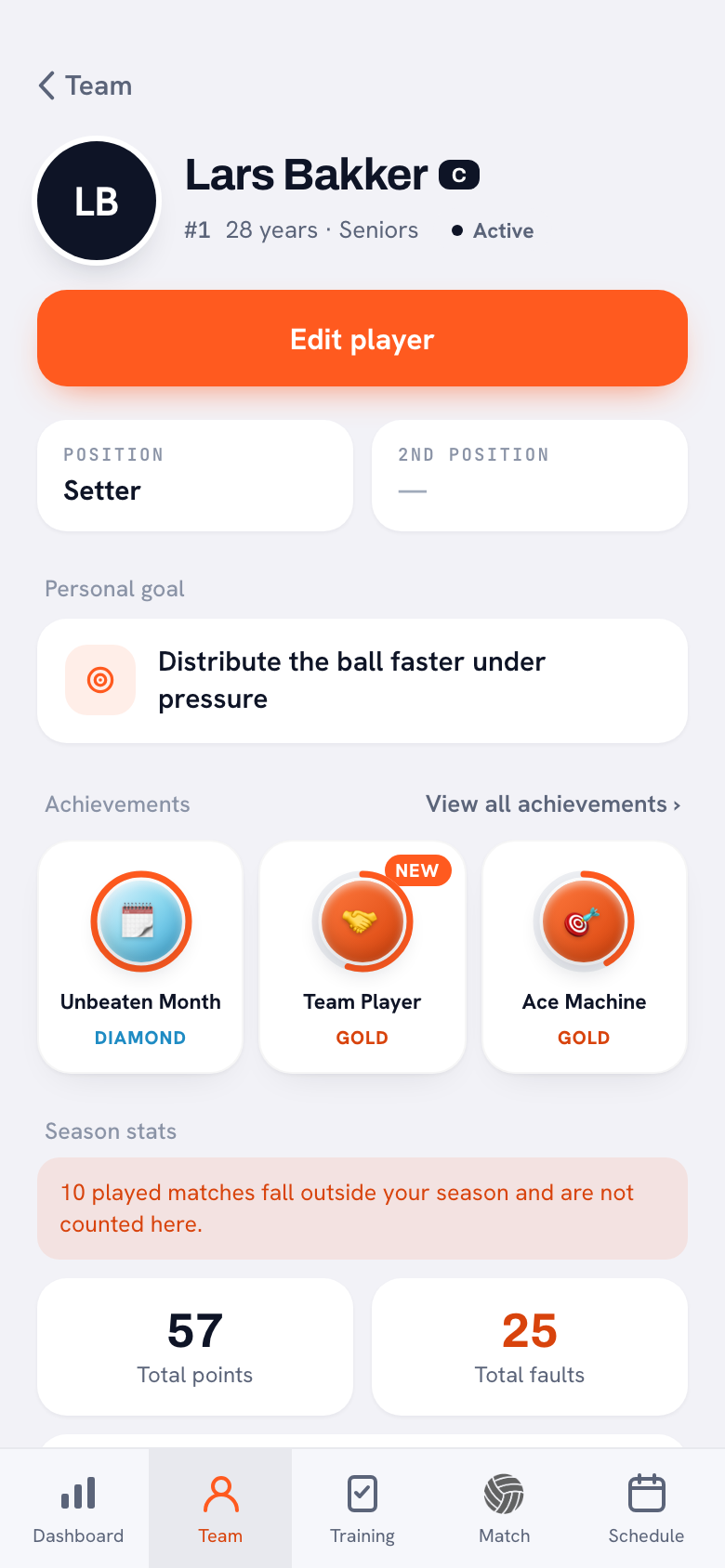
Whether they choose well in a match is not something you see from one set. You do see it in the distribution over a season. In Koach every attack point scored while a player is the setter counts as an assist for them, and their profile shows the setting distribution: the season's attack points per hitter. If one hitter scores almost everything, you still do not know whether that hitter is the best or simply the only one getting the ball — but you do have the question for your next conversation. Bear in mind that these are points, not attempts: a set that was not put away does not show up.
Workload: the setter touches the most balls
In a 5-1 the setter plays the second ball in almost every attack your team makes. In the rotations where they are in the back row, they also run from the back to the net for every rally. And in practice they set in every drill with an attack in it, while the hitters take turns. No other player handles so many balls, and in no other player is it so easy to overlook.
You see the signs that it is getting too much in the ball before you see them in the player: sets that get shorter or lower as the evening goes on, feet that arrive under the ball later, a setter who more and more often rescues with one hand what they used to play with two. If they complain of pain in fingers, wrist or shoulder that has not gone after a few days, have it assessed by a doctor or physiotherapist instead of letting them keep setting.
Three things help without them learning less:
- Do not have them set in every group drill. Put your second setter in for some of them, or the coach. That way they also get passing and defensive balls, which they need just as much in a match.
- Put their own block early in the practice. Then they learn with fresh hands and do not go into the game form already tired.
- Plan the week, not just the practice. If your last practice falls shortly before a match, keep the setter block short and technical that evening.
A setter who does not look tired can still be tired. They do not run out of steam the way a hitter does after a series of jumps, but they do set every ball. Look at the height and placement of their sets at the end of the evening, not at their face.
Developing a second setter
Every coach knows the setter will be ill at some point, get injured or go on holiday. Yet the backup is often only chosen on the evening itself, and then it is whoever has the least bad hands. That player has never had to make a choice and does not know the agreements with the hitters, and you notice that within a few rallies.
Name the second setter before you need them, and record it. The right person does not necessarily have the second-best hands: someone who reads the court and stays calm under pressure is often a better candidate than the player with the prettiest overhead ball.
The development itself is simpler than it sounds, because you already have the structure. Have them join your regular setter's block regularly, and put them in for some of the group drills — the same drills in which you give your first setter a break. Give them a goal of their own that suits their level, for example only setting high to the middle at first, and the choice between two hitters later. Whatever they can do at home for ball feel, you can give them as homework.
If you play a system with two setters, you are already training the second one anyway. The question then is mainly when one of the two will carry the position alone; that is covered in switching from a 4-2 to a 5-1.
When your setter cancels: what you train that evening
This is about that evening's practice, not about the lineup for the next match. How to prepare and save a lineup for that situation is in saving and reusing a lineup.
The reflex is to switch the evening to something without a set. That is a waste: this is precisely the evening to train what otherwise never gets a turn. Three options, depending on who is there:
- The backup setter's evening. If you have named a second setter, they get the block and all the group drills tonight. That is the best preparation they can get: a whole evening in the position, without a match depending on it.
- The second ball for everyone. Play game forms in which the player closest to the second ball sets it. That is what happens in a match after a bad pass anyway. Who takes the second ball in a smaller game form is described in the 4 v 4 lineup.
- Attacking off a fed ball. If you do want to keep the attack going, set the balls yourself or have someone with good hands do it. How to set that up is in the spiking drills.
What does not work that evening is letting a random player set for the whole practice without a goal: they learn little from it, and the hitters only get bad balls.
If you do not want to remember this plan every time: in Koach you put the setter block in a practice template and use it to create a series of recurring practices, so it comes back at every practice, and with a second position per player you record who your backup setter is. Then the evening your setter cancels is no longer a surprise.
Frequently asked questions
How do I train a setter if I was never a setter myself?
By focusing on what you can see: where the ball goes, how high it is and whether the hitter can do something with it. The technique you can take from a good description; the set choice and the workload do not require a setting background of your own, but they do require you to make time for them at every practice. Have your setter explain after a drill why they played a ball that way — then you both learn.
How much extra attention does the setter get per practice?
A fixed block of their own early in the practice, every time, plus the choice not to have them set in every group drill. How long that block is depends on how long you train and how many setters you have; more important than the length is that it is always there. A block that only appears when there is time left over never appears.
When do I develop a second setter, and whom do I pick?
Now, and not on the evening you need one. Pick someone who reads the court and stays calm under pressure, even if their hands are not the best yet; you can work on technique, and that is what the setter block is for. Record the choice, have them join the setter block regularly and put them in for some of the group drills.
What do I train when my setter has cancelled?
Use the evening instead of just getting through it. If you have a backup setter, they get the position for the whole practice. If you do not, play game forms in which the nearest player sets the second ball: that trains exactly what happens in a match after a bad pass. Just do not have a random player set all evening without a goal.
How can I tell whether my setter makes good choices?
Not from one set, but from patterns. Look over several matches at how the attack points are distributed across your hitters, and when the distribution is lopsided ask yourself whether that is a choice or a habit. In the match, also watch the balls after a mediocre pass: does the setter then choose the hitter who can do something with it, or the hitter they always choose?


Try it yourself in Koach
Less admin, more coaching.
Get started with KoachOr read first what the volleyball coaching app does.