
Volleyball IQ drills: how to train decision making, not just technique
In practice they hit every ball cleanly: the approach is right, the hand is right, the coach nods. In the match the same player hits straight into the block for the third time, and afterwards says they didn't see it. That is not a technique problem. Volleyball IQ drills are not yet another attacking drill; they are drills in which a player has to make the choice themselves — and choosing is learned differently from hitting.
Volleyball IQ drills: why technically good players make the wrong choices
A choice on court consists of three steps that follow each other so quickly they seem like one. Looking: where your eyes are at the moment it matters. Recognising: what what you see means. Deciding: what you do with it. In most practice forms we skip all three, because the answer has been given in advance.
That is the heart of it. In a line of hitters taking turns on a tossed ball, there is nothing to choose: one ball, one direction and no block. The player is practising execution. In the match they get a set that is slightly different, a block that half closes and a defender who steps away early — and then they have to do something they have never practised, namely decide while already in the air.
How game-like a drill is depends on a few dials you can turn per drill; they are covered in making game-like drills. This piece is about one of those dials, the choice, and about what you as a coach have to do around it: coach differently and count differently. The tactical concepts you need for that — who stands where, what a system does — are in the basics of volleyball tactics.
Worth knowing up front: a player who chooses wrongly rarely chooses stupidly. They choose on old information (the line worked last week), out of habit (this is my shot) or because they never learned where to look. All three can be changed, and none of the three changes by shouting louder.
Forcing a choice: game forms with one constraint
The cheapest way to get a choice into a drill is to add one constraint that makes the easiest option expensive. Not two, not five: one. Two constraints at once quickly make a drill unplayable, and then the attention goes to the rules instead of the ball.
- The setter who may also finish. One blocker on the other side who chooses per ball: stay in the middle or shift with the outside hitter. If the blocker stays, the setter sets outside; if the blocker shifts, the setter tips the second ball over the net. The dump is not the drill; the moment the setter sees the gap is. A ready-made form for this is the Setter dump decision drill. How to train your setter's set choice separately is in how to train a setter.
- Short or deep, without warning. The coach alternates a short tip and a deep ball, in an order the passer does not know. Guessing gets you nowhere: the passer has to read the depth from the feeder's arm instead of the flight of the ball, and that is exactly the decision that goes wrong in matches. See Short-deep serve receive.
- The block that does not see the set coming. The ball comes from behind the blocker, so the flight of the ball is no longer available as information. The blocker has to choose on the hitter's approach, with little time to do it — see Read block / blind block. When you read the ball at all and when you jump with the hitter is a separate subject: read blocking or commit blocking.
- The free ball at an unexpected moment. After a rally has ended, the coach throws an easy ball to one side without warning. The team has to choose: finish straight away or build up first. Both are allowed, but the choice has to be called out loud. What a free ball is and why it goes wrong so often is in free ball and down ball.
One rule makes the difference between a constraint that works and one that gets ignored: it has to be in the scoring. As long as a ball that drops in by accident earns as much as a ball played into the open space, everyone keeps guessing. Let the chosen solution count double, or let the easy solution earn nothing, and you will soon see eyes coming up.
Asking instead of telling
A coach who shouts what should happen does the looking and the deciding for the player. That rally goes better and nothing changes. Questions do the opposite: they force the player to recall what they saw, and that is the only way they will see it themselves next time.
Three questions are enough, and they work in this order:
- "What did you see?" Not: what did you do wrong. You want to know whether they looked at all, and at what.
- "What was the alternative?" This brings out whether they had a choice or only a habit.
- "When did you know?" This is the sharpest one. A player who only knows something during the jump is too late; if it goes well, their answer moves earlier over a few weeks.
In practice: ask after the rally, not during it. Ask one player and let the rest listen in — asking the same question twelve times costs you the whole practice. Then allow a few seconds of silence; if you fill in the answer before the player has said anything, you have not asked a question.
A heavier tool is the freeze: you blow the whistle in the middle of a rally, everyone stays where they are, and you ask the defender in position 5 what they see at that moment. It is a powerful picture, because it is a real situation and not a drawing. Do it no more than twice per practice and keep it under twenty seconds, otherwise it turns into a classroom. What the opposing setter gives away before playing the ball is covered in reading the setter, by the way — that is reading material for your blockers, not part of these drills. And the order "decide first, then move" for a ball that comes from far off the net is in setting from a bad pass.
Counting decisions, not just errors
In almost every gym the same things are counted: points and errors. That is exactly the count that makes decisions invisible, because a good choice that fails and a bad choice that fails look identical in it. So split them, and count two things separately: the choice and the execution.
- Good choice, well executed. This is what you want, and it is the easiest to see.
- Good choice, failed. Praise the choice and say nothing about the execution. If you don't, the player will choose the safe option next time.
- Wrong choice, point anyway. The most dangerous of the four: it looks like a success and so gets repeated. Name it precisely for that reason, calmly and without taking away the point.
- Wrong choice, failed. Here you correct, but with a question from the previous section and not with a verdict.
Counting does not have to be complicated. During one game form, have a player who has just been substituted off make tally marks in two columns — good choice, wrong choice — for two or three players at a time, with one question you give in advance: did they play to the open spot? After ten minutes you have a picture that is sharper than your memory, and the counter has been watching the game instead of their shoes.
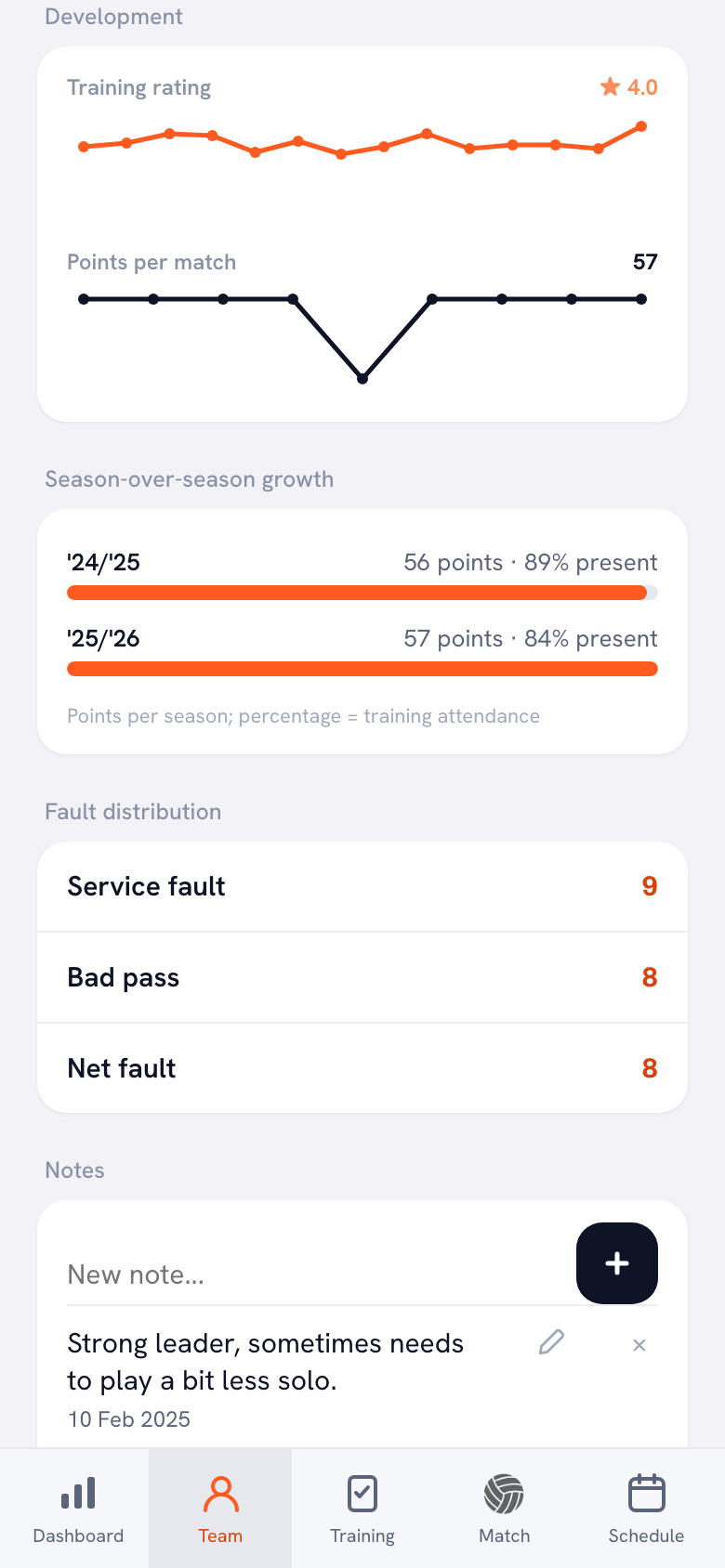
Over a longer period you want an assessment per player, and that is exactly what it remains: an assessment. In Koach, game awareness is one of the five things you rate a player on after a practice, alongside technique, coachability, work ethic and effort; the average of those appears as a training rating in a line over the season. The app does not measure decisions — the number is your judgement — but a few weeks of your own assessments tell you more than the memory of one match. How to fill in an assessment like that fairly is in rating player effort; how to set up a scale like that is in the player evaluation form.
Never punish a good choice that fails. A player who is held to account once for a bold ball will choose the safe option for the rest of the season — and then you are training exactly what you were trying to get rid of. Judge the choice, not the outcome.
By age: when to add choices
You do not wait until technique is finished before training decisions; otherwise you would never start. Age does determine how many options a player can handle at once.
Up to about ten: one choice, and it is spatial. Left or right, short or deep, play it yourself or to a teammate. Small game forms of two against two or three against three do this automatically, because there is always someone there and always a gap. More than one choice per drill is noise at this age.
From about eleven to fourteen: two options, and the block as information. Here you can start with "look at the hands before you hit" and with forms in which the block does something different on each ball. Expect it not to be visible in matches yet; for the first months you will only see it in the drill that contains the constraint.
Fifteen and older: patterns. Now a player can remember what the opponent did earlier and anticipate it. That is the level at which reading per position pays off: what a defender can read from the hitter is in reading the hitter, and how you divide the spaces on court is in defensive systems.
What applies at every age: build the choice into the drill, not into the instruction. A player who hears from you where the gap is has not seen it. So for your next practice, pick one form in which there is something to choose — in Koach the Match play category has more than thirty drills to draw from — and afterwards rate game awareness for the players you watched. After six or so practices you have a series of assessments instead of an impression, and you know whether that choosing is really getting going.
Frequently asked questions
Is volleyball IQ innate or can it be trained?
Some players naturally look earlier, but most of what we call volleyball IQ is experience with recognisable situations. That means it can be trained, provided a player encounters those situations often enough and is allowed to decide for themselves. A season of drills with a fixed answer does not produce game sense, however often you repeat them.
How do you train decision making with beginners without it turning into chaos?
Keep the number of options at one and the number of players low. Two against two on a small court with the question 'where isn't the opponent standing?' is enough for beginners, and the ball comes back so often that a quarter of an hour contains lots of decision moments. Only add a second choice once the first one happens without thinking.
How many choices do you build into one drill?
One constraint per drill, and it only changes once the drill is running. Two constraints at once make players think about the rules instead of the game, and then the drill becomes slow and error-prone. If you want more variety, switch constraints between series instead of stacking them.
How do you assess volleyball IQ without statistics?
Watch two or three players per practice instead of twelve, and in one game form count only whether the choice was good — separately from the execution. Then record your judgement, for example as a rating after the practice, so that over weeks you see a line instead of the memory of the last match. How to set up a scale like that is in the player evaluation form.
Try it yourself in Koach
Less admin, more coaching.
Get started with KoachOr read first what the volleyball coaching app does.