
Setting a team goal for the season
"Just having a fun season" is not a goal, it is an excuse. Teams with a clear, shared goal train with more purpose, accept the coach's decisions more easily and keep each other sharp when things go wrong.
What makes a team goal good?
- Measurable: "promotion to the 2nd division" or "finishing top 3" — come April, you know whether you made it.
- Within your control: it has to depend on what you do, not on the draw.
- Owned by the team: a goal the coach imposes belongs to the coach. A goal the team formulates belongs to the team.
- Ambitious but achievable: too easy motivates no one, too ambitious wrecks morale by November.
How to formulate it together
Schedule half an hour without balls at the start of the season. Have everyone write down what they want to achieve with the team this season, cluster the answers and pick one together. Alongside the outcome goal ("promotion"), also set a behaviour goal ("at least eight players on the floor every practice") — the second one is in your own hands, and it feeds the first. More about that first meeting: making team agreements.
Keeping the goal alive
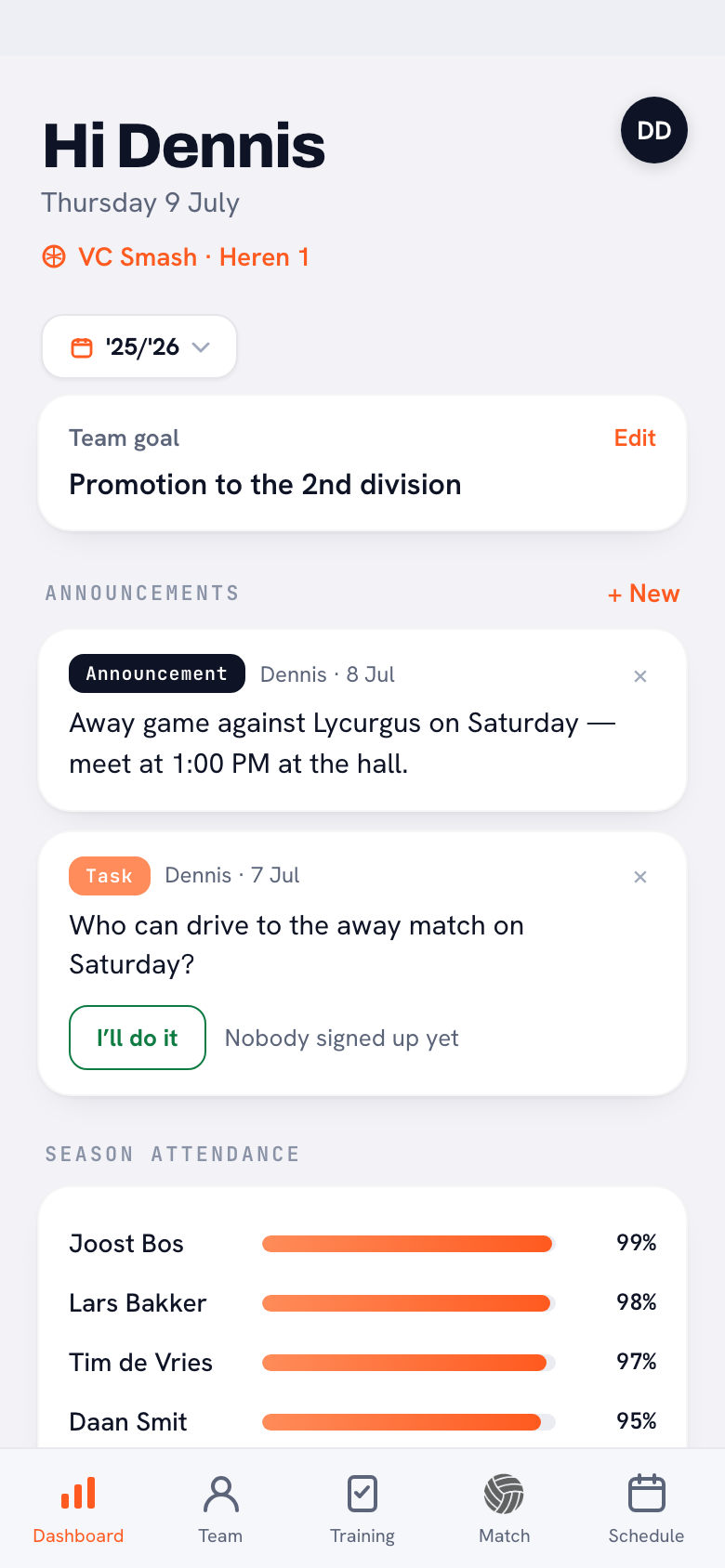
The difference between a goal and a good intention is repetition. In Koach, the team goal sits at the top of the dashboard, right above this season's attendance and effort. That combination is deliberate: the goal and the behaviour that leads to it, at a glance. Refer to it briefly at the moments that matter — after a five-set win, or precisely when attendance starts slipping.
Adjusting mid-season is not weakness. Dead last at the winter break? Turn it into 'win more sets in the second half of the season than in the first'. A dead goal is worse than an adjusted goal.
Frequently asked questions
Should a recreational team have a goal too?
That is exactly where it works well — it just looks different: 'finishing the season together' or 'a full court at every practice' is a perfectly good goal for a recreational team.
What if players disagree about the level of ambition?
That is exactly the conversation you want at the start, not in February. Find the shared minimum and name the differences explicitly — a team that knows three players want to move up understands their training drive better.
How do I connect individual goals to the team goal?
Have every player pick one personal goal that serves the team goal. If the team wants promotion and the opposite wants 45% attack, those two reinforce each other. See also: setting a personal goal per player.


Try it yourself in Koach
Less admin, more coaching — starting at your next practice.
Get started with Koach