
Should You Serve or Receive First in Volleyball?
The captains are standing with the referee, the coin goes up, and in two seconds a decision gets made that most teams have never discussed. Serve or receive? There is a piece of arithmetic that answers it — with a sizeable exception for club teams.
What you are actually choosing at the toss
The winner of the toss picks one of two things: the serve (to serve or to receive), or the side of the court. The loser gets whatever is left. So if you choose 'receive', the opponent gets to pick the side.
Worth knowing: the choice only applies to that set. In the second set it flips automatically — the team that served first in set one receives in set two. In leagues that play four sets it simply keeps alternating. If a deciding set is played, there is a fresh toss before it, and the teams change ends at eight points. What else is different in such a deciding set is worth reading up on.
The arithmetic behind side-out
In rally-point scoring every rally produces a point, and the receiving team wins that rally more often than the serving team. That is exactly what side-out measures. At club level the side-out percentage hovers between 50 and 60 percent; at the top it is above 65 percent.
So if you choose to receive, you start with a rally you statistically win more often than you lose. You take the first lead, force the opponent into the first side-out and then sit one point ahead for the whole set — the classic set pattern where one team keeps drawing level and the other keeps pulling away again. The effect is small, but it is real, and it is free.
Why virtually every top team receives
The higher the level, the bigger that advantage. For teams that win two out of three serve-receive rallies, the opening rally is a near-certain point. And there is a second argument: top teams know exactly which rotation they want to start in, and by receiving they put their strongest side-out rotation on the table immediately. The serve follows along by itself.
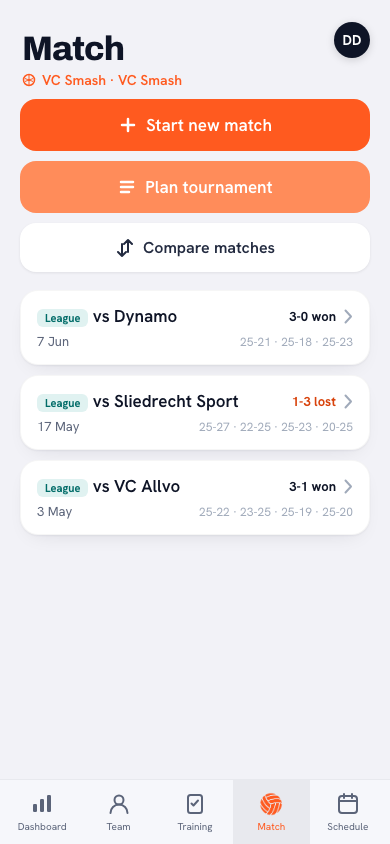
What suits your team is not something you have to guess: your side-out numbers and serving runs in Koach tell you which of the two actually fits.
Why it can work out differently at club level
In the lower divisions the picture tips for one reason: a good serve is far more lethal there than it is higher up. A player with a tight float serve or a jump serve can rattle off six or seven points in a row in an entry-level division against a team that simply cannot get the ball up. Those serving runs are the single biggest source of points at that level — and choosing 'receive' means you only deploy them second.
There is a practical point too: a lot of club teams start nervously. The first reception of a match is one of the most anxious balls of the day, whereas your own first serve is something you control yourself. For a young or unsure team, 'we serve' can therefore be a calmer start than 'we receive'.
A decision rule for your team
- Is your side-out above 55 percent? Choose to receive. You are good enough in the serve-receive rally to take the statistical edge.
- Is it below that, and do you have one outstanding server? Choose to serve, and put that player at P1 so she is up immediately.
- Not sure? Choose to receive. It is the safest default and it keeps your starting order simple.
- Playing outdoors or in a hall with an awkward end? Then the side matters more than the serve — take the good end and let the opponent choose.
What it does to your rotation order
The choice has one consequence that often gets overlooked. Start by serving and your P1 player is up straight away, with your team not having played a single rally yet. Start by receiving and your team plays a serve-receive rally first, with your P1 player only serving after you have scored. In both cases it is your starting lineup that decides which rotation you play out at the beginning of the set — and that is ultimately a bigger dial than the toss itself.
Discuss it before the match, not at the referee's stand. Tell your captain: if we win the toss, we receive — or we serve, and here is why. A captain who has to think on the spot picks whatever the opponent picked last week.
Frequently asked questions
Is it better to serve or receive in volleyball?
Statistically receiving is slightly better, because the receiving team wins the rally more often than the serving team. At lower levels, where one strong server can produce long runs, that advantage carries less weight.
Can you choose the side of the court at the toss?
Yes. The winner of the toss chooses either the serve or the side; the opponent gets the other choice. In halls with a lot of daylight or an awkward background, the end can matter more than the serve.
Does the choice change per set?
The choice only applies to the first set; after that it alternates automatically. If a deciding set is played, there is a fresh toss beforehand and the teams change ends at eight points.