Stacking: How to Hide the Setter in Serve Receive
A penetrating setter who has to run six meters arrives late at the second ball. Yet in a lot of teams she stands neatly in her corner every rotation. She does not have to: the overlap rule allows far more than most coaches think.
What the rule actually says
The alignment rule is usually explained more strictly than it is. At the moment the server contacts the ball there are exactly two requirements, and both only apply relative to your direct neighbours:
- Front-back: every back-row player must have at least part of a foot further from the net than the front-row player she is behind. P1 is behind P2, P6 behind P3, P5 behind P4.
- Left-right: within the same row the order has to be correct. In the front row P4 is left of P3 and P3 is left of P2; in the back row P5 is left of P6 and P6 is left of P1.
What the rule does not say is at least as important. There is no requirement at all between players who are not neighbours — P1 and P4 have nothing to do with each other. There is no minimum distance: a couple of centimeters is enough. And the moment the ball is contacted, everyone may go anywhere. Everything after that is free. More on the rule and the most common mistakes is in avoiding overlap faults.
Why you want your setter close to the net
Every meter the setter has to cover is time she is not watching the ball. A setter who is standing still in her zone between P2 and P3 in good time can run every tempo; a setter still running when the pass arrives plays the ball out of movement and falls back on the high ball outside. So the difference between a six-meter run and a two-meter run is not cosmetic: it decides whether your attacking patterns exist at all.
The three alignments of a penetrating setter
- Setter at P1. She only has to stay behind P2 and right of P6. Put your P2 player close to the net by the right sideline and the setter directly behind her, about two meters off the net. Her run is then under three meters. This is the easiest alignment and should never cause problems.
- Setter at P6. She has to stay behind P3 and between P5 and P1. So let your P3 player stand close to the net, slightly right of centre, and put the setter directly behind her. Do not forget that P1 has to be to the setter's right — so your P1 passer shifts toward the sideline. The run is now a diagonal of about four meters.
- Setter at P5. The hardest one. She has to stay behind P4 and left of P6. The trick: move the whole construction toward the middle. Put P4 not on the sideline but left of centre at the net, the setter directly behind her, and push P6 and P1 well to the right. The setter then starts almost centrally instead of in the left corner, and her run is halved.
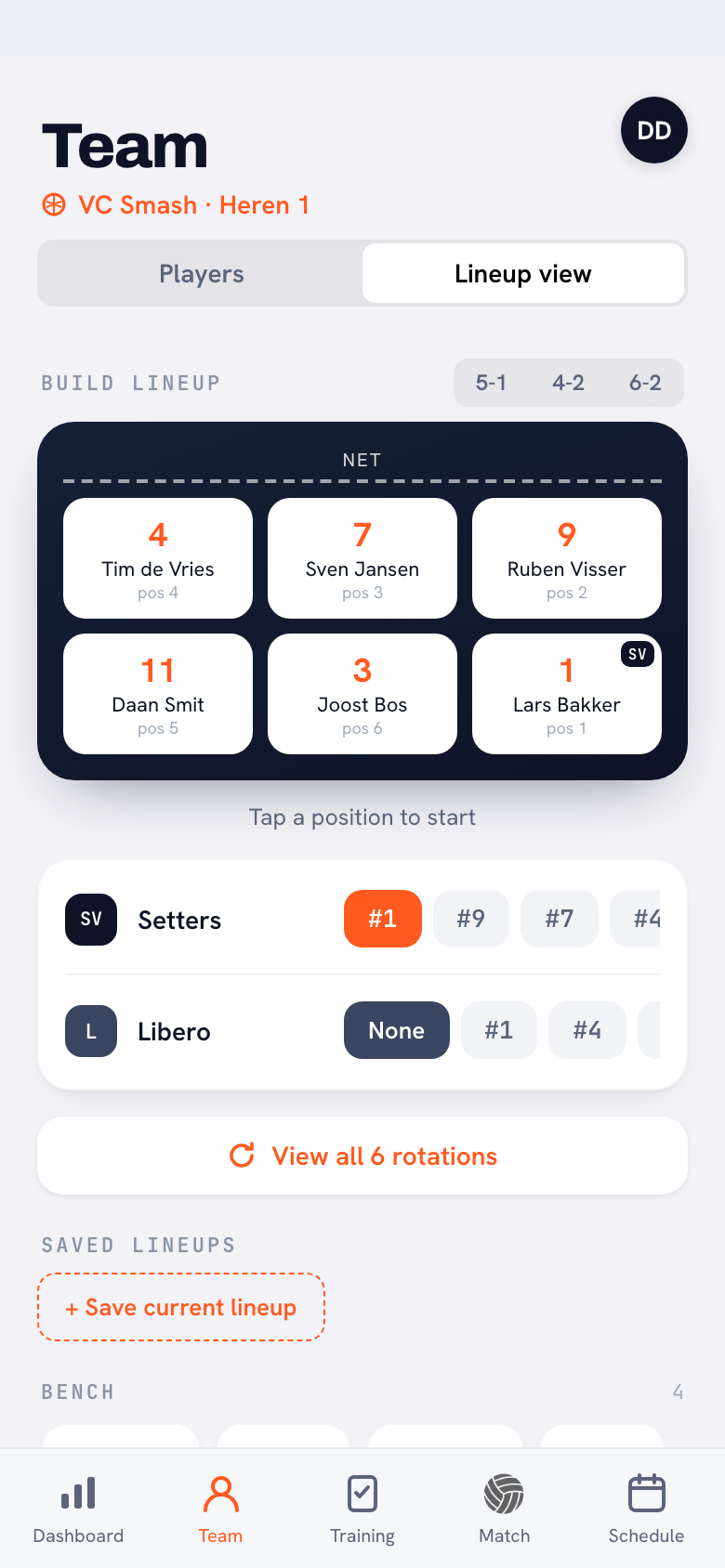
You do not want to reinvent a stacked formation before every match: save the stacked formation per rotation in Koach so you can check it once, calmly at home, instead of on the court with the referee waiting.
You stack your hitters too
The same logic applies to the rest of your team. Your outside hitter at P4 wants to start her approach from outside the court, but before the serve she may perfectly well stand inside it as long as she stays left of P3 — she simply runs out after the serve. Your middle blocker who has to run the quick can start close to the net instead of wedged between the passers. And you can move your weakest passer out of the danger zone by 'hiding' her just behind a teammate and letting the strong passer next to her claim everything. Which formations you are left with after that is in serve-receive formations.
Where the opponent will serve
Stacking is not free money. Squeezing players together leaves space somewhere else, and an alert opponent finds it within a few points:
- The short ball into the vacated zone. With your setter at P5 stacked in the middle alongside P4, the left corner is empty. Agree who sprints there.
- The serve straight at the setter. A setter standing close to the net is a target: if the ball touches her, your offense is out of system immediately.
- The seam you create yourself. Players close together means one big zone next to them. Assign that zone explicitly.
How to check it without risk
Walk through your six alignments one by one and ask each player the same two questions: who is my front-row or back-row anchor, and who is to my left and right? Have every player name her two anchors out loud. Then actually set the formation up in training and have a teammate watch from the sideline to check the order — a photo from the referee's stand works even better. And build it up calmly: start stacking in the alignment where it pays off most (setter at P5) and only expand once that one is flawless. For first steps with a young setter, positioning a beginning setter is a good companion piece.
Every player remembers two names, not a floor plan. 'I am behind Sanne and to the right of Tom' is memorable under pressure; a drawn formation is not. A player who knows her two anchors stands correctly in every rotation automatically.
Frequently asked questions
May players stand in among each other before the serve?
Yes, as long as the order relative to their direct neighbours is correct: every back-row player behind her front-row counterpart, and the correct left-to-right order within each row. Between players who are not neighbours there is no requirement at all.
How much distance has to be between two players?
No minimum distance is prescribed. Part of a foot further from the net or further to the left than your neighbour's is enough, though a clear margin is sensible in practice.
When may players move to their real positions?
The moment the server contacts the ball. From then on there are no positional requirements and everyone may run to the spot where they do their job.
Is stacking useful with juniors as well?
To a limited extent. Teach young players the plain order and their two anchors first; only once that is flawless is it smart to let the setter start closer to the net.