
Volleyball Overlap Rules: Which Two Neighbours Stood Wrong?
The serve is not even over the net and the second referee is already blowing the whistle. Arm pointing to the other side, a circle with the index finger, point gone. On the bench everyone looks at each other: who was out of position? Coaches call this overlap, but if you go looking for the volleyball overlap rules you will find that the word does not appear in any rulebook, and that is where the confusion starts. This piece shows which two neighbours are compared, what rule 7.4 changed for the serving team and at which three moments it goes wrong in the gym.
This piece starts at the whistle, not at the rule. The rules per rotation and how to teach them to your team are in preventing positional faults: the rules per rotation. And if nobody was out of position but the wrong player served, you are dealing with the rotational fault of serving out of order.
Volleyball overlap rules: the coaching term no rulebook uses
On the sideline this fault is usually called "overlap". The rulebooks do not use that word. The FIVB rules call it a positional fault; the American high school rulebook calls it illegal alignment. What coaches mean by overlap is the same thing.
That is more than a matter of wording, for two reasons. The first is practical: if you want to look up the rule, or ask the referee for an explanation through your captain, "positional fault" gets you to the right answer faster. The second is about substance: the word overlap suggests that players may not overlap each other, as if they have to stand neatly in six boxes. That is not how the rule works. Players may stand close together and at an angle to each other. It is only about the order between neighbours, and that is read from the feet on the floor, not from arms or a torso leaning forward. The rest of the rules framework is in all the volleyball rules at a glance.
Which two neighbours the second referee compares
A positional fault is never the fault of one player. It is always a pair: two neighbours who are in the wrong order at the moment of the service contact. On the whole court there are exactly seven such pairs.
- Three front-back pairs. Position 4 with 5, position 3 with 6, position 2 with 1. The front-row player has to be closer to the net than their back-row neighbour.
- Two pairs in the front row. Position 4 with 3, position 3 with 2. From left to right the order has to be correct.
- Two pairs in the back row. Position 5 with 6, position 6 with 1. Here too, the order from left to right is what counts.
Three plus two plus two is seven. The corner players in 1, 2, 4 and 5 are each in two pairs, the middle players in 3 and 6 in three: they have a neighbour in front of or behind them and a neighbour on each side. How the positions are numbered is in position numbers 1 to 6.
For the bench this produces a better question than "who was out of position". Ask which pair it was. The answer immediately tells you where to look. If it is a front-back pair, a back-row player stepped towards the net too early, or a front-row player who had to pass was standing deeper than their back-row neighbour. If it is a pair within the same row, someone slid sideways, usually when hiding a passer or moving the setter.
Since rule 7.4, the serving team can no longer commit a positional fault
In the FIVB rules for 2025 to 2028, rule 7.4 was split. The receiving team still has to be in rotational order at the moment of the service contact. The serving team no longer does: its players may take any spot, as long as they are within their own court. The server is outside that anyway. The full change is in the new volleyball rules.
For your lineup that means three things:
- You can only get a positional fault when you are receiving. When the serve is on your side, nobody has to watch their neighbours.
- You can rethink your serving rotations. Blockers can stand at their blocking spot straight away and the setter can already wait at their spot at the net.
- The serving order does not change. Who serves remains fixed. Free positioning is not the same as free serving: whoever serves out of turn still commits a rotational fault.
That makes the search after a whistle simpler. If you got the signal while your team was serving, under these rules it was not a positional fault. If your team was receiving, it was, and the answer lies in one of the seven pairs.
Check the start date with your own federation. The FIVB sets the rules, but national federations decide for themselves from when they apply and to which competitions. Only teach your team the new serving formation once you are sure the change has taken effect in your competition.
The three moments it goes wrong in the gym: the setter moving in, stacking, the libero in front
The fault rarely comes from pure inattention. There is usually a good intention behind it: someone wants to get to their spot faster. Three situations keep coming back.
1. The setter moving in. If your setter is in the back row while you are receiving, they want to get to the net as fast as possible after the opponent's serve. The formation is correct, but the setter leaves a fraction too early: before the service contact they take a step forward or sideways, and in doing so pass their neighbour. So the fault is not in where they stand, but in when they move. The rotations in which that happens most often, and how far you may shift, are in stacking with the setter.
2. Stacking in serve receive. To take a weak passer out of serve receive or put a hitter in place early, players shift to a corner or to one side of the court. That is allowed, and a few centimetres' difference from your neighbour is enough. But a few centimetres too far is also enough. With stacking it almost always goes wrong in a pair within the same row, because that is where most sideways shifting happens.
3. The libero ending up in front. The libero may only replace a back-row player. After rotating, the libero's spot can end up in the front row, and if nobody then brings back the player the libero replaced, the libero is in the front row at the moment of service. Formally that falls under the libero rules and not under the neighbour rule, but it becomes visible at the same moment: the service contact. And it happens at the moment everyone is busy with something else, namely rotating. What else the libero may and may not do is in the libero: rules, role and registration.
In all three cases the same question after every rotation helps: who is standing next to whom now? How the order rotates is in rotation order.
What the fault costs, and what does not happen
The bill is short. The opponent gets a point and keeps the serve, and the players of your team are put back in their correct positions. Because the serve stays on the other side, your team does not rotate: you receive the next serve in the same rotation.
What does not happen is at least as important to know:
- No points are cancelled. That only happens with a rotational fault, when the wrong player has served. A positional fault is about one rally.
- A failed serve does not save you. If the opponent's serve goes into the net or out after the contact, your positional fault still counts, because it came first. Only a fault by the server at the moment of the contact itself, such as a foot fault, takes precedence.
- No extra penalty follows. No warning and no card: a positional fault is a playing fault, not a conduct issue.
What you do next is brief. The game captain asks which pair it was, you look up in your lineup which two players that is in this rotation, and you agree one thing with those two for the next reception in the same rotation. Because that comes straight away.
What Koach sees — and what it doesn't
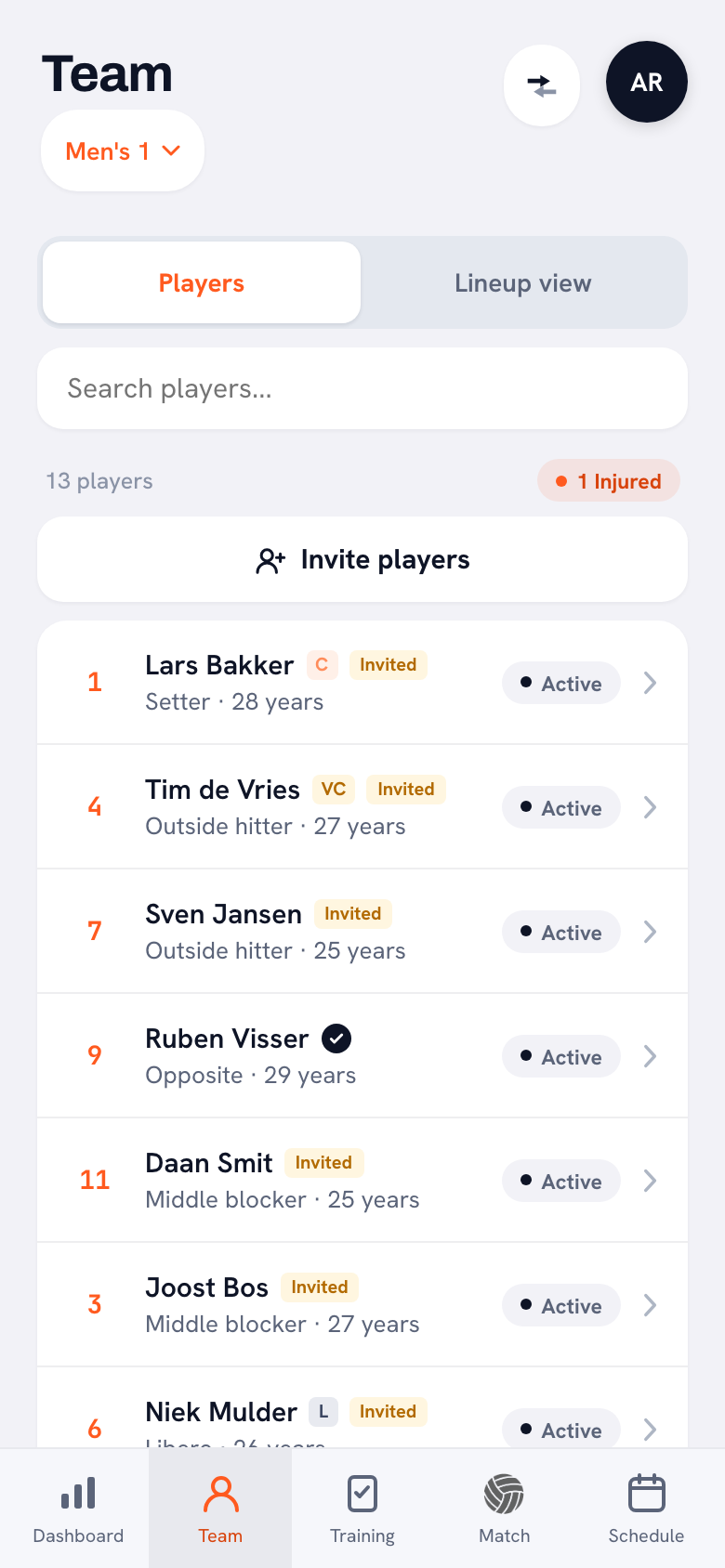
The honest summary is that the app recognises one lineup fault by itself, and not the rest. When you build the lineup and during live scoring, a warning with name and position appears as soon as the libero ends up in the front row. On top of that, the rotation check shows you the six rotations before you lock in the lineup, and the free rotation generator lists the base positions at the moment of service for each rotation.
What the app does not do:
- There is no general overlap check. The neighbour rule between the other five players is not checked.
- There is no warning during the rally or at the moment of service: the app does not know where your players are really standing in the gym.
- The weakest rotation in the rotation check is about attacking power in the front row, not about faults.
- The rotation generator draws base positions, not a passing formation and not stacking.
If you want to go through the six rotations once with your captain, lay them out in the free rotation generator and print the sheet. If you set up your lineup in Koach, you get a warning straight away while preparing it if the libero ends up in front. Try Koach free for fourteen days.
Frequently asked questions
What is overlap in volleyball?
Overlap is the term coaches use for a positional fault: at the moment of the service contact, two neighbours in the receiving team are in the wrong order. The word appears in no rulebook; the FIVB calls it a positional fault. Seven pairs are compared: three from front to back and four from left to right.
How can I see from the bench who was out of position?
Usually not with certainty, because it happens at the moment of the service contact and it is a matter of centimetres. Have the game captain ask which pair it was, and look up in your lineup which two players that is in this rotation. A front-back pair points to someone who stepped towards the net or backwards too early, a pair within the same row to someone who slid sideways.
Is overlap the same as a rotational fault?
No. With a positional fault players are out of position relative to their neighbours at the moment of service; that costs one rally, so the opponent gets the point and keeps the serve. With a rotational fault the wrong player serves, and points already scored can be cancelled. The referee uses the same signal for both, a circular movement of the index finger.
Can the libero be in the front row?
Not as a front-row player at the moment of service. The libero may only replace a back-row player; if the libero's spot rotates to the front row, the player the libero replaced has to come back before the next serve. During the rally the libero may move to the net, but may not block or attack with the ball above the top of the net. More on that in the libero: rules, role and registration.
Who checks the lineup: the first or the second referee?
The second referee checks the positions of the receiving team, and since rule 7.4 that is the team that matters. If there is only one referee, as in many lower-level matches, that referee watches the receiving team's positions on top of everything else. If in doubt, ask for an explanation through the game captain.
Try it yourself in Koach
Less admin, more coaching.
Get started with KoachOr read first what the volleyball coaching app does.