The 6-6 Volleyball Rotation for Beginners Explained
A brand-new team, six players who still have to learn everything, and a first match in three weeks. That is not the moment for penetration runs and fixed roles. The 6-6 is the answer: everybody does everything, and the rotation takes care of the rest.
The principle: your job follows your position
In a 6-6 there are no specialists. There is no fixed setter, no fixed middle blocker, no opposite. Instead, your job hangs on the spot you happen to be standing in: whoever rotates into a given position picks up the job that belongs to it. So across a single set, all six players fill all six roles. Hence the name: six hitters, six setters.
The most common agreement is that the player at P3 (middle front) takes the second ball. The alternative — often better once your team has a few months behind it — is the player at P2 (right front), because setting from the right lines up naturally with an attack to the left. Pick one and stick to it; mixing the two versions is the fastest way to lose beginners.
Who does what, rotation by rotation
Because the job hangs on the position, the split of work is identical in every rotation — only the names change:
- P1 (right back): serves, then defends the right half of the back court.
- P2 (right front): blocks on the right and hits from the right. In the version where P2 sets, this is the setter for that rotation.
- P3 (middle front): sets (the standard version) and blocks in the middle.
- P4 (left front): the main hitter of the rotation: almost every ball goes high to the left.
- P5 (left back): passes and defends the left corner.
- P6 (middle back): passes the deep serves and covers the tip through the middle.
The setter for that rotation stays out of serve receive; the other five pass in a W formation. That is the only agreement you genuinely need in order to play. Every other rotation rule still applies in full: even without specialists, everyone has to be in a legal position at the moment of the serve, or you concede an overlap fault.
What you gain
Three things, and for a beginning team they carry real weight. One: there is nothing to learn except the rotation order — no release routes, no timing, no substitutions. Two: everybody develops every skill, which produces better volleyball players in the long run than early specialisation does. Three: you are not vulnerable anywhere. If two players are missing, a different six plays exactly the same game — there is no indispensable setter.
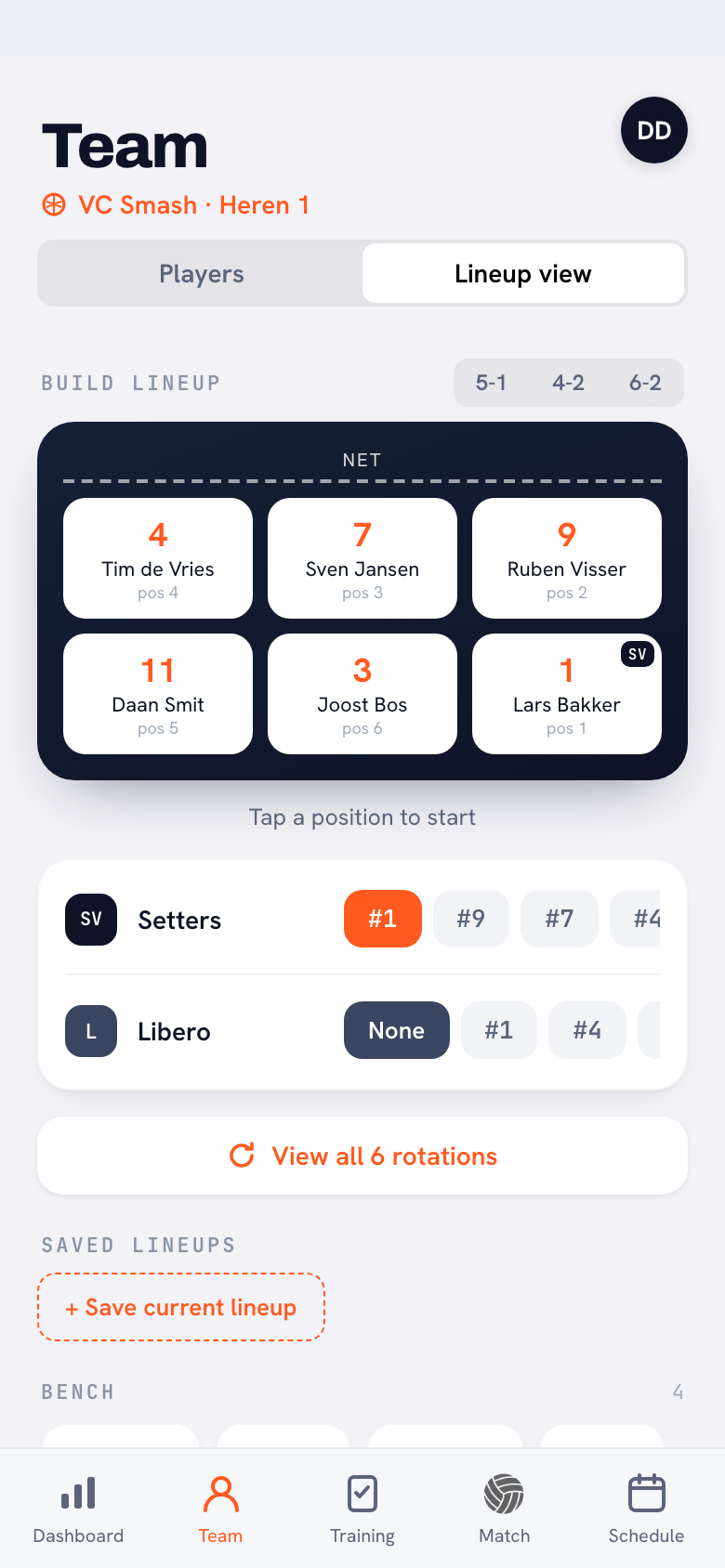
Because nobody specialises yet, you can give each player a second position in Koach and let the lineup simply follow the rotation — handy when you do want to specialise later and need to see who comes out best where.
And what it costs
The bill arrives the moment your opponent is organised. Your setting quality swings from rotation to rotation: one rotation delivers a tidy ball to the left, the next produces a set that sails behind the hitter. Fast tempos are impossible, because the setter of the moment does not have the hands for them. And because the role only comes into being the moment the ball arrives, your attacking threat stays limited to 'high ball to the left'.
That need not be a problem — at beginner level the team that plays the ball three times and gets it over the net wins. But as soon as your opponents play three touches and serve with intent, you will see that swing show up on the scoreboard.
How to make a 6-6 better without specialising
- Give the setter a fixed spot. Agree that the second ball always goes to the same zone: just right of centre, about a meter off the net. Whoever is standing there sets. That way the whole team learns to deliver the same pass.
- One attacking pattern. High ball to P4, every time. Predictable, but achievable — and it gives the hitter the time she needs.
- Fixed calls. 'Mine!' on the pass, 'yours!' for the setter. In a system without roles, the voice does the work that role definitions do elsewhere.
- Take out the weakest position. If one player consistently gets stuck in the setting rotation, let P2 set for her rotation only. A team can remember one exception; it cannot remember three.
When do you move on?
There are three signals. Your team consistently passes three out of four balls playably to the setting zone. Two or three players are clearly better setters than the rest. And you are losing points because the offense is too predictable. Then it is time for a 4-2: you appoint two setters who stand opposite each other, and the rest of the system stays exactly as it was. That is the smallest step that exists and usually the right one. With juniors there is no need to force it — young players who have just moved up to the full court gain more from learning every role than from being pinned to a position early.
Do not let the 6-6 run too long with talented players. For a recreational team the system can work happily for years. For a junior team with ambitions, a season and a half to two seasons is enough: after that, players learn more from a role with depth than from a different job every week.
Frequently asked questions
Who sets in a 6-6 system?
Whoever is at middle front (P3) at that moment, or in the widely used variant the player at right front (P2). So it is a different player every rotation, and the setter of that rotation stays out of serve receive.
Is a 6-6 the same as 'just winging it'?
No, and that difference matters. In a 6-6 the jobs are fixed per position — only the names change each rotation. Without that fixed split of work per position it is not a system, it is improvisation.
Can you play league volleyball with a 6-6?
Certainly, it is used all the time in recreational and entry-level divisions. You notice the ceiling as soon as opponents serve deliberately at your weakest rotation and attack with three front-row hitters.
Can you use a libero in a 6-6?
You may, but it fits badly: a libero is a specialist by definition and may not set an attack from inside the front zone, may not serve and may not block. In a system without roles that mostly creates confusion.