
The momentum line: see where the match turned
Everyone on the sideline féels momentum: the run that is coming, the hall that tips. But by Tuesday's debrief that feeling has evaporated and only the result remains. The momentum line captures the feeling as a wave — rally by rally, with a dot on the point where the set really turned.
What the momentum line shows
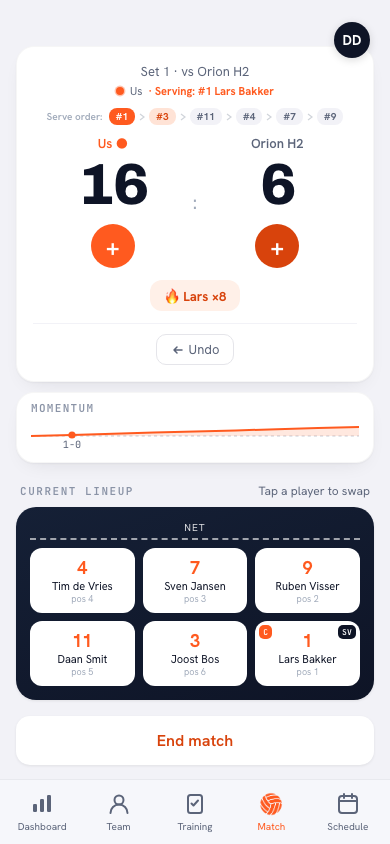
The line draws the cumulative point difference per rally: above the zero line you are ahead, below it the opponent is. A flat wave is a set that stays level; a steep slope is a scoring run. Where the score progression retells the set rally by rally, the momentum line shows in a single image when the match flowed and when it drained away. It is the same data, but as a shape — and a team remembers shapes better than numbers.
Live: the small wave under the score
When you score a match live, a small wave appears under the score automatically from the fourth rally on. No extra input, no setting — it draws itself from the points you are already recording. On the sideline it is an early alarm: a wave diving the same way for three, four rallies is exactly the moment to think about a time-out instead of looking back on one.
In the match detail: the dot on the turning point
Afterwards, each set gets its own momentum wave in the match detail, with a dot on the turning point: the start of that set's longest scoring run, including the score at that moment. So not 'we lost set three', but 'at 16-14 up, their run of six began'. That one score is worth gold: it tells you where to look — the opponent's serving turn, the substitution just before, the time-out that never came.
How to use it in the debrief
In the match review, show the wave instead of retelling the set. Start at the dot: "here it was 16-14 — what happened there?" — and let the team reconstruct it themselves. Because the line belongs to nobody, the conversation becomes about the pattern instead of the culprit. If you see the same kink return across matches — always midway through set two, always after a run of your own — you have no incident but a training goal. For the rally-level detail behind the kink, you then dive into the score progression.
Discuss the score, not the culprit. 'At 16-14 it turned' is an observation everyone can work with; 'that is where you lost it' is a reproach nobody gets better from. The dot hands you the first sentence of the debrief for free — keep it neutral.
Frequently asked questions
Do I need to track anything extra for the momentum line?
No — the line emerges automatically from the regular point tracking of live scoring. For matches where you only enter the result, there is no progression and therefore no momentum line.
What exactly does the dot on the wave mean?
The dot marks the set's turning point: the start of the longest scoring run, with the score at that moment. At a glance you see at which score the set turned.
Why does the line only appear after a few rallies while scoring?
The wave appears from the fourth rally on. Before that there is simply no progression to draw — two points are a score, not yet a movement.
See where your matches turn
Score your match live in Koach and the momentum line draws itself — turning point included.
Get started with Koach