
Volleyball drills with 3 people: 8 drills in the triangle
The short answer
Volleyball drills with 3 people let you train the whole chain of pass, set and attack. Work in a triangle with a tosser, a passer and a target, or with a passer, a setter and a hitter, and rotate the roles after a fixed number of balls. Finish with two against one on a narrow court.
Volleyball drills with 3 people are more than drills for two plus a spectator. The third player completes the chain: someone tosses, someone plays, someone catches or sets. Here are eight drills, how to rotate the roles fairly and an hour you can use as it stands.
What three players make possible
With two players you can train a lot of technique, and there is a separate article on that: volleyball drills for two people. With three, something fundamental changes. Suddenly there is a destination: the pass does not go back to whoever tossed it, but to a third player in the setter's spot. And there is a full chain: pass, set and attack all sit in one drill.
Three players also give you a fixed split between work and rest. One player works, one feeds and one is the target or the setter. Whoever tosses gets a breather without standing still, and meanwhile learns something every practice needs: tossing accurately. That way the working player can go all out and the quality stays high.
Fixed names help. In the drills below, the player who brings the ball into play is the tosser, the player doing the work is the worker (passer, defender or hitter), and the player who receives the ball is the target or the setter.
Eight drills with three people
Passing
- 1. Triangle passing. Tosser, passer and target stand in a triangle. The tosser throws, the passer plays to the target, the target plays back to the tosser, and then everyone moves one corner on. The animation on the Triangle passing page shows that after every ball; if you want more reps per role, rotate only after a series of ten. Count: how many of the ten passes the target can take without moving a step.
- 2. Passing triplets with two balls. The tosser has two balls. They throw the first one to the passer and the second straight away to the side, so the passer has to shuffle along. The target rolls both balls back. That gives you lots of reps per minute; switch after eight balls.
Setting
- 3. Setting in a line, with a back set. Three players stand along the net at positions 4, 3 and 2. The player at 3 is the setter and always faces position 4. Position 4 plays the ball high to the setter, who back sets to position 2. Position 2 plays back to the setter, who now sets forward to 4. The setter never turns around. Every set has to clear the top of the net. Switch after ten sets.
Attacking and defending
- 4. Pepper with three. A hitter, a digger and a setter. The hitter hits under control at the digger, who digs to the setter, and the setter sets for the hitter. That gives the dig a real target, something regular pepper lacks. How pepper works in general and where it falls short is in pepper in volleyball; the version for three is in Pepper series (build-up).
- 5. The triangle over the net. Player A stands on the other side and plays an easy ball over the net to B in the back court. B passes to C, the setter at the net, and C sets high to position 4. B makes an approach and attacks towards A, who digs or catches the ball and brings in the next one. After eight attacks everyone moves on: A becomes passer, B setter, and C goes to the other side.
- 6. Hitter against one blocker. A setter, a hitter and a blocker on the other side. The setter tosses the ball up for themselves and sets outside, the hitter attacks and the blocker tries to take away the line or the cross-court. The blocker calls out before the set which side they will take; the hitter has to choose the other side. Switch after six attacks.
Serving and receiving
- 7. The butterfly. A server, a passer and a target. The server serves cross-court and follows the ball to the other side, the passer plays to the target, and then everyone moves one role on: the server becomes passer, the passer becomes target and the target takes the ball along and serves. The animation is in the Butterfly drill.
Game format
- 8. Two against one. Play on a narrow court, for example half the width and six meters deep. The pair has to use three contacts. The single player may play the ball up to three times in a row: pass, set themselves and play it over the net. In a real match that is not allowed; there, no player may hit the ball twice in a row. The exceptions concern the block and two contacts within one action on the team's first hit (FIVB rule 9.1.1). Play to seven points, then someone else becomes the single player. If it is too easy for the pair, let them attack only from behind the attack line.
Give the tosser something to achieve too. Give the tosser a goal of their own, for example eight out of ten balls exactly where the worker needs them. A sloppy toss costs the worker their reps, and an accurate toss is a skill your team uses in every drill.
Rotating: how to switch roles fairly
With three players, things go wrong on the switching, not on the drill. Agree on one rule beforehand and stick to it.
- After a fixed number of balls. Ten balls per worker, then everyone moves one role on. Fair and predictable; suits technique drills.
- After a goal. The worker stays until they have six good balls. That adds tension, but set a maximum of fifteen balls, or a weaker player stays in too long.
- Whoever makes the error becomes the tosser. Quick and playful, good for pepper with three and the triangle over the net. Not for beginners: whoever makes the most errors then plays the least.
- Always the same direction. Tosser becomes worker, worker becomes target, target becomes tosser. That way everyone has had every role after three switches.
An hour with three players
- Warm-up, 10 minutes. Warming up as a three in a triangle, first overhead, then forearm passing, then pepper with three at half power.
- Passing, 15 minutes. Triangle passing and passing triplets with two balls, with a count per worker.
- Setting, 10 minutes. Setting in a line with a back set; everyone is the setter once.
- The chain, 15 minutes. The triangle over the net, with eight attacks per turn.
- Two against one, 10 minutes. Three short sets to seven, so everyone is the single player once.
How to build the blocks of a practice and keep an eye on the clock is covered in running a volleyball practice.
What you do not train with three players
A serve receive formation, a block with defense behind it and running through a rotation need more players. Do not try to imitate them with three; you would be training a version that does not exist in a match. If four to six players turn up more often, have a look at training with a small team.
Finding drills for three in Koach
Open a drill in Koach and you see at the top how many players it needs, such as 3 players for Triangle passing. If you open it from the plan of a practice, the bottom shows Previous and Next with the name and the minutes of the next block, so in the gym you go from drill to drill without searching back.
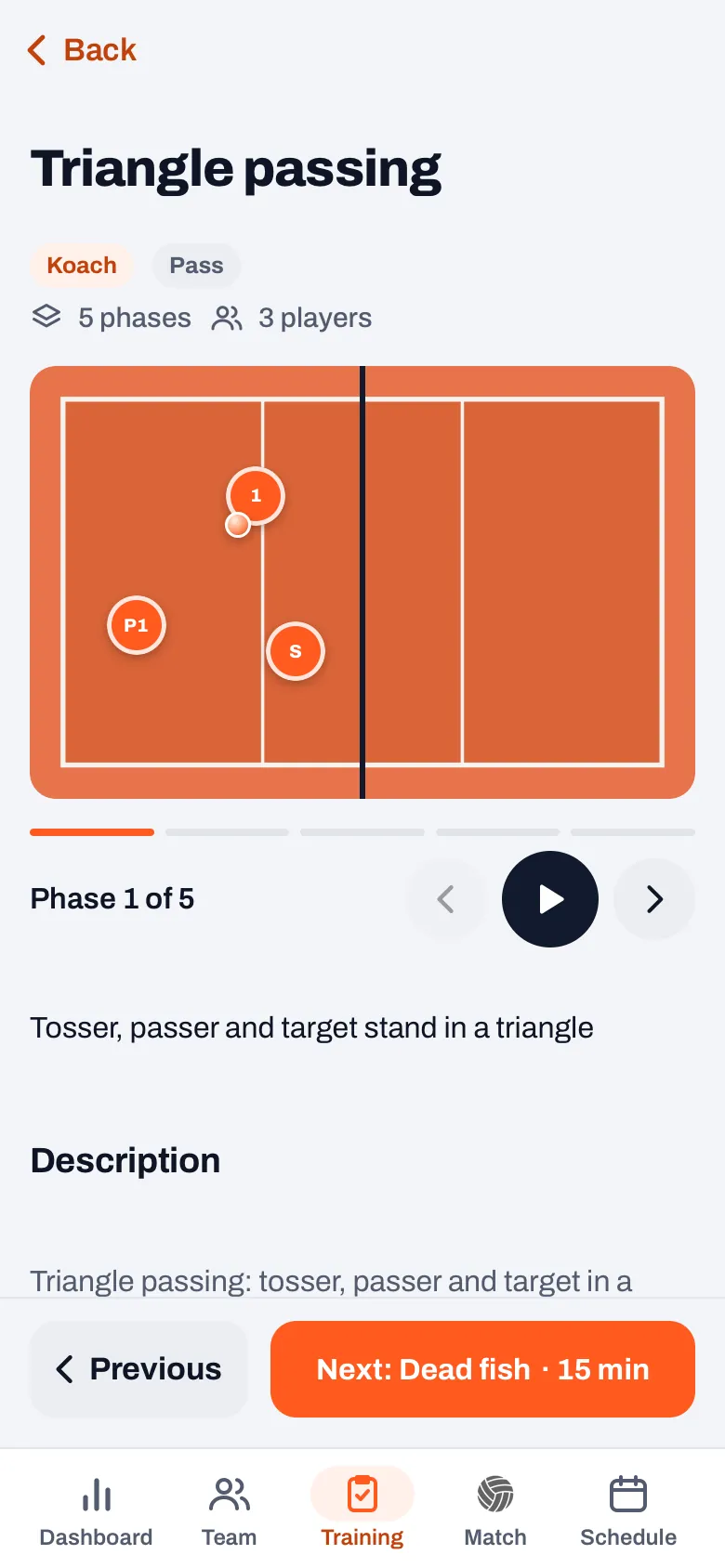
Pick your drills with + Add drill in the Add drill sheet, and each drill shows its number of players. If three players have signed up for the practice, the Fits 3 chip only shows drills for three or fewer. Note one thing: the number counts the players drawn in the drill, not the coach. A drill in which the coach tosses, such as Passing triplets, is therefore listed with 2. With three players, the third simply takes over the coach's role.
Players pay nothing; the coach tries Koach free for 14 days. What it costs after that is on the pricing page.
14 days free, no credit card. Put an hour for three players in your plan and work through it in the gym with Next.
Plan your practice in KoachFrequently asked questions
What volleyball drills can you do with three people?
With three people you can pass in a triangle, set with a back set, play pepper with three and train the whole chain of pass, set and attack over the net. A serve with a pass and a target, such as the butterfly, and a small game of two against one on a narrow court also work well. Rotate the roles after a fixed number of balls.
How does pepper with three players work?
There is a hitter, a digger and a setter. The hitter hits under control at the digger, who digs the ball to the setter, and the setter sets for the hitter. Then it starts again. The difference with pepper for two is that the dig has a real target: the setter's spot. Rotate the roles after ten good rounds.
Can you play a game with three players?
Yes, with two against one on a narrow court, for example half the width and six meters deep. The pair uses three contacts, and the single player may play the ball up to three times in a row: pass, set themselves and play it over. In a real match a player may not touch the ball twice in a row; in this practice format that is deliberately different. Play to seven points and then switch, so everyone is the single player once. If the pair is too strong, they attack only from behind the attack line.
How many balls do you need for a practice with three?
Three to five balls is enough. With one ball you lose a big part of the time chasing it, especially in the drills over the net. Keep the balls with the tosser, so they can bring in a new one right away, and have the target roll balls back instead of throwing them.
Put your hour for three in your plan
14 days free, no credit card. In the gym you work through it with one tap per drill.
Get started with KoachOr read first what the volleyball coaching app does.