
Volleyball league points system: 3-0, 3-1 and 3-2 explained
The short answer
In the volleyball league points system of FIVB competitions such as the Volleyball Nations League, a 3-0 or 3-1 earns the winner three points and the loser none, and a 3-2 earns the winner two and the loser one. Ties are broken by set ratio and point ratio. The system does differ by country and competition.
The volleyball league points system differs by country and by competition, and that raises the same questions every season. What does a 3-1 earn, why does the loser of a five-setter get a point, and what does a set ratio do? This article starts from the FIVB competitions and uses examples to show how other competitions differ.
The FIVB system: 3, 2, 1 or 0 points
Under the rules, a volleyball match is won by the team that wins three sets; how those sets and the fifth set work is in how many sets a volleyball match has. How many league points a result earns is not in the rules of the game but in the regulations of the competition. In its own competitions, such as the Volleyball Nations League, the FIVB uses this split:
| Result | Winner | Loser |
|---|---|---|
| 3-0 or 3-1 | 3 points | 0 points |
| 3-2 | 2 points | 1 point |
| Forfeit | 3 points (counts as 3-0) | 0 points; the sets count as three times 0-25 |
Source: the Volleyball Nations League 2026 Competition Regulations, article 2.5. The idea behind it: winning in three or four sets is worth the same, but a team that only wins in the fifth set shares a point with the opponent. A team that loses 2-3 kept the match open until the last set and gets one point for it.
How many points do you get for a 3-1 win?
In the FIVB system, three: exactly as many as for a 3-0. This is precisely where competitions differ. In a competition where four sets are always played, every set has its own value and a 3-1 is worth less than a 4-0. An example follows further down. If you do not know which system applies in your competition, check your federation's competition regulations: they take precedence over everything in this article.
Ties: wins, points, set ratio and point ratio
If teams finish level, a fixed order of criteria decides. In the Volleyball Nations League it is:
- the number of matches won;
- the number of points according to the table above;
- the set ratio: all sets won divided by all sets lost;
- the point ratio: all points scored divided by all points conceded, across all sets;
- the head-to-head result. If three or more teams are tied, only the matches between those teams count.
FIVB documents call these the sets ratio and the points ratio. Note the order: the VNL looks at the number of wins first and only then at the points. Other competitions rank by points first. The league of the Dutch federation, for example, looks first at the set ratio when points are level, then at the point ratio and then at the head-to-head matches (Nevobo competition regulations, chapter 1, December 2025).
Worked example: same results, different order
Say two teams have these results after four matches:
| What counts | Team A | Team B |
|---|---|---|
| Results | 3-0, 3-1, 2-3, 1-3 | 3-2, 3-2, 3-1, 0-3 |
| Matches won | 2 | 3 |
| Points (3-3-2-1-0) | 3 + 3 + 1 + 0 = 7 | 2 + 2 + 3 + 0 = 7 |
| Sets | 9 won, 7 lost | 9 won, 8 lost |
| Set ratio | 9 / 7 = 1.286 | 9 / 8 = 1.125 |
With the VNL order, team B ranks higher, because it won three matches and team A two. In a competition that looks at points first, they are level on seven and the set ratio decides: then team A ranks higher. The same results therefore produce a different table, depending on the regulations.
A standings table usually shows these figures per team: matches played, won and lost, the points, the sets won and lost, and the points scored and conceded. If the ratio is not listed, you calculate it yourself from those columns.
If the set ratios are also equal, you calculate the point ratio the same way. If a team has scored 412 points in all its sets combined and conceded 398, its point ratio is 412 / 398 = 1.035. A ratio above 1 means the team scored more points than it conceded; the higher, the better.
Keep the set scores of every match, even when you win. At the end of the season the point ratio can decide a place in the table, and then every 25-13 and every 23-25 counts. If you only note the result in sets, you cannot recheck the standings.
Other systems: it differs by country and competition
The points system differs by country and by competition. Three examples:
- Always four sets. In the league of the Dutch federation, the Nevobo, four sets are always played from the Topdivisie down to the regional leagues, even after 3-0. At 2-2 a fifth set follows. A 4-0 earns the winner 5 points and the loser 0, a 3-1 earns 4 and 1, a 3-2 earns 3 and 2. In the Superdivisie, the highest amateur division, best-of-five applies with 3, 2, 1 or 0 points; this chapter of the regulations does not apply to the Eredivisie (source: the Nevobo regulations above).
- Five points per match with best-of-five. The FIVB documentation of its results system VIS also lists a ranking method named Norceca-2016, after the confederation of North and Central America: 3-0 earns 5 points, 3-1 earns 4, 3-2 earns 3, and the loser gets 2, 1 or 0 (FIVB VIS, ranking methods).
- Two points for a win, one for a loss. The same documentation lists this simpler system. In a tie, the point ratio decides first and only then the set ratio.
Tournaments, youth leagues and cup rounds often have their own format, with timed sets or a single deciding set. In European cup rounds with a home and an away leg, a golden set sometimes decides. All the playing rules themselves are in volleyball rules at a glance.
What the points system means for your coaching
- In the 3-2-1-0 system the fourth set weighs heavily. If you lead 2-1, winning the fourth set is worth one point more than winning in the fifth. If you trail 1-2, winning the fourth set already earns you a point, whatever happens after that.
- In a competition with four fixed sets, every set counts. At 3-0 the fourth set is no throwaway: it is the difference between 5 and 4 points. If you bring everyone off the bench then, you should know what it might cost.
- Do the math before a head-to-head match. Say you play in a competition that ranks by points with 3-2-1-0, you are two points behind a rival, and your last match is against that team. If you win 3-0 or 3-1, you take three points and they take none: you finish one point ahead. If you win 3-2, you get two and they get one, and you stay one point behind. So you need to win that match in four sets, and that decides how you go into the fourth set.
- Giving up on a hopeless set costs you in the ratio. A set you lose 12-25 weighs more heavily in the point ratio than a 23-25.
Tracking results and set scores in Koach
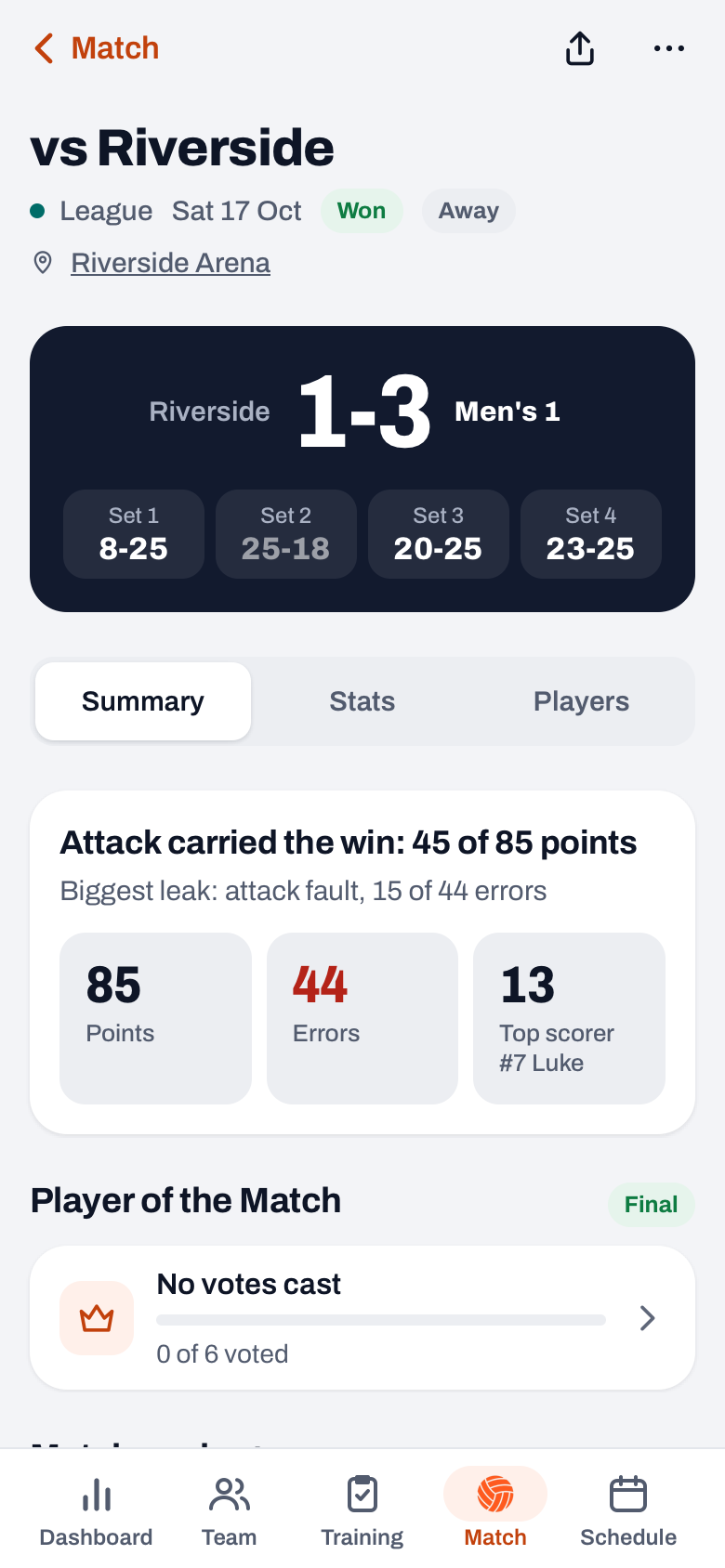
After a match you track live in Koach, the result and the score of every set are on the match screen. That gives you everything you need to recheck your set ratio and point ratio. After each set you choose whether to start the next set or end the match, so a competition that always plays four sets can be tracked without workarounds too. If you play in the Netherlands, you can also follow your league table in the app.
What Koach costs after the 14 free days is on the pricing page.
14 days free, no credit card. Track your match live on Saturday and have every set score at hand afterwards.
Try Koach at your next matchFrequently asked questions
How many points do you get for losing 3-2 in volleyball?
In the FIVB system, one point: the winner of a 3-2 gets two, the loser one. After a 0-3 or 1-3 the loser gets nothing. Competitions that always play four sets split the points differently: in the Dutch federation's league below the Superdivisie, for example, the loser of a 3-2 gets two points. For your competition, check your federation's regulations.
What is the set ratio in volleyball?
The set ratio is the number of sets won divided by the number of sets lost, across all matches. A team with 9 sets won and 7 lost has a set ratio of 9 / 7 = 1.286. The set ratio decides when teams are level on the earlier criteria, such as points or wins.
What is the difference between set ratio and point ratio?
The set ratio divides sets won by sets lost. The point ratio divides all points scored by all points conceded, across all sets. The point ratio only comes into play when the set ratio is also equal, so it looks at the smallest differences: every set you win or lose by a few points counts.
Is a fourth set played after 3-0?
Not in the international format: a team that wins three sets has won the match. Some competitions do always play four sets, because every set earns points. One example is the Dutch federation's league below the Superdivisie: there a 4-0 earns more points than a 3-1. The regulations of your competition decide what applies.



Keep every set score in Koach
14 days free, no credit card. At the end of the season you can recheck your ratio in minutes.
Get started with KoachOr read first what the volleyball coaching app does.