
Golden set in volleyball: when and to how many points
The short answer
A golden set in volleyball is one extra set to 15 points, with a two-point margin, that decides who advances when two teams play a home and away match and those two matches produce no winner. It is not in the rules of the game but in a competition's regulations, such as the European cups.
You mostly see a golden set in volleyball in European cup matches: after two legs between the same teams, one set to 15 decides who goes through. Here you read when it is played, what the European federation changed about the rule in 2026 and how to prepare your team for that one set.
What is a golden set?
A golden set is an extra set that decides a tie after two matches. You see it in a knockout round in which two teams play each other home and away. If those two matches together produce no winner, the teams play one set to 15 points straight after the second match, with a lead of at least two points. Whoever wins that set goes through, whatever the results of the two matches were.
The golden set is not in the rules of the game. The FIVB Official Volleyball Rules 2025-2028 govern how one match is played: sets to 25 and, at 2-2, a deciding fifth set to 15 (rules 6.2 and 6.3). How a round over two matches is decided is set in the competition's regulations. The best-known example is the CEV's European cups, such as the Champions League, the CEV Cup and the Challenge Cup. National federations sometimes use a golden set too, for example in a cup round or a playoff with a home and away match. This differs by competition, so check the regulations of your own league.
How a regular match is built up in sets is covered in how many sets a volleyball match has. All the other rules are in volleyball rules at a glance.
When is a golden set played?
In the European cups the rule changed in 2026. On June 1, 2026 the CEV announced that every knockout round with a home and away match gets a golden set as soon as each team has won one of the two matches, regardless of the scores. Until then, the match points the teams earned over the two legs counted. According to the Champions League explanation, it worked like this:
- 3 points for a 3-0 or 3-1 win;
- 2 points for a 3-2 win;
- 1 point for a 2-3 loss;
- 0 points for a 0-3 or 1-3 loss.
Only if the points were level did a golden set follow back then. You still come across that points rule in reports on earlier seasons, and a national competition can have it in its own regulations. How such a points system works in a regular league is covered in league points in volleyball. The difference between the old and the new rule shows in these examples, each time between team A and team B:
| Leg 1 and leg 2 | Old rule (points) | Rule from 2026 |
|---|---|---|
| A wins 3-0, B wins 3-1 | 3 to 3: golden set | Golden set |
| A wins 3-0, B wins 3-2 | 4 to 2: A advances | Golden set |
| A wins 3-2, B wins 3-2 | 3 to 3: golden set | Golden set |
| A wins 3-2, B wins 3-1 | 2 to 4: B advances | Golden set |
| A wins 3-1 and 3-2 | A advances | A advances |
Under the new rule, a round is only decided without a golden set if one team wins both matches. A 3-0 in the first leg therefore no longer gives you a cushion to manage in the second leg: lose that one, even 2-3, and the golden set follows. According to the CEV that is exactly the point: the tie stays open until the last ball.
How does a golden set work?
- To 15, with a two-point lead. There is no cap: 16-14 and 17-15 happen. In that respect it is the same as the deciding fifth set of a match (rule 6.3.2).
- Straight after the second match. There is no extra evening and no long break. How the coin toss, the break before it and any change of courts work exactly is set in the competition's regulations. What the rules of the game say about switching sides in a deciding set is covered in switching sides in volleyball.
- A new lineup. As for every set, the coach hands in a lineup (rule 7.3.2). So you choose again which rotation you start in.
- Normal set rules. Under the rules of the game, each team has two timeouts and six substitutions per set (rule 15.1), and your libero simply plays, unless the competition's regulations say otherwise.
- Disqualifications carry over. The CEV competition regulations (2021 version) state that a player or staff member who was disqualified in the match before does not take part in the golden set and may not be replaced by anyone.
The golden set does not change the result of the second match. That stays, for example, 1-3; the golden set only decides who goes into the next round.
What a golden set asks of your team
A set to 15 forgives little. Being three points down in a set to 15 weighs as much as being five points down in a set to 25, and a run of four points against you can already decide the set. Five things help.
- Make your lineup before the second leg. If you still have to think about your starting rotation in the break after a lost match, you choose on gut feeling. Decide beforehand which rotation you start in and who serves, and at most adjust it to what you saw in the second leg.
- Start in a rotation that sides out. In a short set you do not want a long run against you in your weak rotation. Pick a start that brings your weak rotation up as late as possible.
- Agree on the serve. A missed serve costs relatively more in a set to 15 than in a set to 25. Decide per server whether they serve aggressively or mainly need to get it in, and stick to it.
- Take your first timeout early. At 2-5, a lot is already gone in a set to 15. Do not wait for the moment you would choose in a set to 25.
- A fixed routine in the break. A drink, one tactical message, the lineup and a team ritual. A team that just lost a match has to switch in a few minutes, and a fixed routine helps with that.
What to do at 14-14 is covered in set point and match point in volleyball.
Once a month, practice a set to 15 starting from 0-3 down. Have your team play a short set in practice that starts three points behind. That way it gets used to the pressure of a golden set, and you see who keeps serving and passing calmly in that situation.
Preparing for a golden set with Koach
Koach has no separate golden set. But after two matches against the same team you do have the numbers you need for that one set. For every match you scored live, Stats has a table under Rotations with your side-out, your break points and your errors per rotation; R1 to R6 stands for your setter's position. Put the tables of the two legs side by side and you see which rotation you want to start the golden set in, and which rotation you would rather get through quickly.
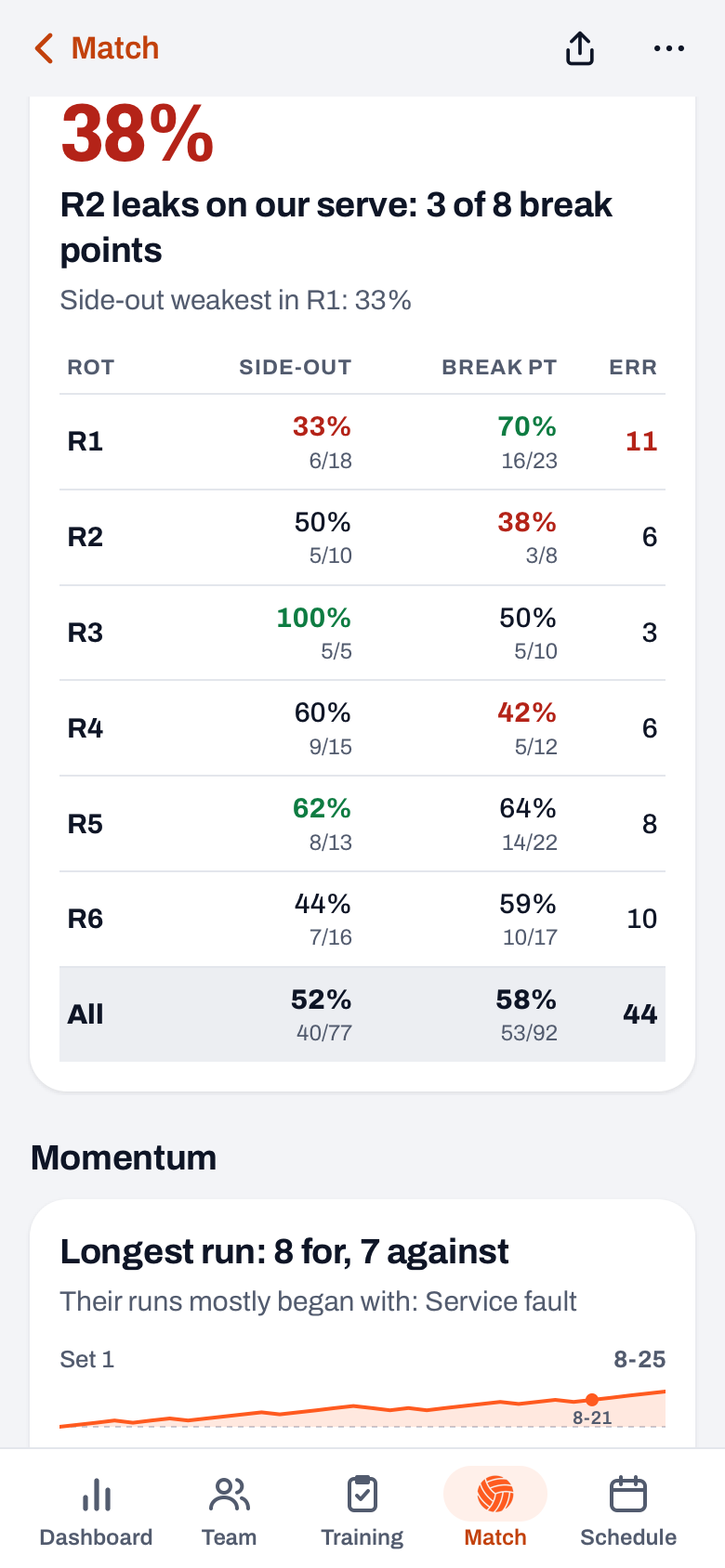
You can only score the golden set itself as a separate match: on the start screen, under Match settings, set Set 1 to to 15, and after the set choose End match. The app treats a first set to 15 as a short set, so without a coin toss and without a prompt to switch sides; the referees in the gym handle those. What Koach costs after the 14 free days is on the pricing page.
14 days free, no credit card. Score your next two matches and see per rotation where you win points and where you give them away.
Try Koach at your next matchFrequently asked questions
How many points is a golden set played to?
To 15 points, with a lead of at least two points and no cap. At 14-14 the set continues until one team is two points ahead, for example 16-14. In that respect it is the same as a deciding fifth set, but it is not part of a match: it decides who advances after two matches.
When is a golden set played?
When two teams play a home and away match in a knockout round and the two legs together produce no winner. In the CEV's European cups, since a decision in June 2026, that is the case as soon as each team wins one match, whatever the scores. Before that, the match points counted. National competitions have their own rules.
Does the golden set count toward the match result?
No. The golden set is played after the second match and is separate from it: the result of that match stands, for example 1-3. The golden set only decides which team goes into the next round.
What is the difference between a golden set and a deciding set?
The deciding fifth set belongs to one match: you play it when that match is tied 2-2 in sets, and it is in the rules of the game. A golden set is played after two separate matches between the same teams and is in the competition's regulations. Both go to 15 points with a two-point margin.

Prepare for your next deciding set
14 days free, no credit card. After two matches you know which rotation you want to start in.
Get started with KoachOr read first what the volleyball coaching app does.