
When do you switch sides in volleyball? After every set and at 8
The short answer
You switch sides in volleyball after every set, during the three-minute break. Before the deciding set there is a new toss, and as soon as a team reaches 8 points in that set you switch sides right away, without a break and with the same lineup. In beach volleyball you switch every 7 points, in the third set every 5.
When do you switch sides in volleyball? Usually it happens by itself: the set is over and everyone walks to the other bench. Except in the deciding set, where it happens in the middle of the set. These are the FIVB rules for indoor and beach, what happens if someone forgets and how to prepare your team for it.
When do you switch sides in volleyball?
The FIVB Official Volleyball Rules 2025-2028 keep it short: after each set the teams change courts, except before the deciding set (rule 18.2.1). That happens in the break between two sets, which lasts three minutes; in that same break both coaches hand in the lineup for the new set (rule 18.1). What else has to happen in those three minutes is covered in how long the break between sets lasts.
Before the deciding set the teams don't switch automatically. There is a new toss (rule 7.1). The winner chooses either to serve or receive, or a side of the court, and the loser gets the other choice. In the middle of that set comes the extra switch. This is what a five-set match looks like:
| Moment | What happens |
|---|---|
| After sets 1, 2 and 3 | Switch sides during the three-minute set break |
| After set 4, at 2-2 | No automatic switch, but a new toss: the winner chooses serve or receive, or a side |
| Deciding set, at 8 points | Switch sides right away, without a break, with the same lineup |
Under the FIVB rules the deciding set is the fifth, played to 15 points. If your league or tournament plays best of three sets, the third set is the decider and the same arrangements apply there. How the set format differs between competitions is covered in how many sets a volleyball match has.
The rules don't say why the switches exist, but you see the effect in every gym. No team plays the whole match facing the light from the windows, with a wall just behind the end line or on the side where the ball rolls away fastest. The extra switch in the deciding set does the same for that one short set: without it, one team would play the whole decider on the more difficult side.
Switching sides in the deciding set: at 8 points
As soon as the leading team reaches 8 points, the teams change courts without delay, and the players keep their positions (rule 18.2.2). So at 8-5 or 6-8, whoever is ahead. The scorer reports the eighth point to the referees, the first referee gives the signal (both forearms in front of and behind the body, twisted around the body), and after the switch the second referee checks that the lineup still matches the line-up sheet.
What doesn't change matters more than what does:
- The score and the serve. The team that won the eighth point has the serve, and whoever was due to serve still serves after the switch.
- The rotation. Everyone takes exactly the same spot on the other side. A team that rotates one spot out of habit after the switch commits a position or rotation fault and gives away a point.
- The libero and the substitutions. Whoever was on court is on court again. The counts for substitutions and time-outs simply carry on.
The switch at 8 is not a time-out and not a break. Play continues right away, and a team that turns it into a huddle risks a delay sanction (rule 16.1). If you want to say something, request one of your two time-outs. How to coach such a short set is covered in the deciding set.
Practice the switch at 8 once in training. Play a game to 15 and switch sides at 8 points, bench and water bottles included. Agree that one player takes the gear along, that the captain says out loud who is serving, and that nobody rotates. On match day it's no longer something anyone has to think about.
Forgot to switch sides: what now?
If the switch at 8 doesn't happen, the teams switch as soon as someone notices, and the score stands (rule 18.2.2). No points are taken off and nothing is replayed. At matches without an experienced scorer it is sometimes only noticed at 10 or 11; as captain, report it to the first referee instead of playing on.
Switching sides in beach volleyball
On sand you switch sides far more often, because wind and sun make one side harder than the other. Under the Official Beach Volleyball Rules 2025-2028 the teams switch every 7 points played in sets one and two and every 5 in the third set, right away and without delay. There too, if a switch is forgotten, it happens as soon as it's noticed and the score stands (rule 18.2). There is a one-minute break between sets. In set two, the team that lost the first toss gets the choice: serve or receive, or a side (rule 7.1). Before the third set there is a new toss. The rest of the beach rules are in beach volleyball rules.
Youth, tournaments and recreational play
In youth matches, summer tournaments and recreational leagues the format is often shortened, to one set, timed sets or a match with a fixed number of sets. Whether and when you switch sides then is decided by the organizer or by your federation's rules. Ask before the first match of the day, so you aren't left wondering at 8-6 in a short set.
If you win the toss, you usually choose between serving and receiving; the trade-off is explained in serve or receive after the toss. You only pick a side when one side is clearly different: low sunlight through the windows, a wall just behind the end line or a slippery spot on the floor. Because you switch after every set, you are really only choosing where you start. The general rules of the game are in volleyball rules at a glance.
Switching sides in Koach
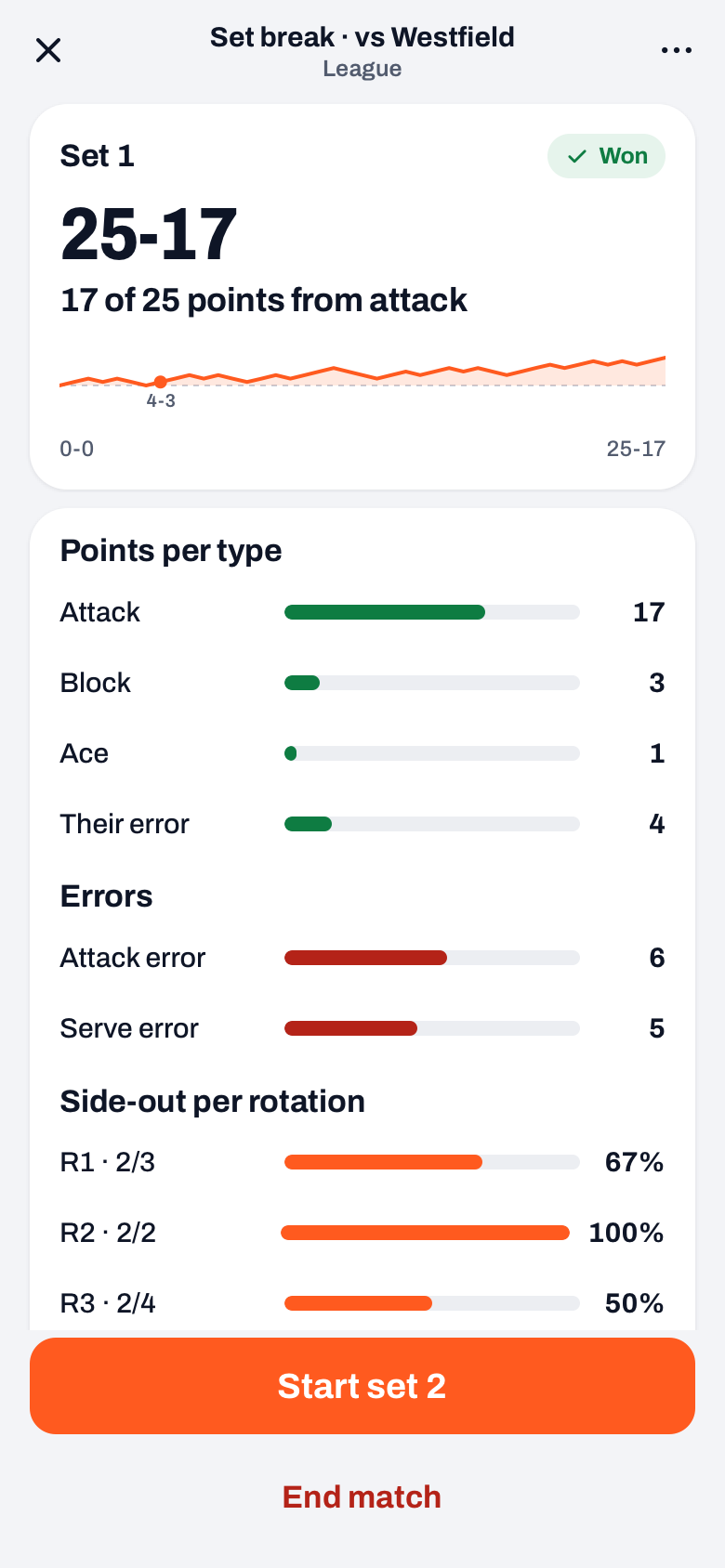
If you score live in Koach, you don't have to do anything when the teams switch sides. The court on your screen is always drawn from your own team's side, with the net at the top, so the lineup and the serving order carry over unchanged to the other side. Set 5 is set to 15 points by default, and in the set break you set each next set to 25 or 15. If you play best of three, set the third set to 15; from set 3 on, the app treats a set to 15 as the deciding set.
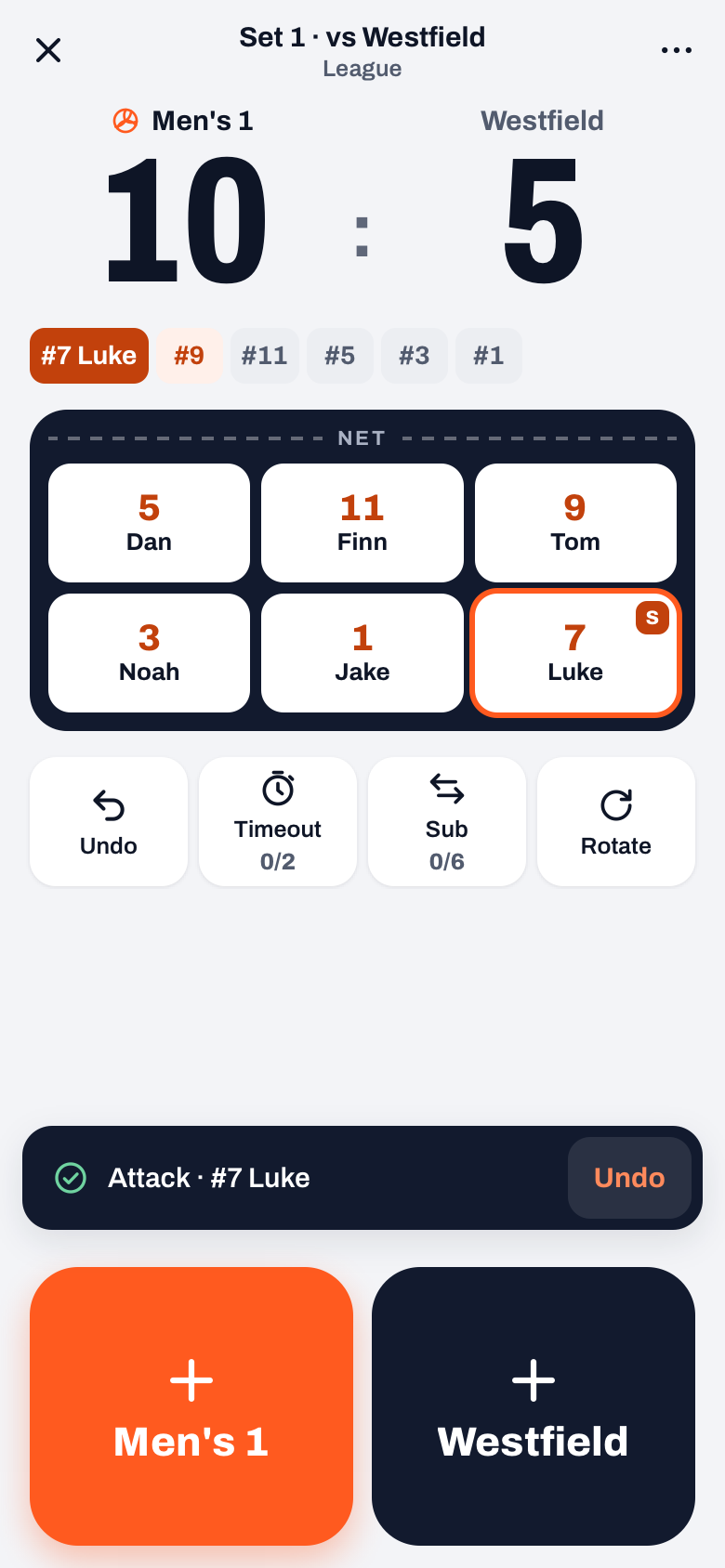
Before a deciding set, the set break asks Toss · who serves first? which team serves first, and you choose Us or Them. At 8 points the message Switch sides appears, with Deciding set · 8 points below it; you dismiss it with Done, or it disappears at the next point. That way nobody on the sideline forgets the switch, even without a scorer. What Koach costs after the 14 free days is on the pricing page.
14 days free, no credit card. Score your next match live and let the app keep an eye on the switch in the deciding set.
Score your match in KoachFrequently asked questions
Do you switch sides after every set in volleyball?
Yes. After every set the teams change courts, during the three-minute break in which the lineup for the new set is also handed in. Only the deciding set works differently: first there is a new toss, and then you switch one extra time at 8 points.
When do you switch sides in the fifth set?
As soon as the leading team reaches 8 points. The teams switch right away, without a break, and everyone takes the same spot on the other side. Score, serve and rotation stay the same. If your league plays best of three sets, this happens in the third set.
What happens if you forget to switch sides?
Then you switch as soon as someone notices. The score stands: no points are taken off and nothing is replayed. That applies indoors and on sand. If you notice it as a player, let the captain report it to the first referee.
How often do you switch sides in beach volleyball?
In sets one and two every 7 points played, in the third set every 5. The teams switch right away, without a break. That way neither team has to deal with wind or sun on the same side for a whole set.


Let the app watch the switch for you
14 days free, no credit card. In your next deciding set nobody forgets the switch at 8.
Get started with KoachOr read first what the volleyball coaching app does.