
How long is the break between sets in volleyball?
The referee whistles the set dead and a window opens in which far more has to happen than will fit: change ends, drink, hand in the line-up, say something. Most coaches assume three minutes of speaking time. In reality you are left with a little over one — and that changes not only what you say, but when you start.
Three minutes — and where that number comes from
The break between two sets lasts three minutes. That isn't a local custom but a rule of the game: the chapter on interruptions and court switches in the international rules sets all intervals between sets at three minutes, and names two things that must happen inside them — the teams change court and both coaches hand the line-up for the new set to the scorer. National federations adopt that rule almost everywhere, so the same three minutes apply in the lowest regional division as in the top flight.
Line up the interruptions you get in a match and you can see how generous three minutes actually is:
- Time-out: 30 seconds. Two per set, and they expire at the end of the set — you cannot carry them over. What to say in those thirty seconds is in using time-outs.
- Technical time-out: 60 seconds. Only in competitions that play them, at points 8 and 16 in the regular sets and never in the deciding set. Many federations have since scrapped them; whether you have them is in your competition regulations.
- Interval between two sets: 3 minutes. Your only real speaking moment in the whole match.
- Court switch at 8 points in the deciding set: no interruption. Change immediately, play on immediately.
Two nuances to those three minutes. Some regulations allow the organiser to extend one interval, usually the one between the second and third set, for a presentation or an interval programme. The competition management arranges that in advance; it isn't a right you can claim as a coach on the night. And if you play in a competition with a fixed number of sets — four every time, for example, even when the score is already 3-0 — then a full interval follows every set, including the one that already decided the match. How many sets get played where you are and why that differs by federation is in how many sets a volleyball match has.
The clock starts earlier than you think
This is where it goes wrong for most teams. The interval doesn't begin when everyone is standing at the bench, but at the whistle with which the referee ends the previous set. And it ends at the whistle for the first serve of the next set. Everything in between — shaking hands, crossing over, drinking, talking, clearing the bench — falls inside those three minutes.
In practice, then, the first chunk of the interval is gone before you open your mouth. There are congratulations or groans along the net, bags and bottles move to the other side, someone fills in the line-up sheet. A coach who only calls his team in once everyone is seated starts his talk around 1:15 and is cut off at 2:30 by a referee who wants the court back. Out of three minutes you are left in practice with a little over a minute of speaking time. That is what you pitch your message at, not the three.
The arithmetic: where the three minutes go
This is what an interval looks like that doesn't run away from you. The timings aren't a prescription, but they show what realistically fits:
- 0:00 – 0:30 · finish and cross over. Shake hands, grab your things, walk to the other side. If your team drifts here, you lose twenty seconds just gathering them.
- 0:30 – 0:50 · hand in the line-up. The sheet for the new set has to be with the scorer or the second referee before that set starts. One fixed person, every set, no discussion.
- 0:50 – 2:05 · the team moment. A little over a minute. One thing that stays, one adjustment, and who starts.
- 2:05 – 2:35 · bench loose, starters warm. The players starting the set loosen their arms; the substitutes move as well, so that whoever comes on at 22-22 isn't serving cold.
- 2:35 – 3:00 · on court and ready. The moment the referee is ready, your six are standing there. Not the other way round.
And then the honesty: at club level that interval rarely runs exactly three minutes. Without official timekeeping it often stretches to four or five, and with a packed hall schedule — the next match has to start at eight — the referee shortens it instead. So always plan your talk for the short version. Finishing early is never a problem; being cut off halfway is, because then exactly the part you needed to say is the part left unsaid.
The interval before the deciding set: also three minutes, plus a toss
A stubborn misconception is that the interval before the deciding set is shorter or longer. It isn't: that one lasts three minutes too. Something is added, though, that the other intervals don't have. Before the deciding set there is a fresh toss for serve and court. Your captain has to be with the referee for it, and the outcome decides whether your line-up still stands: anyone who filled in his six assuming he would serve starts again.
So count on the first thirty to forty-five seconds of this interval going to the toss, and on only finalising your sheet after that. The practical fix is simple: have two line-ups ready, one for serving and one for receiving, so that after the toss all you have to do is pick. How to reason that choice through is in choosing your starting line-up.
What is not an interval is the court switch at 8 points in the deciding set. Both teams change ends immediately, with the same score, the same server and the same line-up, and play continues straight away. It isn't a time-out and it isn't a drinks break; turn it into a team talk and you are asking for a delay sanction. If you want to say something at that moment, use one of your two real time-outs. The rules also state that a forgotten court switch is carried out as soon as anyone notices, with the score standing — at matches without experienced scorers that is not a theoretical situation. How that set runs on is in the deciding set.
Can you hit, serve or pass during the interval?
The rules prescribe what has to happen in the interval, not what else is permitted. The latter is decided by the competition regulations and by the referee standing there that evening. Three rules of thumb that hold almost everywhere:
- The court belongs to the referee. The moment he has the match ball, hitting over the net is finished. Carrying on anyway produces exactly the sort of discussion that earns you a warning — and it costs you the time for your own talk on top of that.
- Outside the court, almost anything goes. Passing in the free zone or the warm-up area, a few tossed balls for the player starting the new set: virtually no referee makes an issue of that, as long as nobody is in the way and the balls don't roll onto the court.
- Serving is the exception. Serving needs the full length of the court, so it isn't on. Whoever has to hit the first serve of the new set loosens the arm without a ball — shoulder rotations and a few empty swings do exactly enough. The real warm-up belongs before the match, not in a three-minute interval.
If you are unsure what is customary in your hall, ask the referee before the first set rather than during the interval. One ten-second question and you know for the whole match.
Where players, coach and bench stand in those three minutes
After the change of ends each team settles on the new bench side, bags, bottles and jackets included. Have one player handle that move while the rest already walk to the new side, or your huddle will break up halfway through your talk to relocate after all — thirty seconds gone, and the conversation starts over.
For the position of the team moment there is one practical rule: on your own side and off the court. During play the coach is confined to the zone in front of his own bench; in the interval referees are more generous, but the court itself stays theirs. A huddle in the middle of the court or on the opponent's side gets moved on, and that costs you time again. The bench is simply part of it: have your substitutes stand in the circle instead of staying seated, if only because one of them will be going on shortly. What jobs to give them during the match is in keeping bench players engaged.
Late onto the court: what the referee does then
A team that isn't ready after the interval is delaying the game — and there is a sanction for that. It comes in two steps:
- Delay warning. The first time a team delays the game; it applies for the whole match and costs no point. It is recorded, and it belongs to the team, not to the person: whether it was the coach or a player makes no difference.
- Delay penalty. Every subsequent delay by anyone from that team: the opponent gets a point and the serve. In a set to 25 you can come back from that. In a deciding set to 15 you start 0-1 down and without serve, before a ball has been struck.
At club level the causes are almost always the same four: the team is still in the huddle at 3:00, the line-up sheet isn't there, someone has gone to the toilet, or the coach is at the scorer's table arguing about the last set. All four are avoidable with a one-sentence agreement: if you aren't on court at the whistle, you are late. Agree that your captain or a bench player watches the clock and calls "on court" out loud at 2:30. It costs you nothing and it takes the discussion away from the referee.
What you say in that one minute
Deliberately short here, because the full story — including the fixed structure of a between-sets talk — is in match coaching: time-outs, substitutions and your role on the sideline. Three rules follow directly from the clock:
- One adjustment, not four. The coach who wants to put four things right in the interval changes nought. Pick one, and say it twice in different words.
- Phrase it as an instruction. "We serve number 5 all set" is executable; "we need to serve sharper" is a wish. A message a player can carry out literally survives the first rally.
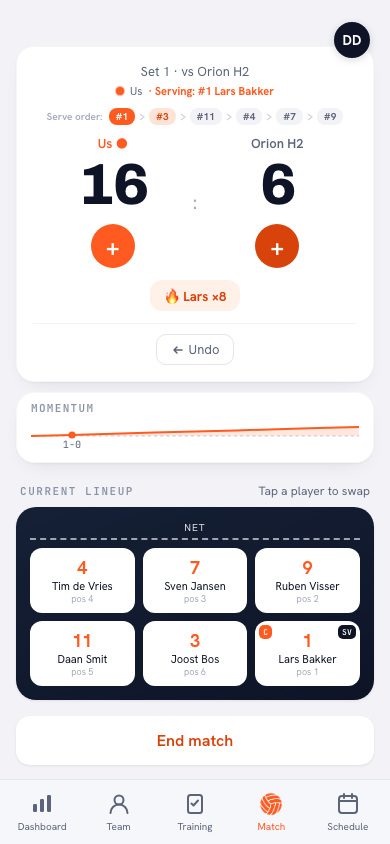
- Look at the numbers, not at your gut. After a lost set it is mainly the last few points that stick. The score progression shows whether the set ran away there or already at 8-8, and that is a completely different conversation. With the set scores and the progression in Koach, that check costs five seconds instead of an argument on the sideline.
Organise the interval before the match, not inside it
Everything you still have to work out during the interval comes off your speaking time. Four agreements you make once and keep all season:
- Who hands in the line-up sheet? One fixed player or assistant, the same one every set, with the sheet already half filled in.
- Who moves the gear? Two players grab the bags and bottles the moment the last ball drops.
- Who keeps the bench moving? A fixed job, rotating per match.
- Who watches the clock? Someone who calls "on court" at 2:30, even if you are still talking.
And know before the end of the set which six you want in the next one. Between two sets you may fill all six positions differently without it costing you a single substitution, because the substitution count restarts every set — see the substitution rules. That makes the between-sets interval the cheapest adjustment available to you in a match, and the only one you can implement in full in three minutes. A time-out changes a moment; the interval changes a set.
Key point: you don't have three minutes, in practice you have a little over one. Accept that and you pick one adjustment and say it twice. Refuse to accept it and you say four things, get cut off at 2:30, and start the new set with a team that has retained none of them.
Frequently asked questions
How long is the break between two sets in volleyball?
Three minutes, counted from the whistle that ends the previous set to the whistle for the first serve of the next. Changing ends, drinking and handing in the line-up all fall inside it. So count on a little over a minute of real speaking time, not on three.
Is the break before the deciding set longer?
No, that one lasts three minutes too. There is a fresh toss for serve and court before the deciding set, though, and that quickly takes the first thirty to forty-five seconds. So keep two line-ups ready: one for serving, one for receiving.
Can you hit or serve during the break between sets?
Hitting over the net on the court is out as soon as the referee has the match ball, and so is serving, because that needs the whole court. Passing in the free zone or the warm-up area is usually allowed. What applies in your competition is a question to ask the referee before the first set.
What happens if my team is late onto the court?
The first time it is a delay warning: no point, but recorded, and valid for the whole team and the rest of the match. Every subsequent delay is a delay penalty and gives the opponent a point and the serve. In a deciding set to 15 you then start 0-1 down straight away.
Can I use a completely different line-up between sets?
Yes. The starting line-up of a new set is free and costs you no substitutions, because the substitution count restarts each set. Do hand the sheet to the scorer in time — that has to happen before the set begins.
Can I carry an unused time-out over to the next set?
No. Time-outs are per set: you have two, and whatever you don't use expires at the end of the set. Sitting at set point down with two time-outs in your pocket isn't thrift, it is a missed chance.
Try it yourself in Koach
Less admin, more coaching.
Get started with KoachOr read first what the volleyball coaching app does.