
Set point in volleyball: what it is and what happens at 24-24
The short answer
You have set point in volleyball when your team needs one more rally to win the set, for example at 24-22. A match point is a set point that also decides the match. At 24-24 there is no set point: you play on until one team leads by two points, with no maximum.
Set point in volleyball: at 24-22 everyone in the gym knows the next rally can decide the set. Here you read exactly what a set point and a match point are, what the rules say at 24-24, and what you do as a coach on a set point for and a set point against.
What is a set point in volleyball?
You have set point when your team needs one more rally to win the set. Indoors a set goes to 25 points, and you have to lead by at least two points (rule 6.2 of the FIVB Official Volleyball Rules 2025-2028). At 24-22 the next rally is therefore a set point: win it and it's 25-22 and the set is yours. For the team that is behind, it is a set point against. All the other rules are in volleyball rules at a glance.
The number of set points is the difference in points once you are on 24. At 24-20 you have four: lose the next rally and it's 24-21 and you have three left. Only at 24-24 is there no set point any more. After that, every one-point lead becomes a set point again: at 25-24 the next rally can decide the set, at 25-25 it can't.
| Score | What it is |
|---|---|
| 24-20 | Four set points |
| 24-23 | One set point |
| 24-24 | No set point: play on until a two-point lead |
| 26-25 | One set point |
| 14-12 in the deciding set | Two set points, and so two match points |
| 20-18 in beach volleyball | Two set points (set to 21) |
Who serves on a set point? Always the team that won the previous rally. If you just scored, you serve your own set point and are looking for a point on your own serve. If the opponent scored, they serve, and you have to win your set point through the side-out. That difference decides what you do as a coach.
When is a set point a match point?
A match point is a set point that also decides the match. Under the FIVB rules, the team that wins three sets first wins the match (rule 6.3.1). If you already have two sets, every set point in the next set is a match point. At 2-2 in sets there is a deciding fifth set to 15 points, also with a two-point lead (rule 6.3.2). There every set point is a match point right away. What else is different in that set is covered in the deciding set.
Whether you get a match point also depends on your competition. If it always plays a fixed number of sets, you play all the sets and each set counts separately in the standings; there is then no match point in the usual sense. In the Netherlands, for example, many leagues always play four sets, but that differs by country and by competition: what applies to you is in your federation's rules. How those formats work is explained in how many sets a volleyball match has. In beach volleyball the first two sets go to 21 and a third set to 15; those rules are in the beach volleyball rules.
What happens at 24-24?
At 24-24 you play on until one team leads by two points: 26-24, 27-25 and so on (rule 6.2). There is no maximum, and sets that end far above 25 happen at every level. In the deciding set the same applies from 14-14.
Nothing else changes. You don't get an extra time-out or an extra substitution: each team has two time-outs of 30 seconds and six substitutions per set (rules 15.1 and 15.4.1), and what you have left at 24-24 is all you have. The service order simply carries on. You only switch sides in the deciding set, as soon as a team reaches 8 points (rule 18.2.2), so not at a tied score at the end.
At tournaments with a tight schedule the organizer sometimes agrees on a cap, for example that at 27-27 the next rally decides the set. That is a tournament rule, not a rule of the game. Ask before the first match, so your team knows where it stands.
Set point for you: what you do as a coach
On a set point for you, above all you don't want to give away a rally. How you do that depends on who is serving.
- Set point on your own serve. You need a point on your own serve. How much risk the server takes depends on the number of set points. At 24-20 a service error costs one set point out of four, and the server just hits their own serve. At 24-23 a service error makes it 24-24; then ask for a serve that lands in the court, at a spot that takes the opponent out of their system. Also agree who blocks the opponent's strongest hitter, because count on that player getting this ball.
- Set point on their serve. You need a side-out, and that starts with the pass. Change nothing about what worked all set: the same passers, the same distribution, and the set to the hitter with the best chance of a point, not necessarily the one who hits hardest.
- No time-out on your own set point. It gives the opponent rest and time to regroup. The exception is confusion on court, such as doubt about who stands where.
- A substitution for one rally. A serving specialist or an extra blocker is only possible within the six substitutions per set. Plan such a substitution before the set gets tight, not at 24-23.
How to approach the whole phase from 20 on, with the choice between pressure and safety for each server, is covered in the end of a set.
Set point against: how to stay in the set
- They are serving. Then you need the side-out. This is the moment for your time-out if you still have one: not for a speech, but for one agreement, for example who takes the serve and where the set goes. When a time-out makes sense is covered in using time-outs.
- You are serving. That happens after you have saved a set point, for example from 21-24 to 22-24. Now a service error ends the set. Ask for a serve in the court, at a target, and save the risk until the score is level again.
- Count per rally, not per set. At 20-24 your team doesn't have to win the six points it needs to reach 26-24 in one go, but to win one rally, and then one more. A coach who says that out loud in the huddle takes the pressure of the whole deficit away.
Call the number, not the word. At 24-21 have your captain call "three" instead of "set point". A player who knows there are still two rallies to spare serves and hits differently from a player who thinks everything hangs on this one ball.
Training set points
In a match you get a handful of set points per set at most. In practice you can play twenty in ten minutes, with three formats:
- Three set points. Six against six, team A starts at 24-21 and serves. If A closes out the set, A gets a point; if B comes back to 24-24, B gets it. Then B starts at 24-21.
- Set point on their serve. Start at 24-23 with the serve for the team that is behind. The team that is ahead has to close out the set through the side-out; if it doesn't, both teams play on from 24-24 until there is a two-point lead.
- Match point in the deciding set. At the end of practice, play a set to 15 from 12-12, with the real rules: two time-outs, substitutions and a two-point lead.
Keep track of which team converts its set points, and above all on whose serve. After a few weeks you see whether your team closes out sets better on its own serve or through the side-out, and you know where your practice needs to go.
Set points in the app: how Koach tracks them
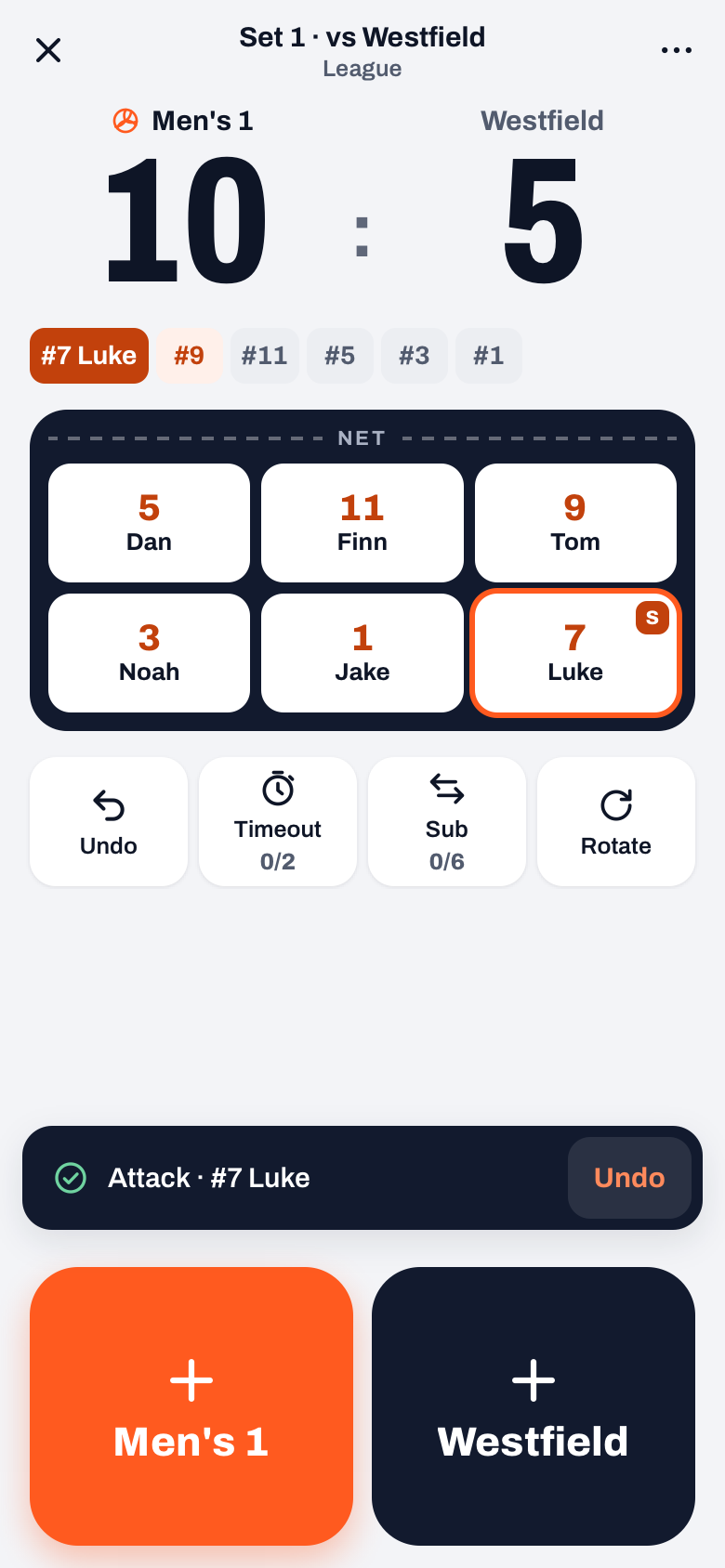
If you track the match live in Koach, you set for each set how many points it goes to: 25, or 15 for a short or deciding set. At 24-24 the app simply keeps counting; the set only ends with a two-point lead. On the live screen, Timeout and Sub show how many you have already used this set, so on a set point against you see without counting whether you still have a time-out.
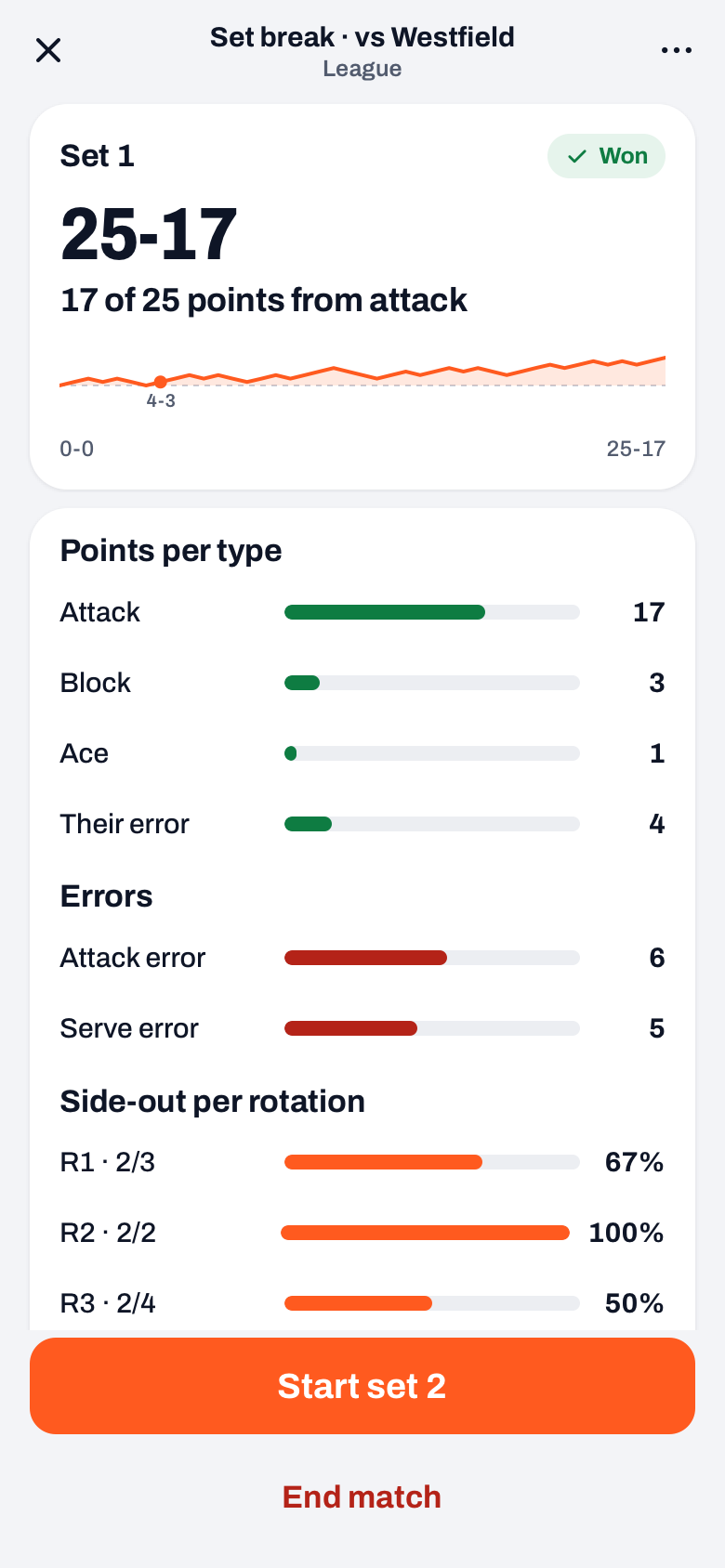
When the last point of the set falls, the set break opens by itself. There you see the score progression, the points per type, the errors and the side-out per rotation, and you start the next set or choose End match. After the match, under Stats, Momentum has the row Closing phase (from 20): how many rallies you won and lost once either team had reached 20 points.
What Koach costs after the 14 free days is on the pricing page.
14 days free, no credit card. Track Saturday's match live and see afterwards how your team closed out its sets.
Try Koach at your next matchFrequently asked questions
How many set points do you have at 24-20?
Four. The number of set points is the difference in points once your team is on 24, or on 14 in a set to 15. At 24-20 you can lose four rallies before it becomes 24-24, and every rally before that can decide the set. In beach volleyball, where a set goes to 21, you also have four set points at 20-16.
Is there a maximum number of points in a volleyball set?
Not under the official FIVB rules: at 24-24 you play on until one team leads by two points, even if that becomes 34-32. In the deciding set to 15 it works the same way from 14-14. Some tournaments agree on a cap for their schedule; that is then in the tournament rules and only applies there.
Can you call a time-out on a set point?
Yes, if you still have one left that set. Each team has two time-outs of 30 seconds per set, and at 24-24 you don't get an extra one. You request it when the ball is out of play and before the referee whistles for the serve. Many coaches save one for a set point against, when the opponent is serving.
Who serves on a set point?
The team that won the previous rally. If you score to make it 24-22, you serve your own set point. If the opponent then makes it 24-23, they serve and you have to close out your set point through the side-out. Within the serving team, the player whose turn it is in the rotation serves; a different server is only possible through a regular substitution.

Track your next match live
14 days free, no credit card. After the match you see how your team closed out its sets.
Get started with KoachOr read first what the volleyball coaching app does.