
What makes a good libero: seven signs on the court
At a lot of club teams the libero is a leftover position: the smallest player gets the odd-coloured shirt and good luck. A waste, because the libero touches more balls in a set than anyone else and decides whether you get to attack at all. These are the signs that tell you you have found the right candidate.
What the libero actually does
The libero is a defensive specialist: he plays only in the back row, replaces back-row players an unlimited number of times and therefore gets the most ball contacts on the team per set. His two core tasks are serve receive and defence, plus a third that often gets forgotten: organising the back three. Who covers where on an attack from the left, who takes the tip, who chases the ball after a block touch — the libero sorts that, or nobody does. The formal restrictions (no serving, no blocking, no overhand set for an attack in the front zone) are in the libero rules.
Seven signs that you are looking at the right player
- He stops early. Good passers are already set before the ball is struck. Don't watch the pass, watch the feet in the second before it.
- His bad balls are still playable. Everyone has perfect passes; the difference is the ball he half-shanks and still keeps inside the three-metre line.
- He talks constantly. "Mine!", "out!", "free!" — and not only on his own ball.
- He goes to the floor without thinking. The willingness to hit the deck is partly character and only partly technique; watch how someone reacts to a ball that is realistically gone.
- He reads the hitter, not the ball. A player who is already moving off the approach and the hitter's shoulder has a defensive instinct that is hard to teach.
- He recovers fast after an error. The libero who spends three rallies chewing on one mistake costs you half a set.
- He enjoys it. Don't underestimate this: a player who sees the role as a demotion will never become a good libero, however well he passes.
What isn't on the list: height. Being small helps you get low, but it isn't a criterion — plenty of tall players pass superbly and don't jump enough to hit.
Comparing candidates fairly
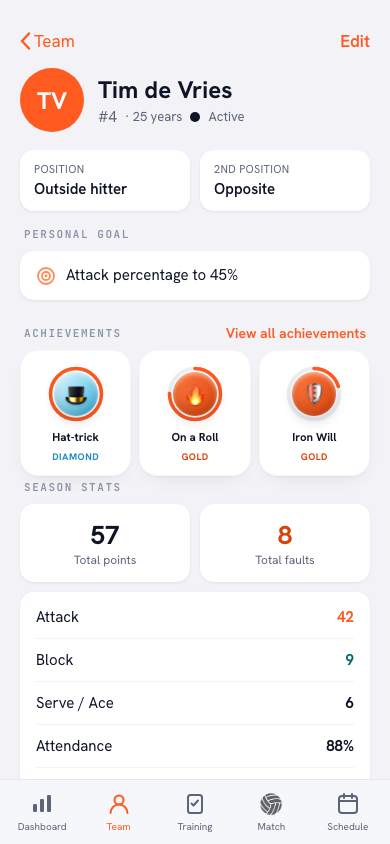
The clearest signal is passing quality, and Koach lets you rate reception 0-3 per player so you can compare candidates over several matches instead of on one impression. That difference matters: a player who handles everything on a Tuesday night can look completely different against a team full of jump servers. Gather three to five matches of ratings and then look at both the average and the spread — a passer who almost always delivers a 2 or a 3 is worth more in a libero role than someone alternating between perfect and unusable. How to keep that tracking going during a match is in tracking serve receive.
What the rules mean for your choice
Three practical consequences. One: your libero doesn't serve, so you lose a serving turn from a player who might be a strong server — weigh that up. Two: the libero may not block and may not attack a ball above net height, so you don't put an attacking talent there. Three: you may list two liberos on the scoresheet, but only one is ever on court, and swapping between them is only possible after a complete rotation or in case of injury. The exact conditions are in the libero replacement rules. For most club teams that means: pick one regular libero and train a second player in the role, so an injury or an absence doesn't blow up your whole serve receive.
Developing the libero once you have one
A libero doesn't improve automatically from the extra ball contacts. Give him three things. First, specific practice time: series where he only passes against increasing serving pressure, and defensive series where he has to start from different positions. Second, responsibility: let him set up the back court in the various reception formations and let him say before the match where the opponent attacks most. Third, recognition: a libero scores no points and never appears in the match report. Put his contribution into numbers — a reception average above 2.2 is excellent for club volleyball — otherwise he is the only player in your team with no visible result.
A practical test: have three candidates pass a series of twenty serves, all from the same server, and count not the perfect passes but the unplayable ones. The libero you are looking for is the one with the fewest zeros — not the one with the most threes.
Frequently asked questions
Does the libero have to be the shortest player on the team?
No. Height helps you get low, but passing quality, court sense and communication weigh more heavily. Pick the player who passes most consistently and can direct the defence, whatever his height.
Can the libero be captain?
The libero may not act as game captain on court. If the team captain is the libero, or is replaced, the team designates another player on court as game captain for that period.
From what age should you use a regular libero?
With youth players it is sensible to fix the role only from around U16. Younger players benefit from learning every facet; a twelve-year-old who only passes misses out on attacking, blocking and serving in the phase where those are easiest to learn.