
What to say to your team after a bad loss
The last point drops, and within four seconds twelve players are looking at you. What you say then sticks longer than any tactical talk. And that is exactly the moment you are most likely to say the wrong thing.
What actually happens in those first minutes
Straight after a painful loss nobody is capable of learning. Heart rates are high, the disappointment is raw and players are mainly busy with their own share of it: the service error at 22-20, the ball they let drop. Information you give in that state doesn't land — or worse, it lands as a verdict. That is the heart of the problem: the locker room after a match is an emotional space, not a learning environment. Treat it as one.
There is something else: players mirror your body language. A coach staring at the floor with his jaw clenched confirms that this is bad. A coach who walks in calmly, puts his bag down and simply starts talking signals that this was a match and not a disaster. You don't have to fake cheerfulness — they see through that — but you are the one who sets the temperature.
Three things that do work
- Name the emotion. "This hurts, and that's allowed." Two seconds, and it saves three players from being ashamed of their disappointment.
- Take it collectively. "We lose this together." No names, no moments, no "if that ball had gone in". Anyone who names one player after a match, even positively, automatically emphasises everyone he didn't name.
- Set a moment. "Tuesday we look at the numbers and pick one thing out of it." That gives the team the most valuable thing available in that locker room: the idea that something will be done with it, and that it doesn't have to be now.
You don't need more than that. Two minutes, then out of the locker room. Do stay nearby: some players want to say something precisely then, and that conversation is often worth more than your speech.
What you save for later in the week
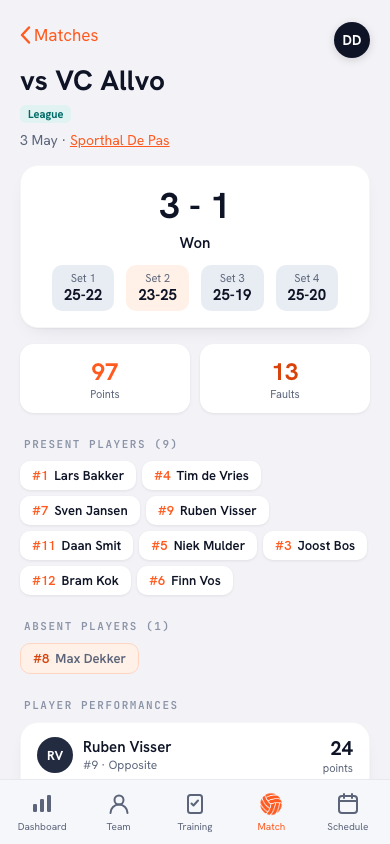
The match report is ready in Koach the second the game ends, but that is material for the debrief later in the week, not for the locker room. So save everything that is analysis: the side-out percentage, the error breakdown, the rotation where it went wrong, the substitution that didn't work. Save your criticism of individual behaviour too — the player who rolled his eyes, the hitter who stopped covering — because you hold that conversation separately and calmly. And definitely save your own doubts: wondering out loud whether you picked the right lineup sounds like panic afterwards. How to build a debrief with numbers is a craft in itself; it only works if you hold it two or three days later.
A fixed closing routine, including after a loss
Teams that have a ritual after a win and quietly scatter after a loss learn that losing sits outside the team. So pick one closing routine that is always the same: clearing the hall together, a circle with one sentence per player, or simply sitting around a table together for twenty minutes. That last one is underrated — staying together after a defeat does more for the atmosphere than the best speech. With youth teams a simple fixed question works ("what went well anyway?"), where everyone names something about someone else. That isn't a sweetener: it trains players to notice what did work, even in a match they lost.
With youth the parents are already at the door
At youth matches the second debrief starts in the car park, and that one is out of your hands. What you can do is give parents one sentence they can work with ("we played well until 18-18 and then forced too much — that's what we're working on Tuesday"). That gives them a line that matches yours instead of their own analysis in the car. At the start of the season, agree how people react on the sideline and afterwards; more on that in parents on the sideline. And keep an eye on which player needs the most support right after a defeat — it is rarely the one making the most noise, but usually the one walking out quietly. The players who withdraw are worth three sentences from you afterwards.
A rule for yourself: never say anything after a loss that you wouldn't also say after a win with the same numbers. If the message only comes after a defeat, it isn't analysis but a reaction to the result.
Frequently asked questions
Am I allowed to be angry as a coach after a loss?
Anger about behaviour — not covering, not getting back on defence — is fine, as long as you express it briefly and factually. Anger about the result itself achieves nothing and mainly teaches players to hide when things go wrong.
How long should a post-match debrief take?
Straight after the match, two to three minutes at most. The substantive review belongs at the next practice, once the emotion has settled and you can put the numbers on the table.
What if players start blaming each other right after the match?
Cut it off immediately and state that the review happens on Tuesday. Do pick the subject up later, because pointing fingers after a loss is a team-agreement issue and not an incident.