
Pep talk before volleyball games: what to say to your team in five minutes
Five minutes before the start, the team stands in a circle in the corner of the gym. The coach starts enthusiastically and ends with a list: serve at their number four, get to the block on time, talk in the back row, watch out for the short ball from their middle, stay calm if we fall behind. After the first rally nobody remembers a single one. A pep talk before volleyball games only works when it is short and contains one agreement — with the motivation built in, not instead of the content.
Pep talk before volleyball games: why a long speech doesn't stick
After a match, try asking your players what the agreements were. The answer is almost always the same: one, sometimes two, and often not the most important one. That is not unwillingness. A player who will step onto the court in three minutes is already halfway to the first serve in their head, and what you tell them then has to land in one go.
A long talk therefore gets two things wrong at once. The content disappears, because ten points in practice amount to zero. And the energy from the warm-up drains away, because players stand still listening just as their bodies were warm. The pure pep talk without content has the opposite problem: it gives a peak that is gone by three-five in the first set, and after that nobody has anything to fall back on.
There is a third trap, and it is a sneaky one: telling them something new. An agreement that is spoken out loud for the first time just before the match has not been trained. Players start thinking about it while they need to be playing, and then things get worse instead of better. Whatever goes into the talk has to be something the team already knows.
When exactly those five minutes fall, and what else needs to happen from the moment you arrive at the gym, is in the schedule in the pre-match warm-up. This piece is only about what you say in that circle.
The pep talk in three parts: calm, one agreement, one line that lifts
A fixed structure helps you more than it helps the team. You do not have to improvise at a moment when you are tense yourself, and after a few matches players know what is coming. Three parts, in this order.
1. Bringing calm — one to two minutes. Make the circle tight, wait until everyone is looking and only then begin. Say what is the same as always: we play the way we train, with the same agreements and the same way of serving. Name one thing that went well in the last few practices, concretely and with a name attached. That is not a compliment for the sake of it, it is an anchor: this is something we can already do. If you want players to settle with a breathing routine, this is where it goes; how to build one is in mental training for volleyball players.
2. One agreement — two minutes at most. The one thing the team focuses on in this match. One sentence for the agreement, one sentence for the reason, and then you have a player repeat it. How to pick that one is below.
3. One line that lifts — under a minute, ritual included. The last line is the one they take onto the court. Keep it short, about you as a team and about something you control. "Our first ball is a good ball." "We set the pace, from point one." Not "we have to win" — that is an outcome nobody can do anything with in the first rally. Then the team's ritual, whatever it is, and off they go.
Together that is three to five minutes, and preferably three. If it runs over, it is almost always in part two: an agreement that needs explaining is an agreement that has not been trained.
Choosing one agreement, and keeping it short
The agreement does not come from the circle but from the preparation you did earlier in the week. A game plan can easily have more points; the talk picks out the one point that makes the biggest difference in this match. How to get from what you know about an opponent to a plan like that is in scouting the opponent.
A good agreement meets four requirements:
- It is an action, not an outcome. "Serve deep at their number four" is an agreement; "make fewer errors" is a wish.
- Everyone can repeat it in one breath. If they can't, it is too long or too complicated.
- You can see in the first set whether it is happening. Then you can come back to it at the set break, instead of finding out afterwards that nobody did it.
- The team has trained it. An agreement about an attacking combination that was not in practice this week does not belong in the circle before the match.
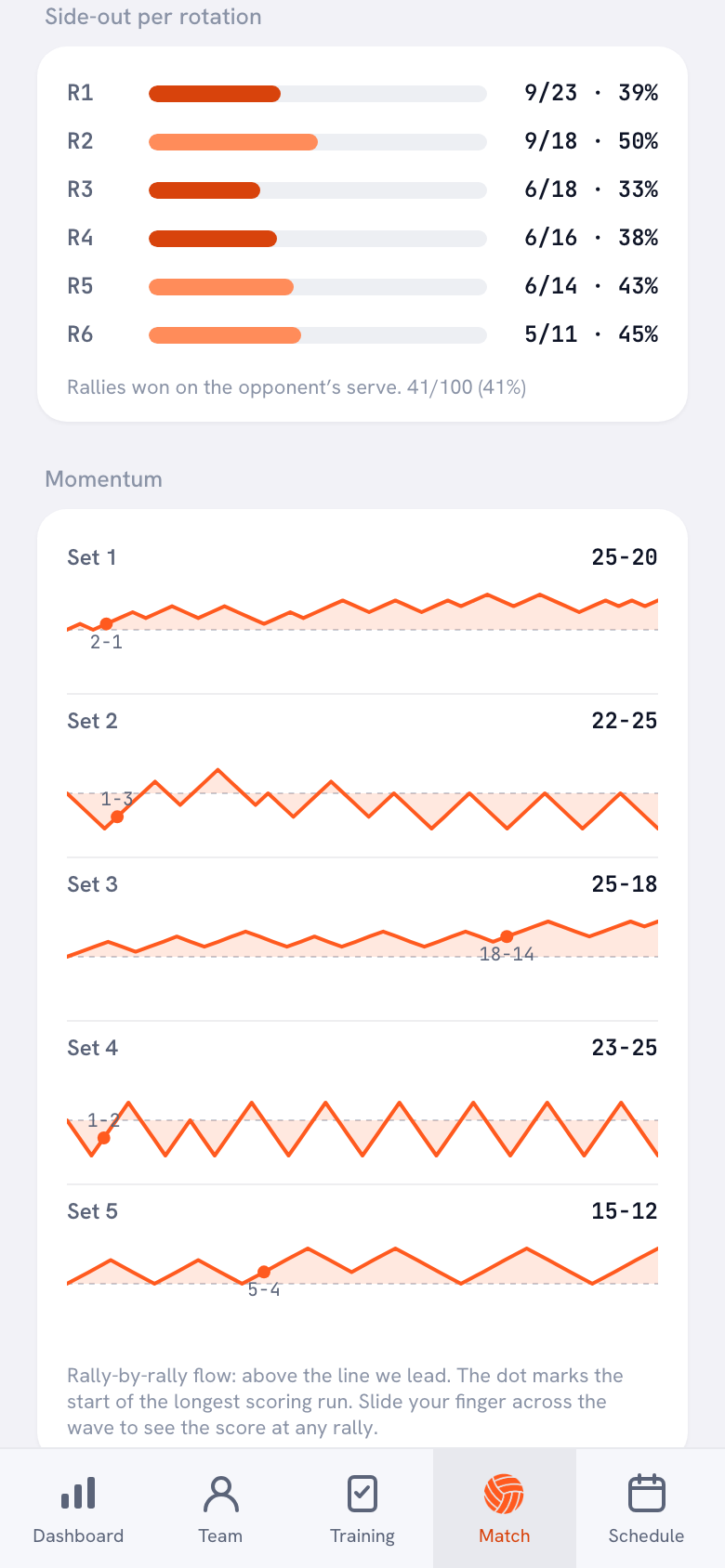
Where do you get that one agreement if you have no detailed scouting? From your own matches. In Koach the match screen shows "Previously vs" with the last five matches played against an opponent with exactly the same name, across all seasons, with the win or loss and the set scores. In the detail of your previous match you see the numbers the agreement can rest on, such as the side-out per rotation and the error breakdown, and if you track stats the rotation check points out the rotation with the least front-row attacking power. You put the chosen agreement in the match note, which only coaches can see, so you do not have to pull it from memory in the circle. And from the sign-ups you know in advance who is there — an agreement that revolves around a player who has cancelled is not an agreement.
Keep the reason for the agreement as short as the agreement itself. Players do not need to know how you arrived at the choice, only why it works: "their number four passes nervously on deep balls." The lineup, and how and when you tell the team, is a separate subject; see preparing the lineup and choosing the starting lineup. An agreement that mainly concerns the setter you discuss with the setter separately, not in the circle; what you go through together is in the role of the setter.
Tone: calm them down or fire them up?
Which tone fits depends on the team at that moment, not on your habit. So look first and talk afterwards. You can usually see it during the warm-up already.
- Tense: quiet, lots of trips back and forth to the changing room, laughing too loudly at nothing, errors in the warm-up that don't happen in practice. Here you talk more slowly and more softly, and the agreement becomes the anchor. Firing them up makes it worse.
- Flat: talking about other things, a relaxed warm-up, little noise. Here it can be shorter and louder, with a challenge in the last line.
- Overconfident: an opponent at the bottom of the table, jokes in the circle. Name your own standard instead of the opponent: we are playing against how we want to play, not against them.
Two situations call for a different tone. If you are coming off a heavy defeat, do not bring it up in the circle; the conversation about it belongs earlier in the week, see what to say after a heavy defeat. And if the team is on a run of lost matches, the agreement is about something small that works, not about the run; see breaking a losing streak. A team losing motivation over weeks or a whole season is not something you fix in these five minutes; how to tackle that is in motivating a volleyball team over the season.
Do not forget your own tone. A coach who is tense talks faster and says more. So stick to the three parts, especially on the days when it is tense. What you say during the match, in a time-out or between sets, is another moment with its own rules; see the time-out with numbers and the interview what to say in a time-out.
Say nothing new in the circle. An agreement that has never been trained, a tactical change you only thought of that morning, a warning about their best hitter: anything a player hears for the first time in that circle, they take onto the court as a worry instead of a plan.
Youth and adults: what you say differently
Youth up to about twelve. Under two minutes, and the agreement is a behaviour a child can see and hear: "everyone calls 'mine' before playing the ball." No information about the opponent. Look each child in the eye for a moment; at this age that is worth more than any sentence. At a very first match, the whole talk is about practical things: where you stand when the whistle goes, what happens when the coach calls a time-out, and that making mistakes is simply part of it.
Youth from about thirteen to seventeen. One tactical agreement is fine, as long as it has been trained. Let the captain say the last line: players of that age often take things more easily from each other than from the coach, and you hand over responsibility at the same time.
Adults. Here a question often works better than a statement: "what did you notice in the warm-up?" Let two players answer briefly and then make the choice yourself. Adult players have little patience for a speech, so keep parts one and three extra short. With recreational players the tone can be lighter and the agreement simpler, but the structure stays the same: calm, one thing, one line.
Preparing those five minutes also takes you five minutes at home. Before your next match, open "Previously vs" and the detail of your last match in Koach, pick one agreement and write it in one sentence in the match note. Then all you have to do in the circle is say what it says.
Frequently asked questions
How long should a good pep talk before a match last?
Three to five minutes, and preferably three. One to two minutes to bring calm, two minutes at most for one agreement, and the rest for the line that lifts and the team's ritual. If it takes longer, there is usually an agreement in it that needs explaining, and an agreement like that belongs in practice, not in the circle.
How do you motivate without it becoming an empty speech?
Link the motivation to something the team controls. 'Let's go for it' is empty; 'our first ball is a good ball' gives the same energy and a direction as well. On top of that, name one concrete thing that went well in the last few practices, with a name attached. That works better than big words, because it is true.
What do you say when the team is tense?
Less, more slowly and more softly. Say what is the same as always — the same agreements, the same way of playing — and make the one agreement the anchor players can hold on to. Firing them up raises the tension. A short breathing routine in the circle can help, provided the team already knows it from practice.
What do you say to youth players at their first match?
Mainly practical things: where they stand when the whistle goes, what happens at a time-out or a substitution, and that making mistakes is part of it. Give one agreement at most that they can see or hear, such as calling before you play the ball. Leave the opponent out of it entirely and look each child in the eye before they go on court.


Try it yourself in Koach
Less admin, more coaching.
Get started with KoachOr read first what the volleyball coaching app does.