
How to motivate your volleyball team when effort drops: what works over a whole season
It is an ordinary practice night, half the team is going through the motions and there are two more cancellations in the group chat. Last month there were none. The tempting conclusion is that they are not motivated, and the tempting response is to get stricter or start a reward system. But how to motivate your volleyball team does not start there: "not motivated" is what you see, not why it is happening. There are four common causes, each with its own fix — and strictness or badges rarely turn any of them around.
How to motivate your volleyball team starts with the cause: four reasons effort drops
A team that trains at half speed almost never does so for the same reason. So first look at where it drops, with whom and when. Four causes keep coming back, and each shows its own pattern.
- Too little playing, too little challenge. Long lines, lots of waiting, drills that are too easy for some and too hard for others. The pattern: effort drops in certain drills and comes back as soon as there is game play.
- No sight of their own progress. A player does not know whether they are improving, and nobody tells them. The pattern: it is mainly the middle group that drifts off — the players who are never the best and never the problem.
- Unclear role or playing time. Players who do not know why they do or do not play, or what is expected of them. The pattern: effort drops once the lineup is known, and especially among those who often sit on the bench.
- A schedule problem. School, work, exams, a second sport. That is not unwillingness but time. The pattern: cancellations come in waves, while those who do turn up train perfectly well.
Which one it is you work out over two weeks, not in one evening. Watch during practices in which drills it drops, and in those two weeks take each player aside for a few minutes. Two questions are enough: "When did you last go home from practice feeling good?" and "What would need to be different?" The most honest answer usually only comes after the second question.
Worth knowing up front: the causes overlap, but there is almost always one that sets the tone. Tackle that one first. If you try to repair all four at once, you change so much that you can no longer see what works. And this is about motivation over weeks and a season, not about the pep talk just before one match; that is a different moment with different rules.
Too little playing: more ball contacts and real challenge
This is the cause that is easiest to check. At your next practice, pick one player and make a tally mark for every ball contact. Do it for an hour. The result is often disappointing, and it explains more than any conversation: a player who hardly touches the ball has little reason to work hard.
The solution lies in the format, not in the player. Smaller groups, more balls, several courts or stations at once, and game forms instead of lines. How to take the waiting out of a practice is in more ball contacts per practice, and why drills that resemble a match also generate more energy is in game-like drills.
Challenge is the other half. A drill that is too easy for your best player gets done at half speed; the same drill may be too hard for your weakest player, who drifts off for the opposite reason. Three forms that absorb that difference because the scoring provides the pressure:
- Queen of the court: only the winners' side scores, and whoever loses goes to the back of the line. Every rally counts, including for whoever has just come on.
- Bonus-point game: a normal set in which the point that fits the practice goal counts double. Nobody has to hold back, and the behaviour you want to see earns the most.
- Team serving challenge: the whole team has to make a run of serves in a row and starts again after a miss. Everyone serves with their teammates' balls on their shoulders.
No sight of progress: a goal per player and per team
Players who do not notice they are getting better assume they are not. That applies most strongly to the middle group: the best players hear that they are good, the weakest get attention because they have to, and the players in between hear little all season. How to keep those players in view is in making quiet players visible.
The simplest intervention is one personal goal per player, which they know themselves, and one team goal that everyone knows. How to word a goal like that so it is measurable and achievable is in a personal goal for your player and setting a team goal. The difference between a goal that works and a goal that gets forgotten lies in what happens afterwards:
- Come back to it regularly. Every few weeks, two minutes per player, at a moment you fix in advance. A goal nobody ever asks about no longer exists after a month.
- Ask the player first. "How is your goal going?" yields more than your verdict, and you immediately hear whether they still remember it.
- Make progress concrete. Not "you're improving" but "last month your serve often went wrong, now you make a run of five in a row." That is only possible if you have tracked something.
That last point is often where it stalls. If you want to follow players' development over a season without turning it into paperwork, you will find an approach in tracking player development.
Unclear role or playing time: agreements you make in advance
Nothing eats away at effort as quickly as the feeling that working hard makes no difference. A player who does not know why they are on the bench draws their own conclusion, and it is rarely: I need to train harder.
So before the season, explain what determines playing time. The rule itself can differ per team, as long as everyone knows it and you stick to it. How to divide playing time is in dividing playing time fairly; what matters here is that the agreement exists in advance.
On top of that, give every player a role for a block of a few weeks, including those who are not starters. "You're our second passer when we substitute." "During the match you keep track of how often we score out of serve receive." A role gives a reason to work hard at practice, regardless of whether you start the match.
If the cause turns out to be the schedule, it is not a motivation problem and talking about effort will not help. What helps then are fixed practice times, planning early and clear agreements about cancelling; see improving practice attendance. And a youth player who is not just showing less effort but actually wants to quit needs a different conversation: when your child wants to quit volleyball.
Recognition without a ranking: badges and Player of the Match in moderation
Recognition works, under two conditions: it names something the player controls, and it is specific. "Well done" evaporates; "you called every ball in the middle, so nobody froze" sticks. A permanent ranking on effort tends to backfire for anyone who is not at the top — what a season average does show is in average effort over the season.
Badges and a vote are ways of making recognition visible, not a motivation system in themselves. Why milestones work and how to use them is in achievements and badges as milestones. Here the point is the limit: they only work alongside practices in which everyone plays a lot.
In Koach, after a practice you rate each player who attended on five things: technique, game awareness, coachability, work ethic and effort. The categories you fill in are averaged per practice into one number — that is your judgement, not a measurement. That number drives the Hard Worker and Riser badges, which only coaches see on the player profile: a player should not have to read their assessment through a badge. What players do see include the attendance badges, such as Iron Will and On a Roll. After the match the team votes for Player of the Match, and how often someone won it is on their profile. How a player earns badges is in earning badges; how the vote works is in voting for Player of the Match.
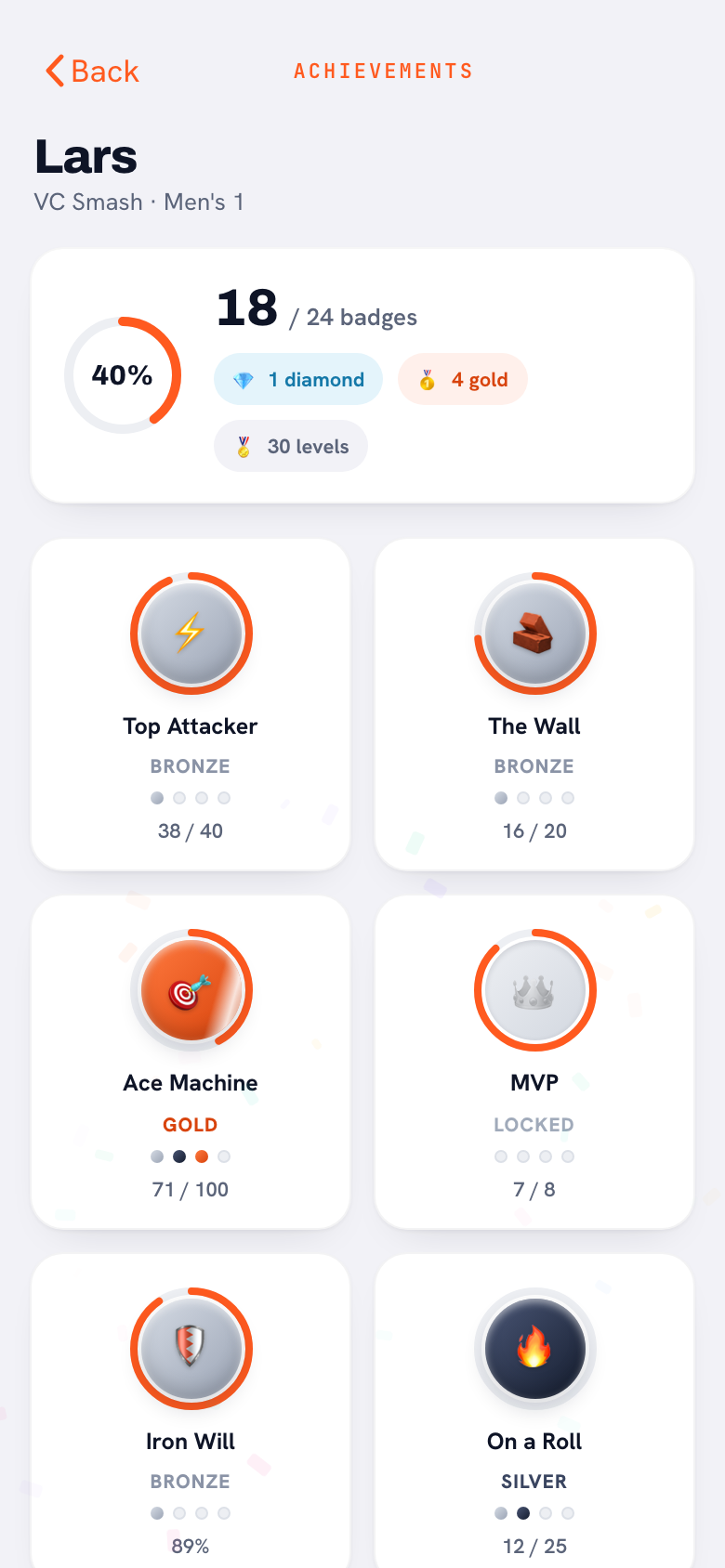
In moderation means three things. Mention a badge or a vote briefly and move on; if you make a big moment of it, you also make it a big moment for those who did not get it. Keep an eye on the vote: teammates often pick whoever scored the points, so name the passer or defender who did the work yourself. And rate effort fairly and consistently, otherwise the number says nothing — how is in rating player effort.
A badge does not fix a boring practice. If half the team stands in a line for twenty minutes, effort drops, with or without a reward. Check the ball contacts first, the recognition second.
Youth, adults and recreational players: what drives each group
Youth up to about twelve. Fun, friends and lots of playing. Motivation here usually drops because of how the practice is set up, rarely because of the player. Visible progress works strongly: a child who notices they can now serve over the net does not need a badge.
Youth from about thirteen to eighteen. Being taken seriously, having a role and having prospects. Let them help shape the team agreements and the team goal; an agreement they made themselves is one they hold on to better. The move to an adult team is a well-known moment when players from this group drop out; what to do about it is in keeping youth players.
Adults. Time is the scarce factor here. A practice that is efficient, with a clear role and a competitive element, is the best motivation you can offer. Adult players hold wasted minutes against you sooner than a hard practice.
Recreational players. The game and the atmosphere. Too much structure backfires here; keep the game forms big, the explanations short and the goal simple. If a team, at whatever level, is on a run of lost matches, something else is at play; see breaking a losing streak.
What applies to every group: you only notice the drop in time if you track it. After your next practice, give each player a rating in Koach and set one personal goal for every player. After a few weeks the development line per player shows you who is growing and where it is slipping, and you can have the conversation before the cancellations start.
Frequently asked questions
How do you motivate a team that has been losing for weeks?
Take the focus off the result and put it on something small the team does control, such as the number of serves in or calling every ball. Show that this is improving, even when the match is lost. Also check whether one of the four causes is involved, because a losing run makes an existing problem more visible. More on that situation is in breaking a losing streak.
What do you say to a player who trains at half speed?
Take them aside, not in front of the group, and start with what you see instead of a verdict: 'I've noticed you've been less sharp these last few weeks, is that right?' Then ask what is going on. The cause often lies outside practice, or in a role or playing time they don't understand. Only once you know the reason do you know what you can agree on.
Do punishments help against low effort?
In the short term they get you obedience, not effort. A player who works harder to avoid a punishment does it for the punishment, and slips back as soon as the coach looks away. Agreements with a consequence do work for behaviour you can see, such as arriving late or cancelling without a message, but not for something you cannot force from the outside, such as being fired up.
How do you keep players motivated who get little playing time?
Give them as many ball contacts in practice as the starters, a clear role for the match and a personal goal they can work on. Tell them honestly what it takes to play more, and come back to it after a few weeks. A player who knows why they are on the bench and what they can do about it stays motivated far longer than a player who has to guess.
How do you notice early that motivation is slipping?
The first signs are small: arriving later, leaving earlier, being quieter in the warm-up, cancelling at the last minute more often. If you record a short rating per player after every practice, you will also see a declining line before it becomes noticeable in the group. Respond to the first sign with a short conversation, not only once three practices have been missed.


Try it yourself in Koach
Less admin, more coaching.
Get started with KoachOr read first what the volleyball coaching app does.